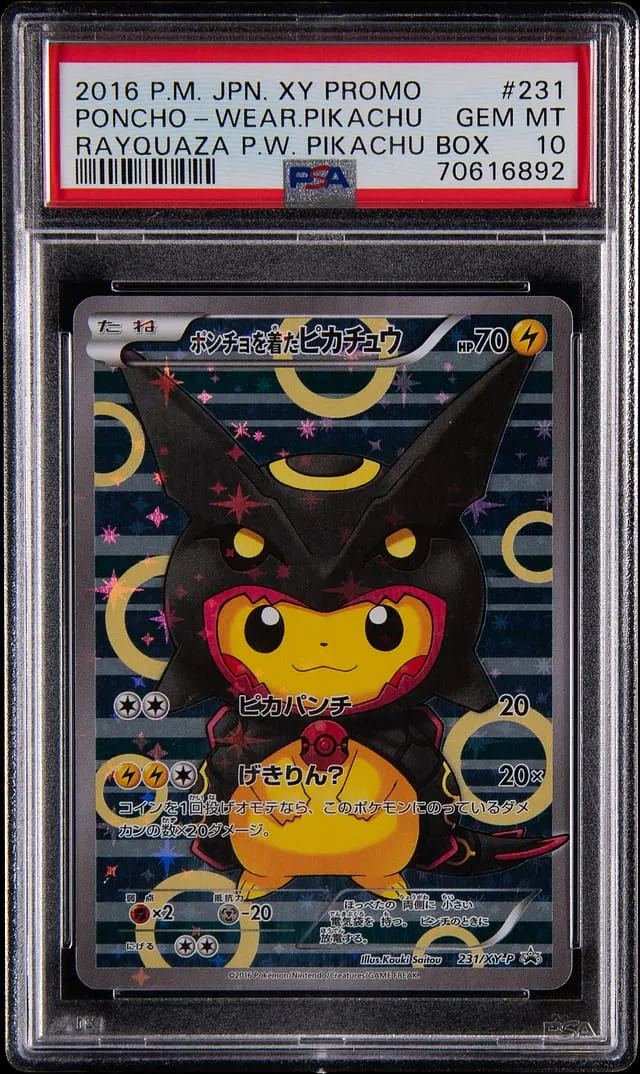
2016 Rayquaza Poncho-Wearing Pikachu PSA 10 Sells High
Goldin sold a 2016 Japanese Rayquaza Poncho-Wearing Pikachu PSA 10 for $13,514. See why this promo matters and how the sale fits recent comps.
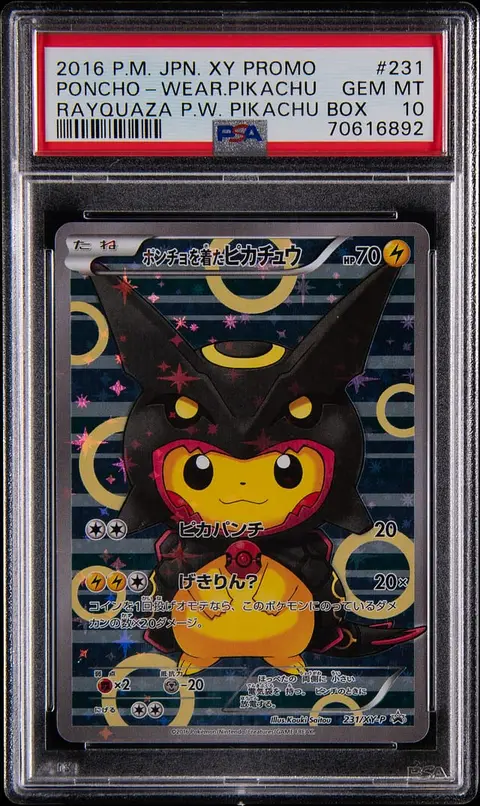
Sold Card
2016 Pokemon Japanese X&Y Promo Rayquaza Poncho-Wearing Pikachu Box #231 Poncho-Wearing Pikachu - PSA GEM MT 10
Sale Price
Platform
Goldin2016 Japanese Poncho-Wearing Pikachu Rayquaza Promo Hits $13,514 in PSA 10
On May 18, 2026, Goldin sold a 2016 Pokémon Japanese X&Y Promo Rayquaza Poncho-Wearing Pikachu Box #231 Poncho-Wearing Pikachu in a PSA GEM MT 10 slab for $13,514.
For a modern promo card, that’s a serious result—and it says a lot about how the hobby views this Pikachu sub-series, Japanese exclusives, and PSA 10 scarcity.
In this breakdown, we’ll look at what the card is, why collectors care, and how this sale fits into recent market data.
The card at a glance
- Game / IP: Pokémon
- Characters: Pikachu in a Rayquaza poncho
- Year: 2016
- Set / Release: Japanese X&Y Era – Poncho-Wearing Pikachu Box (Rayquaza)
- Card number: 231/XY-P (often labeled “#231” on slabs/listings)
- Region: Japan-only promo (not an English release)
- Type: Promo card, not a pack-pulled set card
- Grading company: PSA (Professional Sports Authenticator)
- Grade: GEM MT 10 (PSA’s highest standard grade)
- Attributes: Non-holo full-art style illustration, themed Poncho-Wearing Pikachu art, boxed promo origin
- Era: Ultra-modern (XY era, 2013–2016, but printed in 2016)
This is part of the popular Poncho-Wearing Pikachu run: a sequence of Japanese promo cards featuring Pikachu dressed as various iconic Pokémon, like Mega Charizard X/Y, Gyarados, and Rayquaza.
The Rayquaza Poncho-Wearing Pikachu cards are generally viewed as:
- Key issues among modern Japanese promos
- Strong crossover pieces for both Pikachu collectors and Rayquaza collectors
It’s not a rookie card (Pokémon doesn’t map cleanly to “rookie” the way sports do), but in the promo lane, it’s considered a standout.
Why this promo matters to collectors
1. Pikachu + Rayquaza = crossover demand
Two high-demand characters drive interest here:
- Pikachu is the franchise mascot and one of the most widely collected Pokémon across eras.
- Rayquaza is a top-tier legendary with a strong collector following, especially around high-end EX and Gold Star cards.
A card that combines both—in a visually distinct way—pulls in:
- Character collectors who chase every Pikachu or Rayquaza
- Set and theme collectors building full Poncho-Wearing Pikachu runs
2. Japanese XY promo culture
The X&Y era in Japan was especially rich in creative promos and limited products. This Rayquaza Poncho-Wearing Pikachu comes from a sealed box product, not booster packs. That has a few implications:
- Access was limited to people who bought that box at the time
- Many copies stayed sealed or ended up in casual collections
- Fewer were cared for under gem-mint grading standards
Compared to mass-print English modern sets, many Japanese promos of this period are modestly available raw but meaningfully thinner in PSA 10.
3. The Poncho-Wearing Pikachu sub-set
Collecting themes are a big deal in Pokémon. Poncho-Wearing Pikachu is one of the standout themes from the 2010s because:
- The art is highly recognizable across the run
- The characters Pikachu “cosplays” are usually fan favorites
- The cards trace back to specific Japanese products and events
As a result, the Poncho cards have become a mini “grail lane” for modern promo collectors. Completing the entire run in high grade is difficult and costly.
Grading, scarcity, and population context
A pop report is a grading company’s public count of how many copies of a card exist in each grade.
Without quoting exact live numbers (which change over time), the pattern for 2016 Rayquaza Poncho-Wearing Pikachu typically looks like this on PSA:
- A modest total population compared with mainstream set Pikachus
- A noticeable but not massive number of PSA 10s
- PSA 9s and PSA 8s forming the bulk of graded supply
This sale’s grade:
- PSA GEM MT 10 – PSA’s top standard grade, implying sharp corners, clean edges, centered front/back within tight tolerances, and no print defects visible at normal viewing.
Collectors often treat PSA 10s of this card as the target grade for long-term collections, which is why high-grade comps are especially useful when looking at market context.
Recent sales and price context
This Goldin sale closed at $13,514 on May 18, 2026.
When collectors talk about “comps” (short for comparables), they mean recent, verifiable sales of the same card or very similar cards, used to understand current market levels.
Publicly visible comps across major platforms (eBay, PWCC, Heritage, Goldin, and Japanese marketplaces where data is accessible) show a general pattern for this card:
- PSA 10 Rayquaza Poncho-Wearing Pikachu has historically sold in the several-thousand to low five-figure range, depending on timing and venue.
- Strong prior results have typically come from curated auction houses or fixed-price listings where the card is properly presented to serious promo/Pikachu collectors.
- Lower grades (PSA 9 and below) trade meaningfully cheaper and with more frequent listings.
Within that context:
- $13,514 sits toward the upper end of the observed band for this card in PSA 10.
- It aligns best with other high-visibility auction house results rather than casual, thinly described marketplace listings.
This does not mean prices are guaranteed to stay at this level. It simply shows that, as of mid-2026, serious bidders are still willing to pay a strong premium for a clean copy of this card in PSA 10 when it appears at a major venue.
Factors that may be supporting this result
Several grounded factors help explain why this specific copy reached a five-figure result:
Character and theme strength
Pikachu + Rayquaza + Poncho motif has proven durable with collectors. These aren’t characters tied to short-lived hype cycles.Japanese exclusivity
The card was only distributed in Japan, requiring international collectors to import sealed products or singles. That creates an extra layer of friction and tends to concentrate higher-end demand.PSA 10 scarcity and eye appeal
While not “rare” in absolute terms, PSA 10 copies are much less common than raw or mid-grade examples. Many collectors treat PSA 10 as the “end state” for a Poncho-Wearing Pikachu run.Auction house effect (Goldin)
Goldin’s audience skews toward higher-end collectors. When a desirable promo is well-presented there, it often finds multiple informed bidders, which can produce stronger realized prices than fragmented one-off listings on smaller platforms.Broader modern promo interest
Over the last several years, hobby attention has shifted from only vintage and early WotC to also include high-art modern promos—especially Japanese ones. Cards like this sit at that intersection.
How this sale fits into the broader Pokémon market
The Pokémon market has matured from the 2020–2021 spike into a more segmented structure:
- Top-tier vintage (1st Ed Base, early WotC holos) has its own lane.
- Mid-2000s ex/Gold Star era is treated almost like a separate class.
- Modern and ultra-modern now have clear internal hierarchies—ordinary set cards vs. standout promos.
Rayquaza Poncho-Wearing Pikachu in PSA 10 sits in the modern promo “upper tier,” where collectors pay premiums for:
- Clear character relevance
- Distinct release stories (exclusive boxes/events)
- Recognizable art and strong set identity
This $13,514 sale doesn’t re-write Pokémon history, but it does reinforce several things:
- There is still serious, consistent demand for the Poncho-Wearing Pikachu line.
- High-end collectors are comfortable treating certain promos as centerpiece cards, not just side pieces to vintage.
- The gap between PSA 10 and lower grades remains wide for premium promos with strong art and character appeal.
Takeaways for collectors and small sellers
A few practical observations—none of this is financial advice, just hobby-oriented context:
For collectors
- If you’re building a Poncho-Wearing Pikachu run, this Rayquaza version is one of the more important pieces, especially in PSA 10.
- Raw copies can be attractive, but condition sensitivity (edges, centering, surface) means not all raws are realistic PSA 10 candidates.
- Japanese promos from this era continue to show that strong art + strong characters + defined release can have staying power.
For small sellers
- When handling cards like this, proper identification matters:
- Use full title details (year, language, promo notation, card number, set/product name).
- Include “Poncho-Wearing Pikachu” and “Rayquaza” clearly for search visibility.
- High-end promos tend to do best when:
- Slabbed by a major grading company (PSA, BGS, CGC) for buyer confidence
- Photographed clearly front and back, with close-ups of centering and corners
- Listed in venues or formats where serious promo collectors are likely to see them
Final thoughts
The May 18, 2026 Goldin sale of the 2016 Pokémon Japanese X&Y Promo Rayquaza Poncho-Wearing Pikachu Box #231 Poncho-Wearing Pikachu – PSA GEM MT 10 at $13,514 is another data point confirming:
- The sustained strength of character-driven Japanese promos
- The particular appeal of the Poncho-Wearing Pikachu series
- The premium that well-presented PSA 10 copies can command at major auction houses
For anyone tracking modern Pokémon promos, it’s a useful reference sale—one that helps anchor expectations around where the very best copies of this iconic Pikachu/Rayquaza crossover can trade in today’s market.