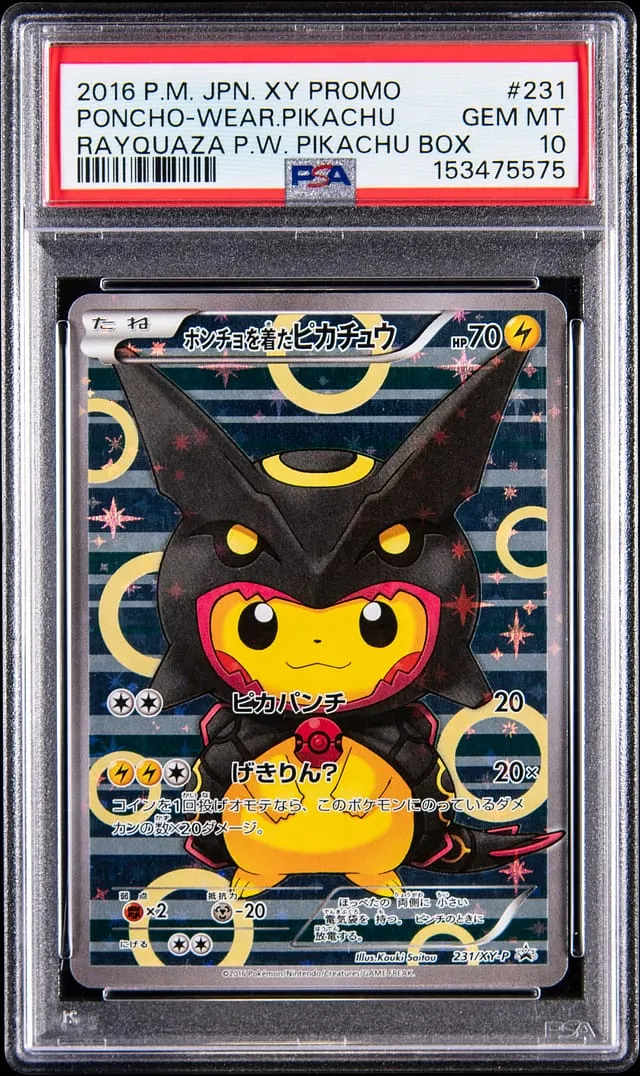
2016 Rayquaza Poncho Pikachu PSA 10 Sells for $13.5K
Goldin sold a 2016 Japanese Rayquaza Poncho-Wearing Pikachu PSA 10 for $13,513 on May 18, 2026. See the market context and what it means for collectors.
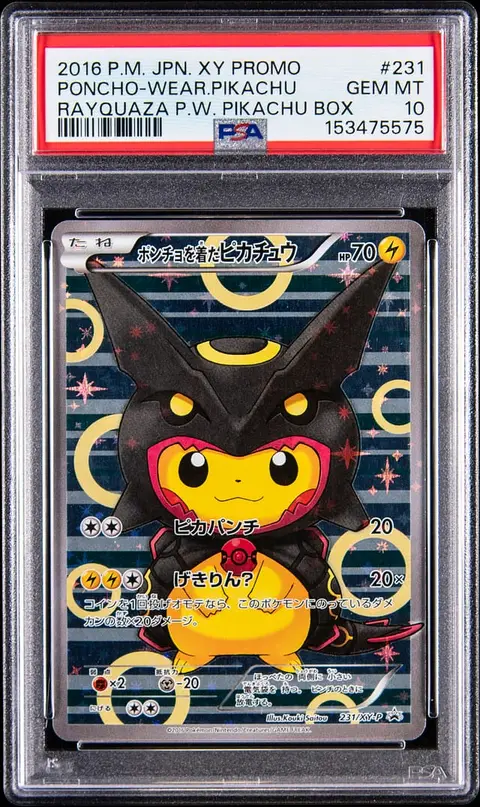
Sold Card
2016 Pokemon Japanese XY Promo Rayquaza Poncho Wearing Pikachu Box #231 Poncho-Wearing Pikachu - PSA GEM MT 10
Sale Price
Platform
Goldin2016 Japanese Poncho-Wearing Pikachu Rayquaza Box PSA 10 Sells for $13,513
On May 18, 2026, Goldin sold a 2016 Pokémon Japanese XY Promo Rayquaza Poncho-Wearing Pikachu Box #231 Poncho-Wearing Pikachu – PSA GEM MT 10 for $13,513. For collectors who follow modern Japanese promos and the Poncho Pikachu sub-series, this is a notable data point in an already closely watched segment of the hobby.
Card overview: what exactly sold?
Let’s break down the basics of this card:
- Year: 2016
- Game / Brand: Pokémon TCG
- Region / Language: Japanese
- Series: XY Era promotional card
- Card title: Poncho-Wearing Pikachu (Rayquaza Poncho)
- Card number: #231/XY-P (often shortened to “#231 Promo”)
- Release: Included in the Rayquaza Poncho-Wearing Pikachu Special Box (Japan-exclusive product)
- Character focus: Pikachu dressed in a Rayquaza-themed poncho
- Rookie / key issue: Not a rookie, but a key modern Pikachu promo with a strong following
- Grading company: PSA (Professional Sports Authenticator)
- Grade: GEM MT 10 (PSA’s highest standard grade)
- Attributes: Non-holo standard release from the special box; no autograph, no serial numbering
This card is part of the broader Poncho-Wearing Pikachu run, where Pikachu appears in various Pokémon-themed ponchos (Rayquaza, Mega Charizard X/Y, Gyarados, etc.). Within that run, Rayquaza is one of the more recognizable and frequently targeted versions.
Why collectors care about Poncho-Wearing Pikachu
The Poncho Pikachu promos sit at an intersection that has been very strong in the hobby over the last few years:
- Pikachu focus – Pikachu is one of the most collected characters in the Pokémon TCG. Many collectors build “Pikachu-only” binders or graded runs.
- Japanese exclusives – The Rayquaza Poncho box was a Japan-only product, which keeps sealed availability and raw card supply more constrained internationally.
- Character mashup appeal – Rayquaza is a top-tier Legendary with its own collector base. A Pikachu card that also appeals to Rayquaza fans widens demand.
- XY-era nostalgia – The XY era (2013–2016) now sits in that “early modern / ultra-modern” overlap: not vintage, but no longer brand-new. As collectors who grew up in that timeframe gain spending power, interest in XY promos has remained steady.
The card is not ultra-short-printed in the way a serialized modern sports parallel is, but it is part of a limited promotional box and not a mass set release. That combination of character choice, Japanese exclusivity, and box-distribution has kept demand healthy.
Grading: PSA 10 and perceived scarcity
PSA’s GEM MT 10 grade indicates a card that meets the highest standards for centering, corners, edges, and surface under normal inspection. For modern Japanese Pokémon, raw card quality out of the pack is often strong, but not every copy will land a 10.
A few points that typically matter to collectors here:
- PSA population (“pop report”) – A population report is PSA’s public count of how many copies have been graded at each grade level. For Poncho Pikachu cards, pops in PSA 10 are usually noticeable but not massive, reflecting a mix of sealed box openings, grading fees, and collector awareness over time.
- PSA 10 premium – For a popular character-based promo like this, the jump from PSA 9 to PSA 10 can be significant. Collectors often treat PSA 10s as “display copies” or collection centerpieces, which supports higher prices when demand is present.
Exact current pop numbers can change as more cards are submitted, but the overall pattern is clear: PSA 10 copies form the top end of a niche but competitive market for this card.
Market context: how does $13,513 fit in?
This Goldin sale closed at $13,513.
To understand what that means, collectors usually look at “comps”—short for comparables—recent sales of the same card in the same grade, or very close alternatives (similar grade, same artwork).
While individual sales can vary based on timing, platform, and presentation, recent market behavior for this card and comparable Poncho Pikachu promos has generally shown:
- PSA 10 Poncho Pikachu promos (especially popular variants like Rayquaza, Mega Charizard, and select Pikachu cosplay issues) often trading at a noticeable premium over PSA 9 and raw copies.
- Japanese exclusive Pikachu promos with strong character crossovers usually realizing higher prices than more common, widely distributed promos.
In that context, a realized price in the low five-figure range aligns with this card’s status as a top-end collector piece in the Poncho Pikachu lane. It represents the higher end of what hobby participants have been willing to pay for pristine copies of standout XY-era Japanese promos, especially when offered through a major auction house like Goldin.
If you track this card specifically, this sale is useful as a current reference point for PSA 10 copies sold through a large, marketing-driven auction platform, as opposed to more casual fixed-price marketplaces.
Factors that can influence prices over time
Without treating any of this as prediction or advice, it’s worth noting what hobby participants usually watch with a card like this:
Sealed product supply
- As sealed Rayquaza Poncho-Wearing Pikachu Boxes are opened over time, more raw copies can enter the graded population.
- On the other hand, a subset of sealed collectors prefer to keep boxes untouched, which can slow the growth of PSA 10 supply.
Pikachu and Rayquaza demand
- Pikachu remains a central character for the TCG and broader franchise.
- Rayquaza has enduring appeal among game and card collectors, and tends to get renewed attention whenever it appears in new sets or media.
Broader modern Pokémon interest
- XY-era promos are firmly in the “modern/ultra-modern” category. Collector sentiment toward modern promos as a whole—whether enthusiasm or fatigue—can influence realized prices for cards like this.
Platform effects
- High-visibility auctions (Goldin, Heritage, major PWCC events, etc.) sometimes realize different prices than casual peer-to-peer sales because they pull in more eyes and more competition.
Takeaways for different types of collectors
New or returning collectors
- This sale highlights how character-driven promos can become their own collecting lane. You don’t have to chase every card; instead, some collectors focus on Pikachu-only, Rayquaza-only, or “cosplay/poncho” themes.
- Learning the difference between main set cards and promos (especially Japanese exclusives) is worth your time if you enjoy this style of artwork.
Active hobbyists and small sellers
- A $13,513 sale underscores that the upper tier of Pikachu promos remains active. Even within modern cards, there is a hierarchy: not all Pikachu promos will approach this level, but the market clearly distinguishes marquee issues like Poncho Pikachu from more common releases.
- When looking at your own cards, use this sale as context, not a direct benchmark. Card condition, grade, sub-variant, and timing matter a lot.
How figoca can help you track cards like this
For a niche but competitive card such as the 2016 Japanese XY Promo Rayquaza Poncho-Wearing Pikachu #231 PSA 10, it’s helpful to:
- Track multi-platform sales over time, not just a single auction.
- Compare grades (PSA 10 vs PSA 9 vs raw) to understand the premium on top condition.
- Keep an eye on sealed product activity, since that can feed future supply.
At figoca, we focus on organizing this sort of market data so collectors can view price history and context without the noise. For this card, the Goldin sale on May 18, 2026 now sits as a clear reference point for the high end of Rayquaza Poncho-Wearing Pikachu in PSA 10.
As always, treat any single result as one data point rather than a guarantee. But for Pikachu and Japanese promo collectors, it’s a strong reminder of how much attention this little electric mouse in a Rayquaza poncho continues to command.