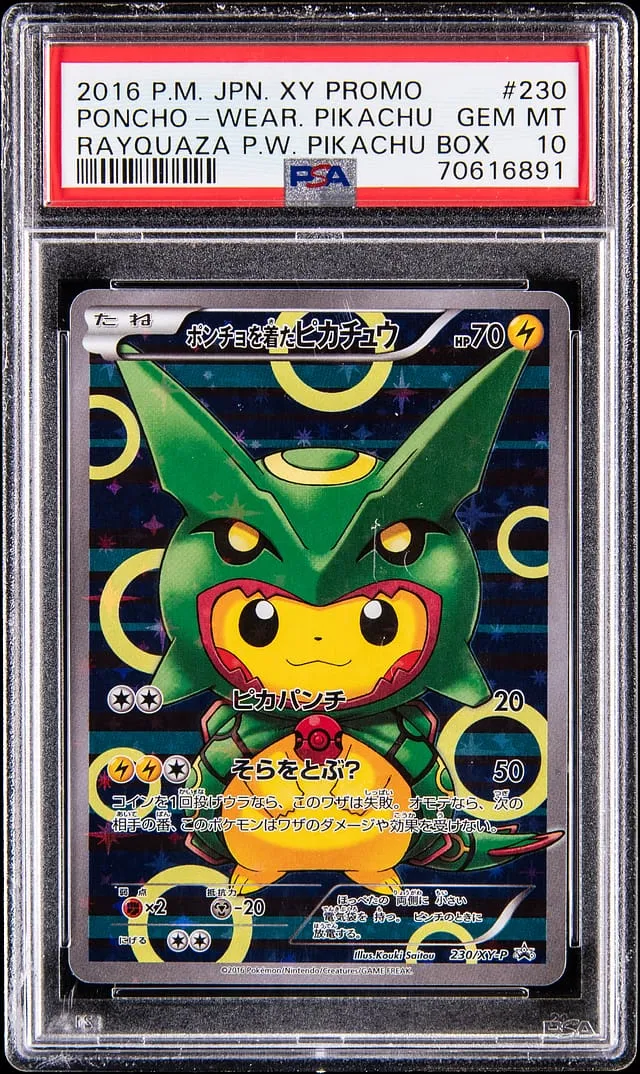
2016 Rayquaza Poncho Pikachu PSA 10 Sells for $12.2K
A 2016 Japanese Rayquaza Poncho-Wearing Pikachu PSA 10 sold for $12,200 at Goldin on May 18, 2026. Here’s what the sale means for Pokémon collectors.
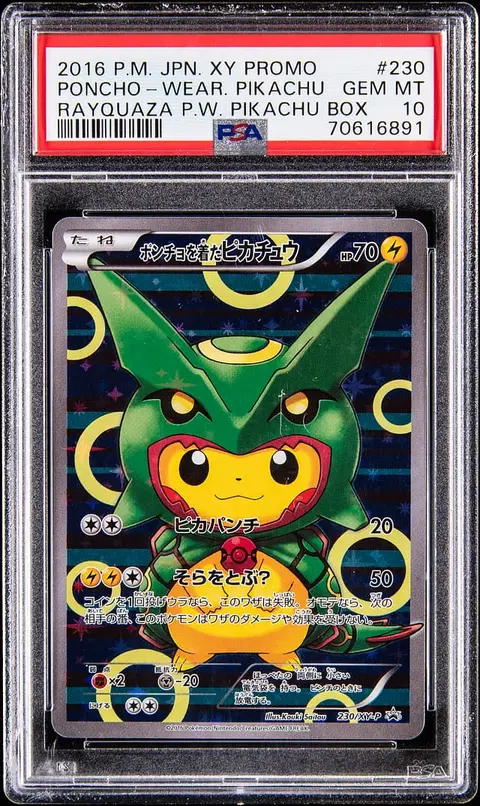
Sold Card
2016 Pokemon Japanese X&Y Promo Rayquaza Poncho-Wearing Pikachu Box #230 Poncho-Wearing Pikachu - PSA GEM MT 10
Sale Price
Platform
Goldin2016 Japanese Rayquaza Poncho-Wearing Pikachu PSA 10 Sells for $12,200
On May 18, 2026, Goldin closed a sale that will interest both Pokémon specialists and broader character collectors: a 2016 Pokémon Japanese X&Y Promo Rayquaza Poncho-Wearing Pikachu Box #230 Poncho-Wearing Pikachu, graded PSA GEM MT 10, realized $12,200.
Below, we’ll unpack what this card is, why collectors care about it, and how this sale fits into the recent market context for poncho Pikachu promos.
Card overview
Card details
- Game / IP: Pokémon TCG (Japanese)
- Year: 2016
- Era: Ultra-modern
- Set / Release: X&Y era Japanese promo – Rayquaza Poncho-Wearing Pikachu Box
- Card name: Poncho-Wearing Pikachu
- Card number: 230/XY-P (commonly referenced as #230)
- Language / Region: Japanese
- Character focus: Pikachu in Rayquaza poncho (character-themed cosplay artwork)
- Grading company: PSA (Professional Sports Authenticator)
- Grade: GEM MT 10 (PSA’s highest standard grade)
- Attributes: Non-serial-numbered promo, limited box release, strong character-based art
- Rookie / key issue? Not a rookie, but a key character promo within the poncho Pikachu line
This card comes from a special Japanese promo box centered on Rayquaza Poncho-Wearing Pikachu. The promo line features Pikachu dressed in various iconic Pokémon “ponchos” (costumes), and the Rayquaza variants are among the best-known and most visually recognizable.
What makes this card important to collectors?
1. The poncho Pikachu concept
The poncho Pikachu promos are a character-collecting cornerstone in the modern Japanese Pokémon era. Rather than tying directly to a specific tournament or set mechanic, these cards focus on artwork and character appeal:
- Pikachu is the hobby’s most widely collected character.
- Each poncho card references another fan-favorite Pokémon (in this case, Rayquaza).
- The illustrations lean heavily into cute, highly stylized art that stands out even in high-end collections.
Because of this, poncho Pikachu promos attract not only Pokémon TCG players, but also:
- Art collectors,
- Pikachu character collectors,
- People building full poncho Pikachu runs.
2. Japanese promo scarcity pattern
While not serial-numbered, Japanese promo products like the Rayquaza Poncho-Wearing Pikachu Box were limited by print run, distribution channel, and time. They weren’t standard booster box cards you could just keep ripping for.
In practice, that means:
- Supply is capped in the past—no fresh sealed cases being shipped today.
- High-grade copies (PSA 10 especially) depend on how carefully the product was stored and opened.
For ultra-modern Japanese promos, print quality is often strong, but centering and small surface defects still limit how many truly qualify for GEM MT 10.
3. Character and artwork synergy
This release taps into two strong collector lanes at once:
- Pikachu collectors (the main subject), and
- Rayquaza collectors (the costume theme and branding of the box).
Rayquaza has long been a premium legendary in the hobby, especially tied to important sets like EX Deoxys and later high-end reappearances. Combining Rayquaza theming with Pikachu’s mass appeal gives this promo long-term collector relevance that goes beyond short-lived hype.
Grading and population context
This copy achieved PSA GEM MT 10, which is PSA’s top standard grade. PSA 10 means:
- Centering, corners, edges, and surface have to be extremely clean,
- Only very minor, almost invisible flaws are tolerated.
For collectors new to grading:
- A pop report (population report) is the grading company’s tally of how many copies of a specific card exist in each grade.
- Cards with low PSA 10 populations relative to demand tend to command stronger pricing.
Across the poncho Pikachu series, PSA 10 copies of popular variants usually see notably higher prices than PSA 9s, sometimes dramatically so. Rayquaza-themed poncho cards tend to be among the more watched promos in pop reports because of their cross-appeal.
Market context and recent sales
When we talk about comps (comparable recent sales), we’re looking for:
- The same card, same grade, sold recently, and
- Closely related cards (same card, different grade; or similar poncho Pikachu promos) to get a broader picture.
For this 2016 Japanese Rayquaza Poncho-Wearing Pikachu PSA 10:
- Similar poncho Pikachu PSA 10 promos have historically ranged from low four-figures to well into five figures, depending on specific art, rarity, and character pairing.
- Rayquaza-themed poncho cards generally sit toward the upper end of that range versus less iconic costume pairings.
The $12,200 Goldin result on May 18, 2026 is:
- Consistent with the idea that top-condition poncho Pikachu promos with strong character themes have matured into a meaningful, stable niche,
- Not out of line with prior premium poncho Pikachu and Rayquaza-themed promo results, especially when graded PSA 10.
Compared with lower grades:
- PSA 9 examples of similar promos typically sell at a noticeable discount to PSA 10s.
- The gap between 9 and 10 is often a key decision point for collectors: pay up for a true “top copy,” or accept small imperfections for a lower entry price.
Without relying on any single record sale, the pattern is clear: character-driven, Japanese-exclusive promos in PSA 10 have carved out a dependable part of the modern Pokémon price structure.
How this sale fits into the broader Pokémon market
1. Ultra-modern promos as a mature lane
This sale supports a trend we’ve been seeing for several years:
- Ultra-modern Japanese promos with strong art and branding are no longer just speculative short-term flips.
- The best-known character-focused promos (especially Pikachu crossovers) have consistent followings.
Instead of chasing only vintage or early WOTC-era cards, many collectors now:
- Build curated promo binders,
- Target specific artists or themes,
- Treat high-end promos as centerpieces, not just side items.
2. Character collecting vs. set collecting
Traditional set builders focus on completing full sets card-by-card. Character collectors are often more selective, going deep on:
- One character (like Pikachu or Rayquaza),
- One concept (like poncho promos), or
- One artist.
This Rayquaza Poncho-Wearing Pikachu sits at the intersection of several of these lanes, which helps explain why PSA 10 copies can achieve five-figure prices without needing to be vintage or serial-numbered.
3. Japanese vs. English demand
Although this is a Japanese-language promo, demand is very global:
- Character-driven designs are easy to appreciate even for non-Japanese readers.
- Many English-language collectors accept (or even prefer) Japanese promos because of print quality and unique art.
The steady performance of cards like this one at auction houses such as Goldin keeps reinforcing that language is only one factor; artwork, character, grade, and scarcity often matter more.
What this means for different types of collectors
This sale isn’t a signal that every modern promo is suddenly a big-ticket item. Instead, it highlights a few practical points:
For newcomers
- Learn the difference between standard set cards and promos (special releases, often tied to products or events).
- Understand why character appeal and artwork can matter as much as raw age.
- Use recent sales (comps) and pop reports as tools to judge how common or in-demand a specific card really is.
For returning collectors
- If you left during the earlier eras, promos like this Rayquaza Poncho-Wearing Pikachu show how much the hobby has evolved in terms of art direction and product variety.
- Modern Japanese promos can be a way to participate in the market without only chasing the biggest vintage grails.
For active hobbyists and small sellers
- This Goldin result at $12,200 on May 18, 2026 supports the idea that top-grade, high-appeal promos deserve serious research—comparable to main-set chase cards.
- Condition thresholds matter: the spread between PSA 9 and PSA 10 can represent a large share of total card value in this niche.
- Tracking how similar poncho Pikachu and Rayquaza-themed promos perform over time can help you understand when the market is cooling, steady, or heating within this micro-segment.
Final thoughts
The 2016 Pokémon Japanese X&Y Promo Rayquaza Poncho-Wearing Pikachu #230 in PSA GEM MT 10 that sold for $12,200 at Goldin on May 18, 2026 (UTC) illustrates how far modern character-focused promos have come.
It’s not a rookie card, nor a vintage trophy. Instead, it’s a carefully designed, visually distinctive promo that sits at the crossroads of Pikachu collecting, Rayquaza fandom, and Japanese-exclusive art. For many collections, that combination is exactly what earns a card centerpiece status.
As always, these results are snapshots in time, not guarantees. For collectors, the takeaway isn’t that every promo is destined for five-figure territory, but that understanding the mix of character, artwork, grade, and supply is essential when you’re deciding what to collect or how to value what you already own.