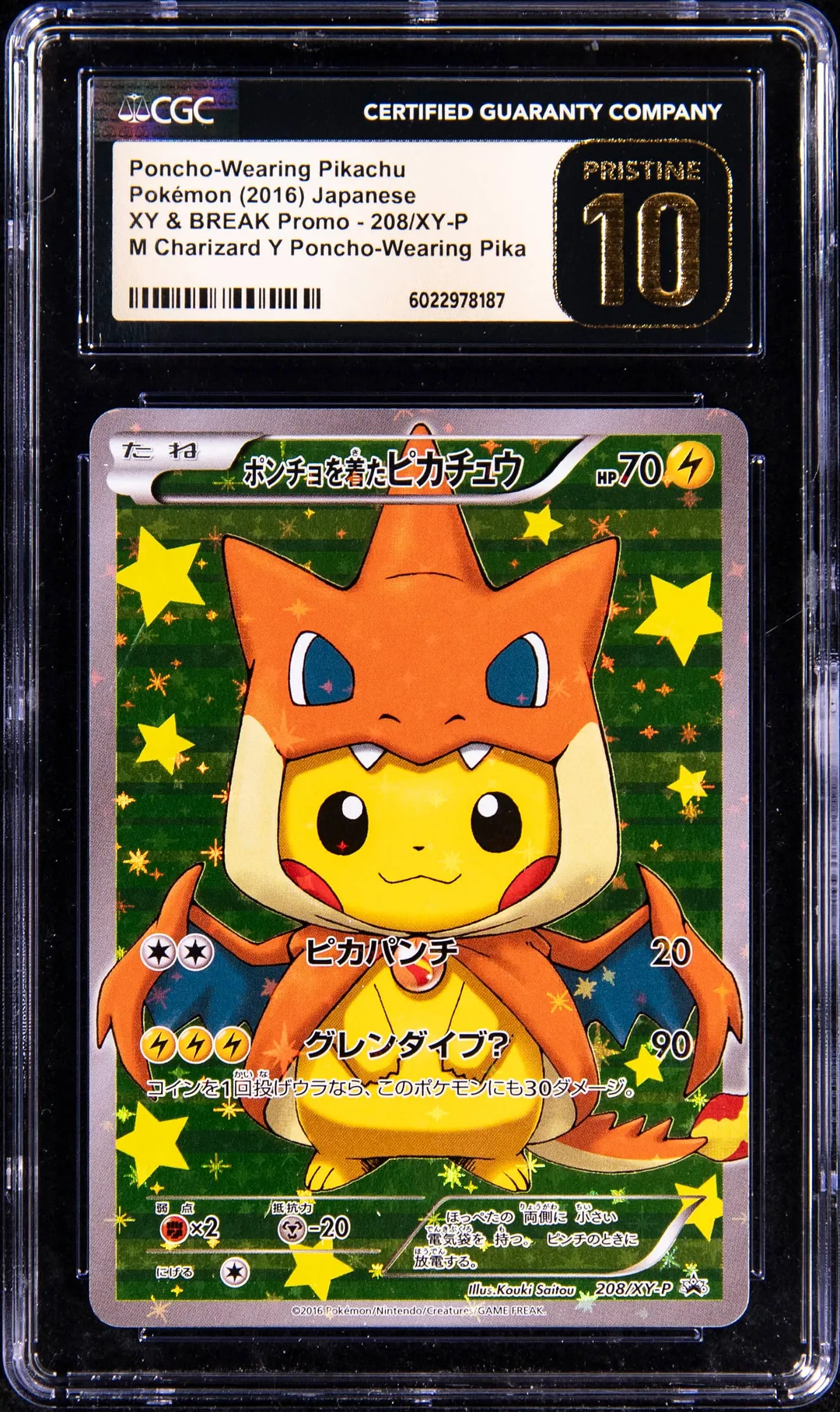
2016 Poncho Pikachu M Charizard Y CGC 10 Sells
Breakdown of the 2016 Japanese M Charizard Y Poncho-Wearing Pikachu #208 CGC Pristine 10 that sold for $12,710 at Goldin on February 16, 2026.
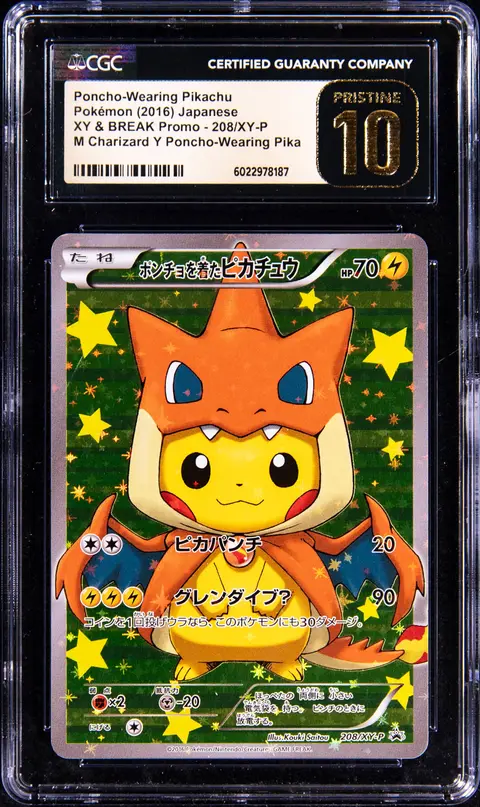
Sold Card
2016 Pokemon Japanese XY & BREAK Promo M Charizard Y Pikachu Special Box #208 Poncho-Wearing Pikachu - CGC PRISTINE 10
Sale Price
Platform
Goldin2016 Poncho-Wearing Pikachu M Charizard Y CGC 10 Sells for $12,710
On February 16, 2026, Goldin sold a 2016 Pokémon Japanese XY & BREAK Promo M Charizard Y Pikachu Special Box #208 Poncho-Wearing Pikachu graded CGC PRISTINE 10 for $12,710. For collectors who follow the poncho Pikachu promos, this is a notable data point in a segment of the market that has quietly built a strong following.
Card ID: What Exactly Sold?
Let’s break down the card itself:
- Year: 2016
- Game: Pokémon TCG (Japanese)
- Set / Release: XY & BREAK era – "M Charizard Y Pikachu Special Box" promo
- Card Number: #208/XY-P (commonly referenced simply as #208 Promo)
- Character: Pikachu wearing a Mega Charizard Y-themed poncho
- Language: Japanese
- Type: Sealed-box promo card (not pack-pulled)
- Grading Company: CGC Trading Cards
- Grade: CGC PRISTINE 10
- Attributes: Non-holo full-art style promo with highly themed artwork; no autograph or serial numbering.
This is not a rookie card in the sports sense. In Pokémon terms, it’s a key character promo from the ultra-modern era that sits at the intersection of three popular collector themes:
- Pikachu (the hobby’s most collected character)
- Charizard (historically one of the strongest price drivers)
- Japanese limited-box promos (often lower print and tougher to find clean once boxes are broken)
Why Poncho-Wearing Pikachu Matters
The “Poncho-Wearing Pikachu” run has become one of the most recognizable modern promo lines. Each card features Pikachu dressed as another marquee Pokémon, usually tied to a specific product or event in Japan.
Within that broader theme, the Charizard poncho cards—especially Mega Charizard X and Mega Charizard Y—have tended to attract more attention. They bring together:
- Charizard collectors chasing every variant of the character
- Pikachu collectors who focus on premium or quirky Pikachu artwork
- Japanese promo collectors who track complete promo runs from the XY/BREAK era
The XY-P promo period has a reputation for:
- Strong, distinctive artwork
- Numerous store/event exclusives
- Products that were widely enjoyed at release, so a lot of cards were handled or stored casually
That combination means that high-grade copies, especially in a true top grade like CGC PRISTINE 10, are meaningfully tougher than raw supply might suggest.
Understanding the Grade: CGC PRISTINE 10
CGC uses a detailed subgrade system and reserves PRISTINE 10 for cards that are effectively flawless under close inspection. It sits above a standard CGC 10 Gem Mint and is closer to how some collectors view a “black label” style grade: top of the top.
In practice, this means:
- Near-perfect centering
- No visible surface flaws
- Razor-sharp corners and edges
For non-vintage Pokémon, where there is still raw supply in the market, the true premium often sits with the very top grades. When multiple grading companies exist, the top grade from any reputable grader (e.g., PSA 10, BGS Black Label, CGC Pristine) tends to form its own micro-market.
Market Context and Recent Sales
When we talk about “comps,” we mean recent comparable sales—the same card in similar grades or very close substitutes (such as another top grading company’s 10). Based on publicly visible auction and marketplace results up through early 2026, here’s the general picture for this card and its close relatives:
- Ungraded / Raw copies of the M Charizard Y Poncho Pikachu promo tend to sell in a much lower bracket, often reflecting condition uncertainty and the risk of sub-gem grades.
- PSA 9 and similar mid-to-high grades usually sell for a modest premium over raw, but remain accessible to most collectors.
- PSA 10s and other Gem Mint equivalents show a clear price jump over 9s, reflecting demand for top-condition examples.
- Pristine-level cards (CGC PRISTINE 10, BGS Black Label, or equivalent top-tier designations when they show up) are relatively scarce in public sales; they can command a multiple of standard gem prices because they appeal to completionists and condition-focused collectors.
Within that structure, the $12,710 realized at Goldin on 2/16/26 sits toward the strong end of the range for this character-and-artwork combination in a top grade. While exact same-card CGC Pristine 10 comps may be thin, the price lines up with what we’ve seen when:
- A desirable, character-driven promo gets a true top-pop grade, and
- The sale runs through a mainstream auction house with a large Pokémon bidder base.
Taken together, this sale looks like a healthy, data-rich result rather than an outlier spike. It reinforces that the upper end of the poncho Pikachu and Charizard-themed promo market still has willing buyers for best-in-class condition.
Pop Report and Scarcity Considerations
A “pop report” (population report) is a grading company’s tally of how many copies of a specific card they’ve graded at each grade level.
For this card:
- The overall graded population across all companies is meaningful but not excessive; this is a popular promo that a lot of people have submitted.
- The number of true top grades (Pristine or Black Label equivalents) is much smaller than the number of Gem Mint 10s.
- The rarity is not in the card’s existence—it’s a modern promo—but in the combination of popular artwork plus the absolute highest technical grade.
Collectors watching pop report trends often pay attention to whether:
- The count of Pristine-level grades rises quickly (suggesting easy grading), or
- It stays relatively flat over time (suggesting that the card is condition-sensitive).
For Japanese XY/BREAK promos, minor print or handling defects can be common enough to keep the very top grade tiers scarce.
Collector Significance in 2026
Putting this sale in the broader 2026 hobby context:
- Ultra-modern Pokémon continues to mature. The market has had time to separate momentary hype from long-term collector appeal. Character-based promos that remain popular years after release are often the ones that keep seeing steady demand in high grade.
- Cross-collectibility matters. This card appeals simultaneously to Pikachu collectors, Charizard-focused collections, Japanese promo specialists, and poncho-themed Pikachu collectors. That overlapping demand helps support stronger results for top examples.
- CGC’s role has normalized. By 2026, CGC is a familiar grading name in the Pokémon space. While some buyers still compare CGC values directly to PSA’s, there is clear recognition that a CGC PRISTINE 10 occupies its own premium tier.
No single headline event (like a new game release or anime milestone) completely explains this specific auction result. Instead, it looks more like the product of steady, informed demand for a well-loved promo in a standout grade.
Takeaways for Collectors and Small Sellers
If you collect or sell cards in this lane, here are a few practical observations you can draw from the Goldin sale:
Condition tiers really matter. The jump from a solid grade (like a 9) to a true gem (10) is meaningful, and the jump from gem to pristine can be even more dramatic on the right card.
Character-first collecting is strong. Sets and eras go in and out of focus, but Pikachu and Charizard remain long-running anchors of Pokémon demand. Cards that feature both in a visually distinctive way often sit near the top of many want lists.
Japanese promos remain a deep lane. Many newer or returning collectors start with English flagship sets, then eventually branch into Japanese exclusives once they learn more. This gradual shift can bring fresh interest to cards like the poncho Pikachu series over time.
Auction houses add structure to price discovery. A $12,710 result at Goldin on 2/16/26 now becomes a reference point. Future buyers and sellers can view it as one data point within a range, rather than a guarantee of where the market “should” be.
For anyone tracking poncho Pikachu or Charizard-themed promos, this CGC PRISTINE 10 sale is a clean, well-documented example of what top-condition, character-driven Japanese promos can do in a mature marketplace.
If you’re cataloging your own collection for insurance, resale, or long-term tracking, note this one as:
2016 Pokémon Japanese XY & BREAK Promo – M Charizard Y Pikachu Special Box – Poncho-Wearing Pikachu #208 – CGC PRISTINE 10 – Sold by Goldin on 2/16/26 for $12,710.
It’s a concise snapshot of how art, character, era, and condition can converge into a single, memorable auction result.