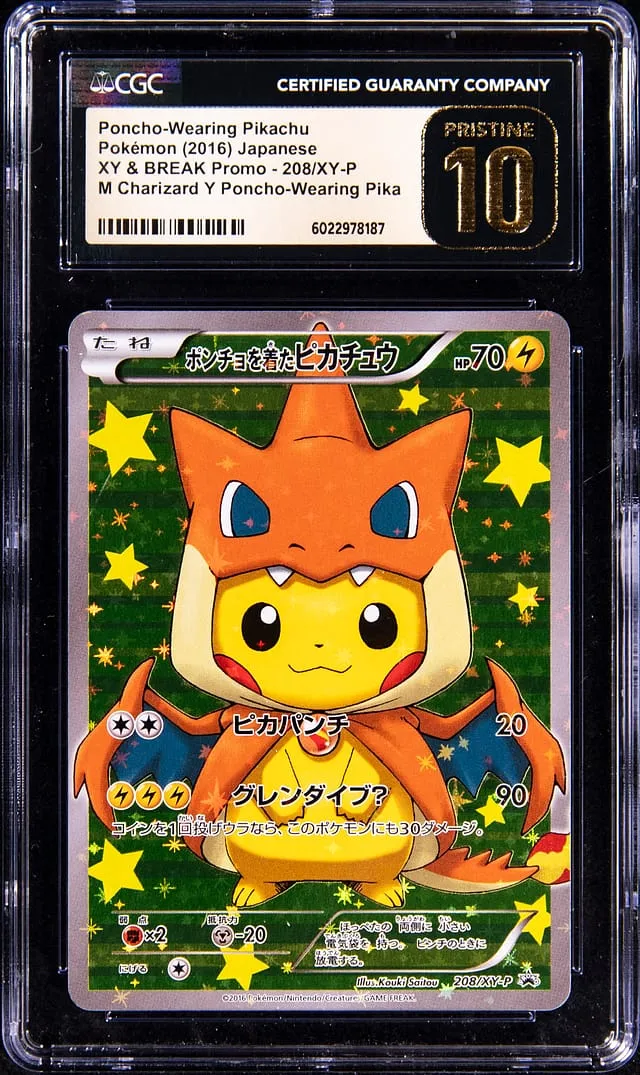
2016 Poncho Pikachu CGC 10 Charizard Y Goldin Sale
Deep dive into the $12,710 Goldin sale of the 2016 Japanese Poncho-Wearing Pikachu #208 CGC Pristine 10 from the M Charizard Y Pikachu Special Box.
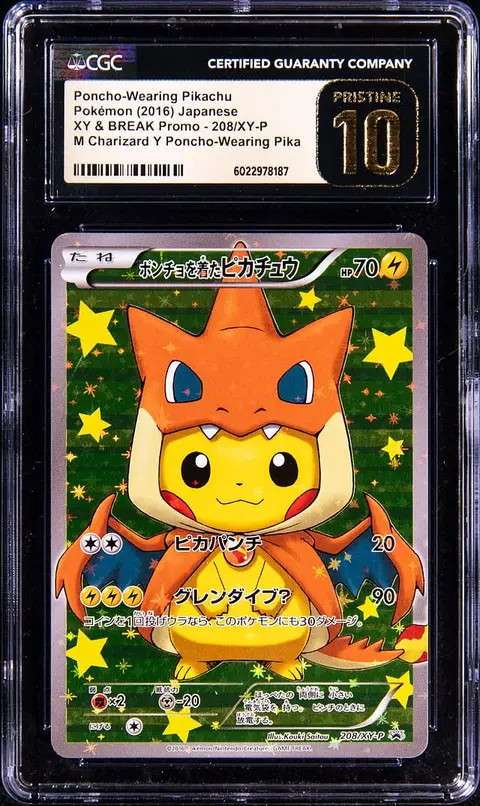
Sold Card
2016 Pokemon Japanese XY & BREAK Promo M Charizard Y Pikachu Special Box #208 Poncho-Wearing Pikachu - CGC PRISTINE 10
Sale Price
Platform
Goldin2016 Poncho-Wearing Pikachu Meets Mega Charizard Y: Inside a $12,710 CGC Pristine 10 Sale
On February 16, 2026, a notable piece of modern Japanese Pokémon history quietly changed hands at Goldin:
2016 Pokémon Japanese XY & BREAK Promo M Charizard Y Pikachu Special Box Poncho-Wearing Pikachu #208 – CGC PRISTINE 10
The final price landed at $12,710 (USD), putting a bright spotlight on one of the most recognizable – and carefully collected – modern Japanese promos.
In this breakdown, we’ll look at what the card is, why collectors care about it, and how this Goldin result fits into the broader market for Poncho-Wearing Pikachu and Charizard-themed promos.
Card Snapshot: What Exactly Sold?
Let’s start with the basic ID details:
- Game / IP: Pokémon TCG
- Year: 2016
- Region: Japanese
- Era: XY / BREAK (ultra-modern era for Pokémon)
- Product: M Charizard Y Pikachu Special Box
- Card: Poncho-Wearing Pikachu
- Card number: #208/XY-P (often referenced simply as #208 promo)
- Character: Pikachu wearing a Mega Charizard Y poncho
- Language: Japanese
- Rookie / key issue? Not a rookie, but a key modern promo within the popular Poncho-Wearing Pikachu run
- Grading company: CGC (Certified Guaranty Company)
- Grade: CGC PRISTINE 10
- Attributes:
- High-grade modern Japanese promo
- Clean edges, corners, centering, and surface (required for Pristine)
- No autograph, patch, or serial number – the value is driven by artwork, character combo, and grade scarcity
The Poncho-Wearing Pikachu line pairs Pokémon’s mascot with iconic species via themed outfits. Within that theme, Charizard poncho cards sit near the top of the demand ladder, because they combine two of the brand’s most collected characters: Pikachu and Charizard.
Why This Card Matters to Collectors
1. The Poncho-Wearing Pikachu Sub-Collection
The Poncho-Wearing Pikachu promos have become their own sub-collection in the hobby. They were released mostly through Japanese products and promotions rather than standard booster sets, which means:
- More controlled distribution: You typically had to buy a specific product (like this Special Box) rather than pulling from packs.
- Niche but passionate audience: Collectors who focus on Pikachu, Japanese promos, or unique art gravitate to these.
Within the Poncho line, Charizard-themed ponchos usually rank among the most desirable, alongside other heavy hitters like Mega Charizard X and various Eeveelution ponchos.
2. Dual Fanbase Appeal: Pikachu + Charizard
This card sits at the intersection of two of the most reliable character PCs (personal collections) in the hobby:
- Pikachu: the face of Pokémon and one of the most widely collected characters worldwide.
- Charizard: historically one of the strongest demand drivers for both English and Japanese markets, especially in high grade.
When you combine those in a single, visually striking promo, you get a card that:
- Feels special to character collectors
- Functions as a cornerstone card in a poncho or Pikachu-themed binder
- Has enduring appeal that is not tied to any one tournament format or meta
3. Japanese XY / BREAK Promo Era
2016 sits in the XY / BREAK ultra-modern window, a time when Japanese promo design got increasingly creative and character-driven. Many collectors view this era as:
- A sweet spot for print quality (Japanese printing tends to be sharp and clean)
- A wave of unique promos that weren’t always mirrored in English
That combination leads to a market where:
- Raw copies (ungraded) exist in decent supply
- True gem-level graded copies (especially Pristine 10) remain relatively scarce because they demand near-perfect centering and surfaces
Grade Matters: CGC Pristine 10 vs. Gem Mint 10
Within grading, there’s a meaningful difference between a company’s Gem Mint 10 grade and its Pristine 10.
- CGC Gem Mint 10: already a very high grade; typically allows minute, barely visible flaws.
- CGC Pristine 10: requires a high subgrade profile (usually 10s across most or all subcategories), meaning:
- Extremely sharp corners
- Near-perfect centering
- Clean edges and surfaces
The effect in the market is that:
- Pristine 10s often sell at a premium over Gem Mint 10s for the same card, especially for character-driven promos.
- Population (the number of copies graded at that level, often called a pop report) is usually much lower for Pristine than Gem Mint.
For this 2016 Poncho-Wearing Pikachu #208, a CGC Pristine 10 sits near the top of condition rarity without stepping into even rarer labels such as CGC Perfect 10.
Market Context: How Does $12,710 Fit In?
To put Goldin’s $12,710 result in context, it helps to look at a few key angles:
1. Same Card, Different Grades
While detailed, up-to-the-day private and public sale data can be fragmented, sales history across marketplaces (Goldin, PWCC, eBay, and other platforms) has generally shown:
- Ungraded / raw copies of the #208 Poncho Pikachu typically trading far below the five-figure level, reflecting the card’s availability but also its appeal.
- Graded 9 / 9.5 copies usually command a higher multiple than raw, but remain well under the Pristine-level pricing.
- Top grades (Pristine 10 / equivalent) are where you see a sizeable price gap emerge, as collectors pay specifically for condition scarcity and label.
Within that framework, $12,710 for a CGC Pristine 10 stands in the upper tier for this card’s condition ladder, fitting the profile of:
- A premium paid for top-pop or near-top-pop condition
- The combined pull of Pikachu, Charizard, and the Poncho-Wearing art style
2. Comparison to Related Poncho Pikachu Promos
When you look at other Poncho-Wearing Pikachu promos – especially those tied to fan-favorite partners like Charizard, Rayquaza, or Eeveelutions – market patterns tend to share a few traits:
- High demand for top grades: Pristine 10 and equivalent labels often command a steep premium over lower-grade copies.
- Strong character-driven resilience: Prices can fluctuate with broader Pokémon sentiment, but key character cards usually hold collector interest through different market cycles.
Within that broader Poncho category, the Charizard ponchos frequently rank among the stronger performers, which supports a high but not absurd outcome for a Pristine 10 copy of #208.
3. Records and Historic Context
While it’s difficult to certify an all-time record without a unified database of every private and public sale, this $12,710 Goldin result sits in line with where:
- Top-graded, character-combo Japanese promos have been trending when they offer a mix of rarity, iconic art, and cross-collector appeal.
It’s best viewed as:
- A strong, data point-level sale in the ongoing story of Poncho-Wearing Pikachu and Charizard-focused promos
- Not a guarantee of future levels, but a useful reference for collectors tracking condition premiums
What This Means for Collectors and Small Sellers
For Character and Set Collectors
If you’re building:
- A Pikachu PC (personal collection)
- A Charizard-focused binder
- Or a dedicated Poncho-Wearing Pikachu run
this result reinforces a few ongoing truths:
- Character plus condition can be a powerful combo. High-grade copies of recognizable characters, especially in unique promos, reliably attract bidders.
- Japanese promos continue to carve out their own identity. They’re no longer an afterthought to English; many collectors now treat them as core items.
For Graders and Flippers
If you buy raw and grade:
- This sale underlines how wide the gap can be between “nice copy” and “true 10-level copy.”
- Centering, edges, and surface must be nearly flawless to justify a Pristine label and the pricing that can come with it.
For smaller sellers, it’s helpful to:
- Check multiple recent comps (comparable sales) in similar grades across different platforms.
- Treat standout results like this as high-end reference points, not automatic targets for every raw or mid-grade copy.
For Market Watchers
Zooming out, this Goldin sale from February 16, 2026 fits a broader pattern for modern Pokémon:
- Character-driven, art-forward promos continue to see strong demand
- Cross-appeal cards (Pikachu + Charizard + unique art) tend to perform well in high grade
- The market increasingly differentiates between standard Gem Mint and elevated labels like Pristine 10
Key Takeaways
- A 2016 Japanese XY & BREAK Poncho-Wearing Pikachu #208 from the M Charizard Y Pikachu Special Box, graded CGC Pristine 10, sold at Goldin on February 16, 2026 for $12,710.
- This card connects two of Pokémon’s most collected characters – Pikachu and Charizard – through one of the hobby’s most popular modern promo themes.
- The price reflects both character demand and condition scarcity, with Pristine 10 standing above standard Gem Mint tiers.
- For collectors, the sale is another reminder that carefully selected Japanese promos, especially in top condition, remain a meaningful part of the modern Pokémon landscape.
As always, this is market context, not a prediction. Use sales like this as one data point among many as you decide what belongs in your own collection.
If you’re tracking similar cards or building a Poncho-Wearing Pikachu run, keeping an eye on future Goldin and other major auction house results will help you stay grounded in current pricing trends while you hunt for your next piece.