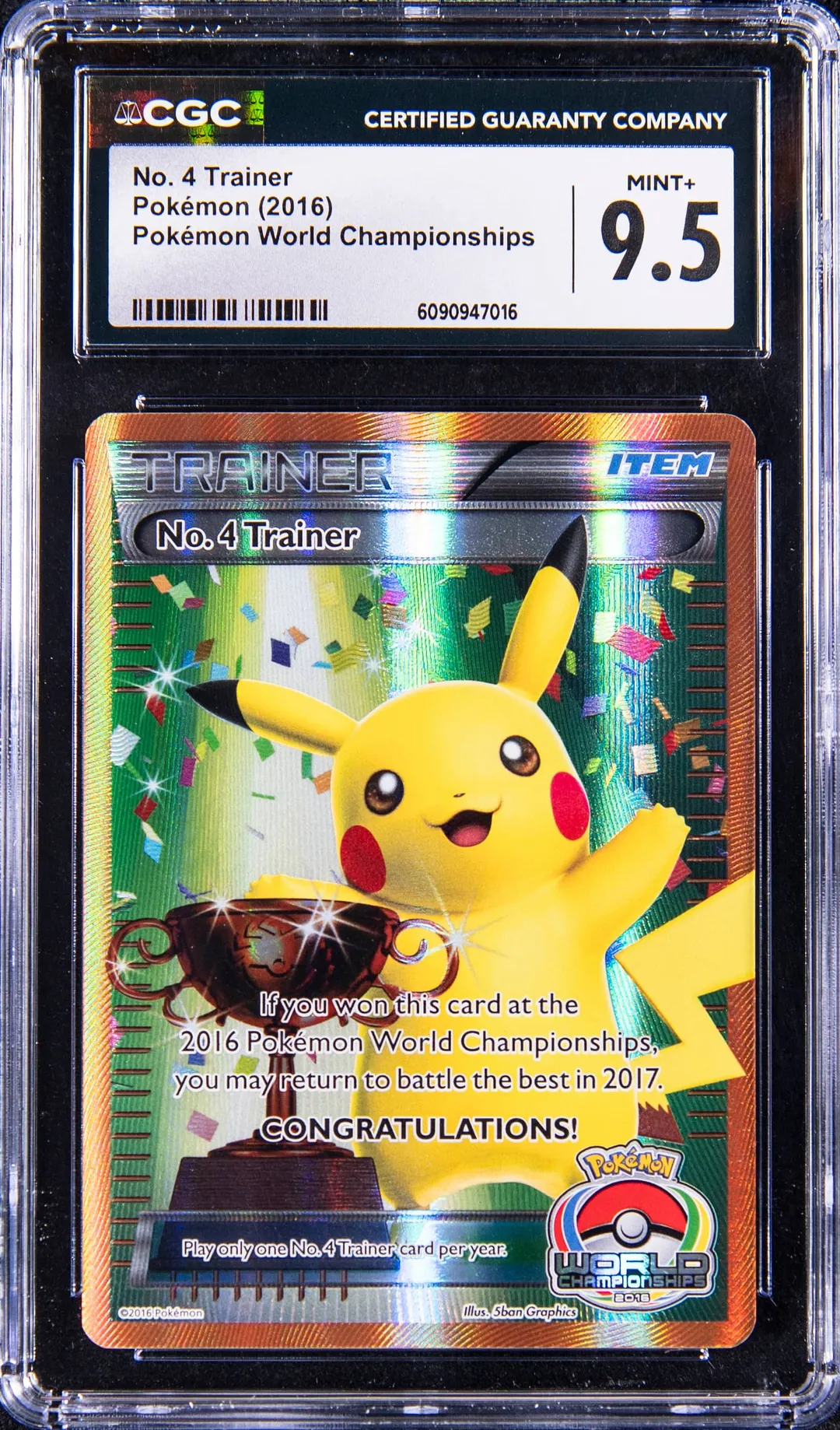
2016 No. 4 Trainer Pikachu Trophy CGC 9.5 Sale
A 2016 No. 4 Trainer Pikachu Trophy Card CGC 9.5 sold for $24,802 at Goldin on Feb 16, 2026. Here’s what it means for Pokémon trophy collectors.
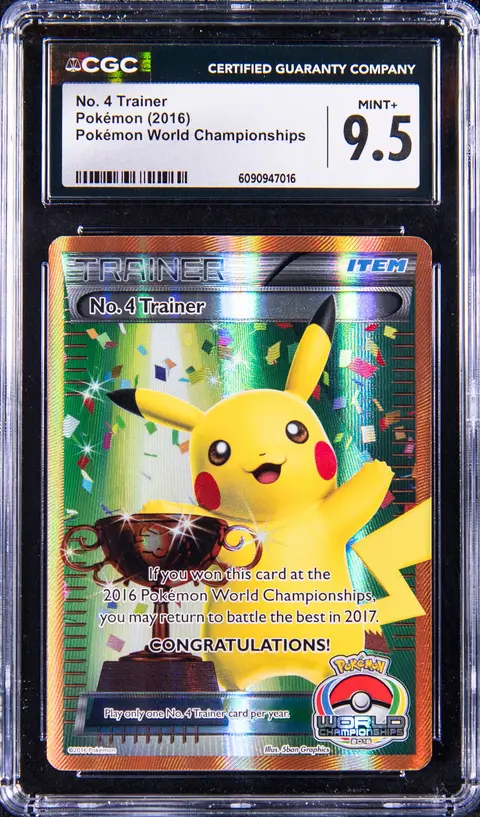
Sold Card
2016 Pokemon World Championships No. 4 Trainer Pikachu Trophy Card - CGC MINT+ 9.5
Sale Price
Platform
Goldin2016 Pokémon World Championships No. 4 Trainer Pikachu Trophy Card CGC 9.5 Sells for $24,802
On February 16, 2026, Goldin closed a quiet but important result in the high-end Pokémon trophy card space: a 2016 Pokémon World Championships No. 4 Trainer Pikachu Trophy Card, graded CGC MINT+ 9.5, sold for $24,802.
For a niche but highly respected corner of the hobby, this sale adds another data point to how modern-era Pokémon trophy cards are being valued in strong, but more selective, market conditions.
Card overview: what exactly sold?
Card: 2016 Pokémon World Championships No. 4 Trainer Pikachu Trophy Card
Character: Pikachu (Worlds “Trophy Pikachu” artwork)
Event: Pokémon World Championships 2016
Placement: No. 4 Trainer (typically awarded to a top-placing competitor)
Era: Ultra-modern competitive trophy card
Grading company: CGC
Grade: CGC MINT+ 9.5
This card is part of the long-running lineage of Pokémon World Championships “Trainer” or “Trophy Pikachu” prize cards. These are not pack-pulled cards. Instead, they are awarded directly to top finishers at the World Championships, which keeps print runs extremely low and puts them in the “trophy card” category.
The 2016 No. 4 Trainer Pikachu Trophy Card is therefore:
- Event-issued, not a mass-released set card.
- Ultra low supply, since only a small number of competitors receive copies in any given year and division.
- Collector-focused, with many copies staying in the hands of players who earned them, making them slow to hit the open market.
The copy in this sale received a CGC MINT+ 9.5, a top-tier grade that signals near-flawless condition with only minor imperfections.
Why collectors care about Worlds Pikachu trophy cards
For newer collectors, “trophy card” is a hobby term for cards that were given out as prizes at major events rather than pulled from packs. In Pokémon, the most famous examples are the early Japanese Trophy Pikachu and University Magikarp cards, along with the later World Championships prize cards.
The 2016 No. 4 Trainer Pikachu Trophy Card fits into this landscape as:
Part of the World Championships trophy lineage
Since the late 1990s, Pokémon has used special Pikachu or event-themed artwork to reward top players. This creates a continuous thread from the early Japanese trophy era through to modern Worlds.Ultra-modern, but not "mass modern"
While 2016 is recent compared with late-90s trophy issues, the supply here is completely different from typical modern Pokémon chase cards. There’s no sealed product to rip, no retail restock, no reprint. If you didn’t win one or buy one from a winner, you simply don’t have access.Crossover appeal
- Competitive players value the connection to Worlds performance.
- High-end collectors see it as part of the broader Pikachu and trophy-card ecosystem.
- Pikachu character collectors tend to track these closely because they represent some of the rarest Pikachu cards issued in the modern era.
Grading, condition, and CGC MINT+ 9.5
Condition is critical on any scarce card, but especially on trophy pieces. A grading company’s numeric score places the card on a standardized condition scale.
- Grader: CGC (Certified Guaranty Company)
- Grade: MINT+ 9.5
A 9.5 generally indicates:
- Centering, corners, edges, and surface all nearing perfection.
- Only tiny print issues or microscopic wear keeping it from a pristine “10”.
CGC has become a serious player in Pokémon grading, often noted for tight standards and subgrade detail. For trophy cards, where a large share of copies may have stayed raw or ungraded for years, each high-grade example helps define what “top condition” looks like.
Population data (often called the “pop report” – a grading company’s count of how many copies exist in each grade) for specific 2016 No. 4 Trainer Pikachu cards is limited and can shift as more cards are submitted. However, even without exact figures, we can say with confidence that any trophy card in 9.5 is part of a small group at the top of the condition ladder.
Market context: how does $24,802 fit in?
This Goldin sale closed at $24,802 on February 16, 2026.
Because this is an event-specific trophy card with very low circulation, public sales are sparse. That means the usual approach of lining up multiple “comps” (comparable recent sales used as reference points) is harder than with mass-released cards.
From available public data and past auction results for similar Worlds trophy Pikachu cards, a few patterns stand out:
Trophy card market is thin but deliberate
These do not trade weekly, or even monthly, on major auction platforms. When they appear, the bidder pool tends to be small but knowledgeable.Grade and award level matter
- Higher placements (e.g., No. 1 or No. 2 Trainer) and earlier-year trophies often command stronger prices.
- Within a given year, condition can create a wide spread. A CGC 9.5, PSA 9, BGS 9.5, or equivalent will usually sit near the top of the price range.
The $20K–$30K region has precedent
For mid-tier Worlds trophy cards from the 2010s (not the earliest 1990s grails, but still scarce Pikachu trophies), public sales in the tens of thousands of dollars have been seen in strong markets, especially for high grades.
Within that broader context, $24,802 for a 2016 No. 4 Trainer Pikachu in CGC 9.5 reads as a strong but believable result rather than an outlier spike. It neither rewrites the record books for Pokémon trophies nor suggests a distressed sale. Instead, it adds a new data point around where modern Worlds Pikachu trophies can clear in high grade.
What this sale suggests for collectors
This Goldin auction doesn’t suddenly redefine the entire Pokémon market, but it does reinforce a few ongoing themes.
1. Trophy scarcity still commands respect
Even as broader modern Pokémon prices have cooled from peak levels, cards that were never mass distributed continue to hold collector interest. That includes:
- Worlds trophy cards (like this No. 4 Trainer Pikachu).
- Early Japanese trophy issues.
- Other invite-only or event-only releases with true low print runs.
The $24,802 result shows that committed collectors remain willing to compete for these when they surface.
2. Condition is a clear differentiator
With pack-pulled modern cards, you can, in theory, open more boxes and submit more candidates for grading. That’s not the case here. The total pool of 2016 Worlds trophies is fixed.
So when a copy shows up in CGC MINT+ 9.5, it checks two boxes at once:
- True scarcity: Very few copies exist at all.
- Grade scarcity: Only a fraction will achieve a top tier grade.
That combination is what often sustains prices on low-transaction cards even when the broader market is mixed.
3. The ultra-modern trophy segment is maturing
Collectors used to focus mostly on the earliest trophy Pikachu cards, but attention has gradually spread to later Worlds pieces as:
- Early trophies have become harder to acquire.
- The competitive Pokémon scene has grown in visibility.
- Character collectors build out full Pikachu or Worlds-focused runs.
This 2016 No. 4 Trainer Pikachu sale fits into that maturing view: later-year trophies are not treated as vintage grails, but are still being priced as serious long-term collectibles.
Takeaways for different types of collectors
If you’re new to Pokémon trophy cards
- Expect very few public sales each year. Price history will look patchy.
- Learn the differences between placements (No. 1, No. 2, No. 3, No. 4 Trainer, and so on) and between years.
- Study pop reports and auction archives to understand how condition and provenance affect realized prices.
This $24,802 result at Goldin can serve as one of the reference points when you’re mapping the modern trophy card landscape.
If you’re a returning hobbyist
You might remember when Worlds trophies were almost invisible outside of niche forums. Seeing a 2016 No. 4 Trainer Pikachu graded CGC 9.5 run in a major auction house in 2026 is a reminder that:
- The high-end Pokémon segment has integrated into mainstream auction platforms.
- Event-only cards are now part of the broader conversation, not just a side note.
If you’re an active buyer or small seller
This sale underscores the value of documentation and grading for rare items:
- For sellers, a recognized third-party grade like CGC 9.5 helps buyers calibrate condition for a card they can’t easily compare elsewhere.
- For buyers, each auction result helps anchor expectations, even if there are only a handful of comps.
It’s still important to treat any single trophy sale as one data point among many, given how thin this segment trades.
Final thoughts
The 2016 Pokémon World Championships No. 4 Trainer Pikachu Trophy Card is not the loudest card on social media feeds, but within serious Pokémon circles it represents a meaningful slice of the World Championships trophy story.
At $24,802 through Goldin on February 16, 2026 (UTC), this CGC MINT+ 9.5 copy adds a measured, data-backed marker for what ultra-modern Pikachu trophies can command in high grade. For collectors building long-term Worlds, Pikachu, or trophy-focused collections, it’s another reminder that event-only scarcity and strong condition continue to find their level in today’s market.