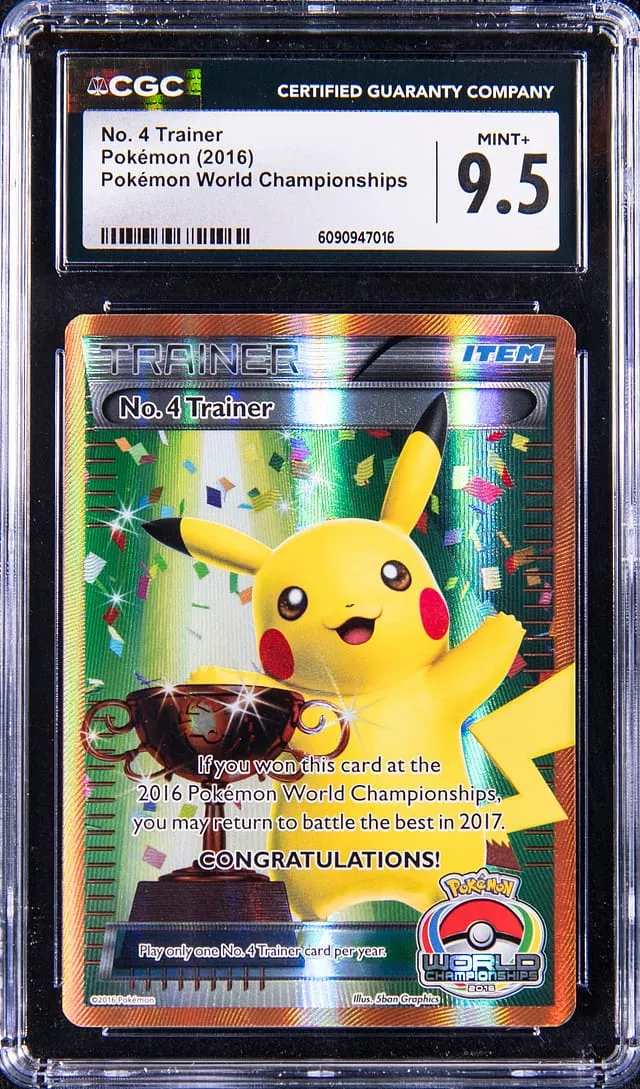
2016 No. 4 Trainer Pikachu Trophy Card Sells for $24K
Goldin sold a 2016 Pokémon World Championships No. 4 Trainer Pikachu trophy card CGC 9.5 for $24,802. See what this result means for collectors.
Sold Card
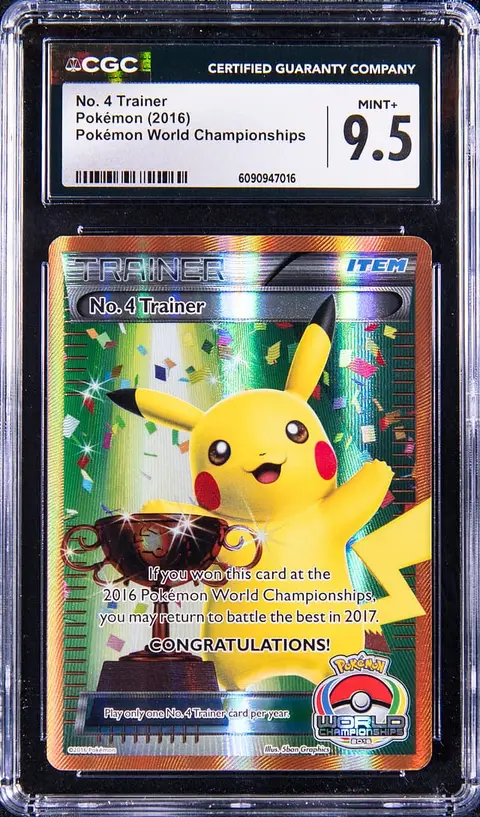
2016 Pokemon World Championships No. 4 Trainer Pikachu Trophy Card - CGC MINT+ 9.5
Sale Price
Platform
Goldin2016 Pokémon World Championships No. 4 Trainer Pikachu Trophy Card – CGC 9.5 Sells for $24,802
On February 16, 2026, a 2016 Pokémon World Championships No. 4 Trainer Pikachu trophy card graded CGC MINT+ 9.5 sold for $24,802 at Goldin. For a niche, event-issued trophy card, this is a meaningful data point for collectors who track the thin but important market for World Championships prize cards.
What exactly is this card?
Let’s start by clearly identifying it:
- Character: Pikachu ("Trainer Pikachu" artwork)
- Year: 2016
- Event / Set: Pokémon World Championships 2016
- Card Type: No. 4 Trainer trophy card
- Variant: Trophy card awarded at the World Championships (not a pack-pulled set card)
- Grading company: CGC
- Grade: MINT+ 9.5
- Attributes: Extremely low original print run, distributed only to top finishers at Worlds
These “No. ___ Trainer” Pikachu cards are not standard set releases. They are award cards given to players who placed at the top of their age division at the Pokémon World Championships. As such, they sit in the same conceptual lane as other high-end trophy and prize cards: not many exist, and even fewer ever leave the hands of original recipients.
Trophy Pikachu and why collectors care
Among serious Pokémon collectors, Worlds trophy cards occupy a very specific niche:
- They are ultra-limited, often with only a handful of copies awarded per division.
- They are tied to the competitive history of the game, not just the collecting side.
- Artwork often features Pikachu in a special pose tied to the year or event.
The 2016 No. 4 Trainer Pikachu trophy card is part of that tradition. While exact print numbers are not always publicly confirmed, the general understanding in the hobby is that these cards have extremely small populations compared to set cards, even low-serial modern chase cards.
This card comes from the ultra modern era (roughly mid‑2010s onward). In ultra modern, most set cards are readily available, so what gives a card long-term interest is usually:
- True scarcity (trophy/prize distribution rather than pack odds)
- Historical relevance (World Championships, major events, or famous players)
- Condition sensitivity versus grading populations
This trophy Pikachu checks the first two boxes very clearly, and the CGC 9.5 grade adds condition appeal.
The CGC MINT+ 9.5 grade
CGC’s MINT+ 9.5 is a high-end grade, especially for cards that were not always stored like traditional collectibles. Prize cards can pick up wear either at the event or over the years, so higher grades are not guaranteed.
A few notes on grading context:
- Technical standard: CGC is known for relatively tight centering and surface standards.
- Registry and slabs: Some collectors still tend to gravitate toward PSA for certain trophy cards, but strong CGC grades have been increasingly accepted, especially when eye appeal is clear and subgrades (when present) are strong.
- Crossover risk: Historically, some buyers would value CGC 9.5s at or slightly below comparable PSA 10/9.5 expectations, but the exact discount or parity varies card by card.
Because trophy cards have low populations, even a single CGC 9.5 sale can become an important reference point for future negotiations.
Price context: $24,802 at Goldin
The card realized $24,802 at Goldin on February 16, 2026.
For this kind of piece, the market is thin—there simply are not many data points. That means:
- “Comps” (short for comparable sales, i.e., recent similar sales used for price reference) are rare.
- Each auction can swing up or down based on who shows up and how badly they want it.
From looking across recent years for similar Worlds Pikachu trophy cards (not limited to 2016 and not limited to CGC):
- Earlier and higher-ranking trophy Pikachu cards (like older No. 1 or No. 2 Trainers, especially in top PSA grades) have historically sold much higher.
- Lower placements, later years, and non-PSA slabs have typically traded at more modest levels, with a fairly wide range.
- Within that pattern, a mid–five-figure hammer for a 2010s Worlds Pikachu trophy card in top condition fits into the upper but not record-breaking side of expectations.
Without a long, consistent sequence of sales for this exact card in this exact grade, it’s more useful to frame this result as:
- A solid confirmation that mid–five-figure interest exists for 2010s Pikachu Worlds trophies in top slabs.
- One of the clearer recent benchmarks for a No. 4 Trainer from this era.
Rather than treating this as a new “ceiling,” collectors may view it as an informed reference point when discussing trades or future auctions.
Scarcity and population
Trophy cards like this tend to have:
- Very low raw population (how many were ever printed and awarded).
- Even lower graded population (how many have been submitted and slabbed).
Pop reports (population reports, which show how many copies exist in each grade at a grading company) for Worlds trophy cards often show only a handful of total graded copies per year/placement, if that.
In practical terms, this means:
- Two different sales a couple of years apart can involve two entirely different copies, each with unique centering or surface characteristics.
- A single high-grade result like this can influence buyer and seller expectations for a long stretch simply because there may not be another comparably graded copy on the market soon.
How this sale fits into the broader Pokémon market
The broader high-end Pokémon market over the last few years has seen:
- A gradual cooling from peak pandemic pricing, especially on mass-printed set cards.
- Continued steady interest in genuinely scarce items: trophies, early promos, and historically important cards.
This Goldin sale reinforces a few patterns that experienced collectors often talk about:
- True scarcity still matters. While many ultra modern hits have healthy populations, event-only cards like this retain a fundamentally different supply profile.
- Event history has staying power. Ties to the World Championships and to the competitive history of the TCG give these cards a unique lane, separate from typical “chase cards” in packs.
- Condition premium remains real. A CGC 9.5 on a card that was never widely distributed is not trivial. High-end collectors frequently pay a premium to pair true scarcity with strong condition.
Takeaways for collectors and small sellers
A few practical observations for anyone watching or participating in this segment:
- Thin market, wide ranges: Expect less predictable price movements than you see with popular set cards. A handful of motivated bidders can move the final number significantly.
- Do your homework on comps: With only a few historical transactions, it’s important to look not just at the headline price but also:
- Grading company and grade
- Subgrades/eye appeal
- Timing and venue (major auction house vs. fixed-price listing)
- Understand the buyer base: Worlds trophies often attract a different mix of collectors—high-end Pikachu collectors, competitive players, and long-time promo specialists.
None of this guarantees how similar cards will perform in the future. It does, however, give today’s collectors a clearer snapshot of where a 2016 Pokémon World Championships No. 4 Trainer Pikachu trophy card in CGC MINT+ 9.5 has recently landed in the market: firmly in the mid–five-figure tier, via a major auction house, in early 2026.
For those tracking the evolution of the trophy-card segment, this Goldin sale is another important marker in how the hobby values ultra-modern Worlds Pikachu awards over time.