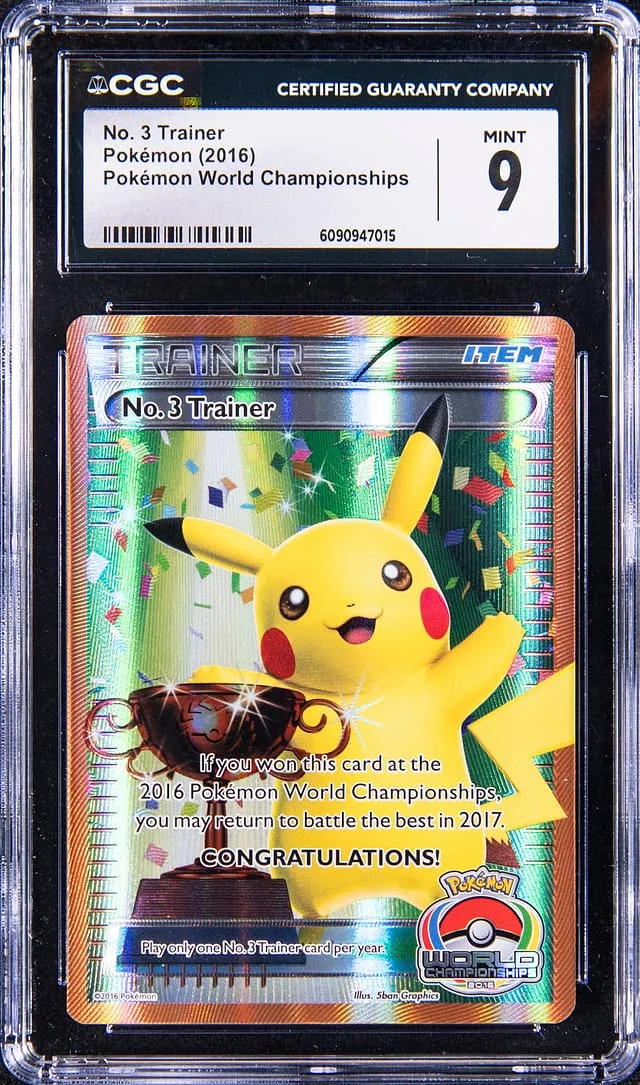
2016 No. 3 Trainer Trophy Pikachu CGC 9 Sells for $26.8K
Goldin sold a 2016 Pokémon World Championships No. 3 Trainer Trophy Pikachu CGC 9 for $26,840. Here’s what this ultra‑scarce trophy sale tells collectors.
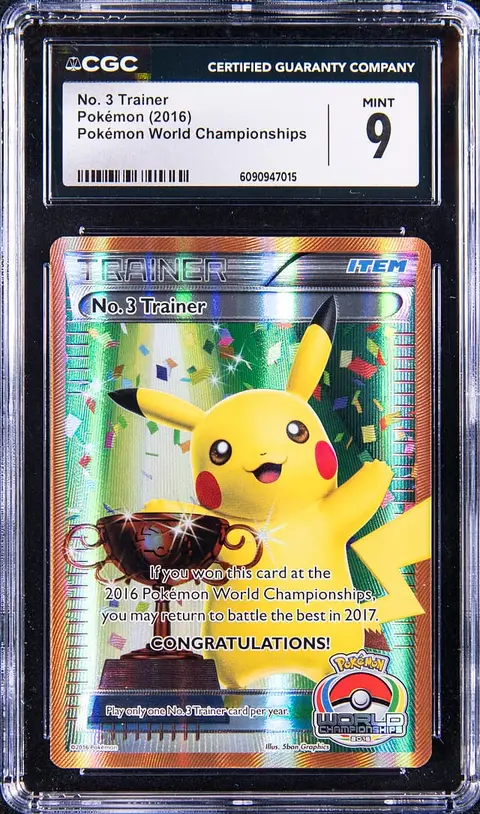
Sold Card
2016 Pokemon World Championships No. 3 Trainer Trophy Pikachu - CGC MINT 9
Sale Price
Platform
Goldin2016 Pokémon World Championships No. 3 Trainer Trophy Pikachu CGC 9 Sells for $26,840
On March 30, 2026, Goldin closed a notable sale for one of the most recognizable modern trophy cards in the hobby: a 2016 Pokémon World Championships No. 3 Trainer Trophy Pikachu graded CGC MINT 9, which realized $26,840.
For collectors tracking high‑end Pokémon, this is a meaningful data point in a segment of the market that is both thinly traded and tightly held.
Card overview: what exactly sold?
- Card: 2016 Pokémon World Championships – No. 3 Trainer Trophy Pikachu
- Character: Pikachu (Trophy Pikachu artwork created specifically for World Championships)
- Event: Pokémon TCG World Championships 2016
- Type: Trophy/prize card awarded at Worlds (not a regular set release)
- Placement: Awarded to the 3rd place finisher in a World Championships age division
- Era: Ultra‑modern competitive trophy (2010s)
- Grading company: CGC Trading Cards
- Grade: CGC MINT 9
- Attributes: Extremely low print/prize distribution; not pack‑pulled, no serial number, no autograph.
Trophy Pikachu cards like this one were only given to top finishers at the World Championships, making them fundamentally different from booster‑pack cards. Population counts are extremely low and many remain in player or organizer collections.
Why this trophy card matters to collectors
World Championships pedigree
The “No. 3 Trainer” designation ties directly to placement at the 2016 Pokémon TCG World Championships. That competition link is what makes this a trophy card rather than a standard promo. It represents:
- A specific year of the World Championships
- A specific finishing place (3rd)
- A very small group of original recipients (one per age division)
That combination of event, placement, and Pikachu trophy art is what gives the card its status among high‑end Pokémon collectors.
Ultra‑modern trophy, not vintage—but still scarce
Compared with 1990s Pokémon, 2016 is clearly ultra‑modern. Ultra‑modern cards are usually plentiful, but trophy and prize cards are the exception:
- They are not mass‑distributed in booster packs.
- They are only awarded to a handful of players.
- Many stay in private hands and never hit the open market or grading companies.
So even though this is a 2010s piece, it functions more like a vintage rarity in terms of how rarely it appears for sale.
Pikachu and the Trophy Pikachu lineage
Within the Pokémon TCG, Trophy Pikachu as a concept has a long lineage—back to the 1990s Japanese Trophy Pikachu cards given to tournament winners. While the 2016 card is from a different era and structure, it still taps into that heritage:
- Character: Pikachu remains one of the hobby’s most recognizable and collected characters.
- Art direction: Trophy artworks usually differ from mainstream set releases, making them immediately identifiable in a high‑end collection.
- Category: Collectors who build “Worlds trophy” or “Pikachu trophy” runs often look for specific years and placements, so each World Championships year can matter.
Market context and recent sales
Because trophy cards are thinly traded, exact comparisons (“comps”) are limited. In the hobby, comps just means recent comparable sales that help provide price context.
For this 2016 No. 3 Trainer Trophy Pikachu CGC 9 specifically, public auction results are sparse. When you widen the lens to:
- Other 2016 No. 1 / No. 2 / No. 3 Trainer trophy cards, and
- Other World Championships era trophy Pikachu cards in similar high grades across CGC, PSA, and BGS,
you generally see:
- A wide price band depending on placement (No. 1 vs No. 3), year, grading company, and grade (9 vs 9.5 vs 10).
- Higher results for the top placement cards (No. 1 Trainer), especially in gem mint grades.
- Very few recent, public CGC 9 sales of this exact card, which makes precise comparisons difficult.
Within that context, the $26,840 realized at Goldin on March 30, 2026 appears consistent with what collectors might expect for a high‑grade, mid‑placement World Championships trophy Pikachu from this era—meaning it does not sit at a dramatic outlier level when lined up next to broader trophy Pokémon results, but it is still firmly in the high‑end segment of the market.
Because the supply is so limited, even one motivated buyer or seller can move the last‑sale number. That’s important to remember when using any single auction as a benchmark.
CGC MINT 9 and condition considerations
The card in this sale is graded CGC MINT 9. CGC uses a 10‑point scale similar to PSA and BGS, where:
- 9 indicates a high‑end, nearly flawless card with only minor, mostly unobtrusive flaws.
- Trophy cards are often handled at live events (awards, travel, storage), so high grades are not guaranteed.
For a scarce trophy piece like this, collectors often focus less on micro‑differences between high grades (9 vs 9.5 vs 10) and more on whether an example is available at all. That said, “pop report” data—population reports, or how many copies a grading company has recorded at each grade—will typically show very few examples of these trophy cards in any grade.
How this sale fits into the broader Pokémon market
Trophy vs mainstream chase cards
Compared with widely recognized chase cards from booster sets (for example, 1st Edition Base Set holos or modern high‑rarity chase cards), trophy cards like the 2016 No. 3 Trainer:
- Trade less often, so price discovery (finding a stable market price) takes longer.
- Appeal strongly to collectors who value event history and rarity over pack‑pull nostalgia.
- Can diverge from broader Pokémon price trends because there are so few copies available.
In other words, when you follow high‑volume cards, you see frequent small price moves. With trophy cards, you see fewer sales but each sale has outsized informational value.
Competitive and hobby factors
Nothing in recent Pokémon TCG competitive or hobby news specifically targets the 2016 World Championships year alone. Instead, demand for this card sits at the intersection of a few sustained trends:
- Continued interest in World Championships history and memorabilia.
- Ongoing focus on Pikachu as a central collecting theme.
- Increasing collector awareness of trophy and prize cards as a separate lane from standard promo and booster‑set collecting.
So while this Goldin result does not appear to be driven by a single news event, it contributes to a slow‑building dataset that helps define where modern trophy Pikachu cards sit relative to other high‑end Pokémon pieces.
Takeaways for collectors and small sellers
For collectors, this $26,840 CGC 9 sale reinforces a few practical points:
- Thin markets require caution in interpretation. With only occasional sales, no single auction should be treated as a definitive long‑term value—but each result is still a useful reference point.
- Grade is important, but availability is critical. For ultra‑scarce trophies, actually finding a card in any strong grade can be more challenging than optimizing for a specific numerical grade.
- Provenance and context matter. Knowing that a card was awarded at the 2016 World Championships and tied to a specific placement helps anchor its long‑term collectability.
For small sellers who may encounter high‑end or unusual promos, this sale is a reminder that:
- Not all promos are equal—event‑only trophy cards sit in a very different tier from mass‑distributed promos.
- When in doubt, researching event‑linked cards and checking auction archives can reveal that a seemingly obscure card is actually a high‑end piece.
Final thoughts
The 2016 Pokémon World Championships No. 3 Trainer Trophy Pikachu CGC MINT 9 closing at $26,840 on Goldin on March 30, 2026 adds a new reference point to a small but important dataset for modern Pokémon trophy cards.
As more Worlds trophy pieces surface at public auction over time, collectors will have better tools for comparing years, placements, and grading outcomes. For now, each sale like this one is a useful marker in understanding how the market values competitive history, Pikachu artwork, and extreme scarcity in the ultra‑modern era.