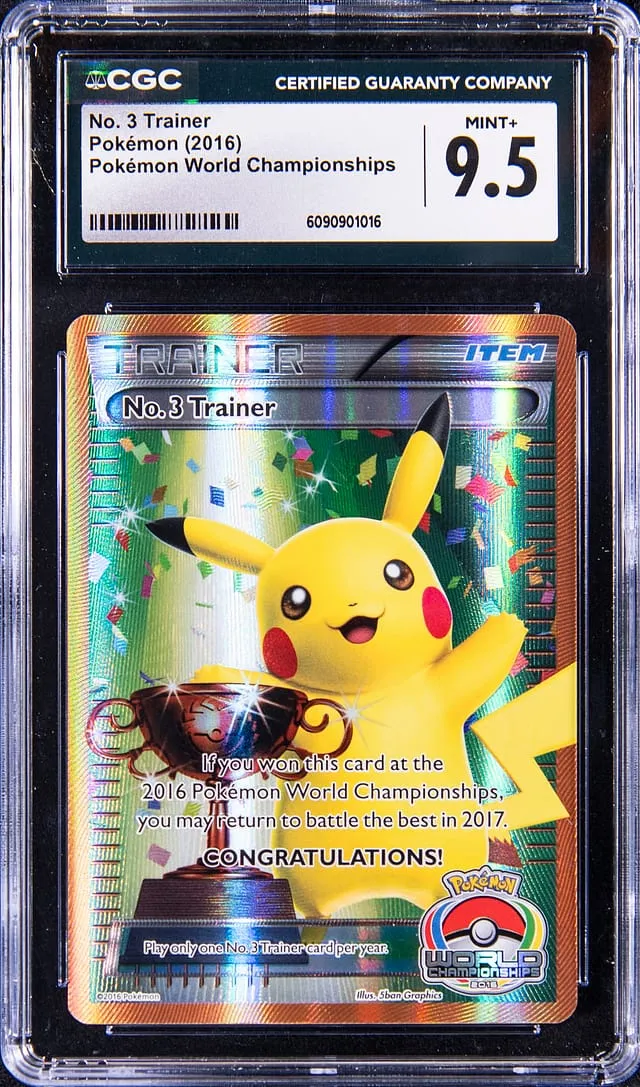
2016 No. 3 Trainer Pikachu CGC 9.5 Sells for $27.9K
2016 Pokémon No. 3 Trainer Pikachu CGC 9.5 (Pop 1) sold for $27,924 at Goldin on Feb 16, 2026. A key modern World Championships trophy card result.
Sold Card
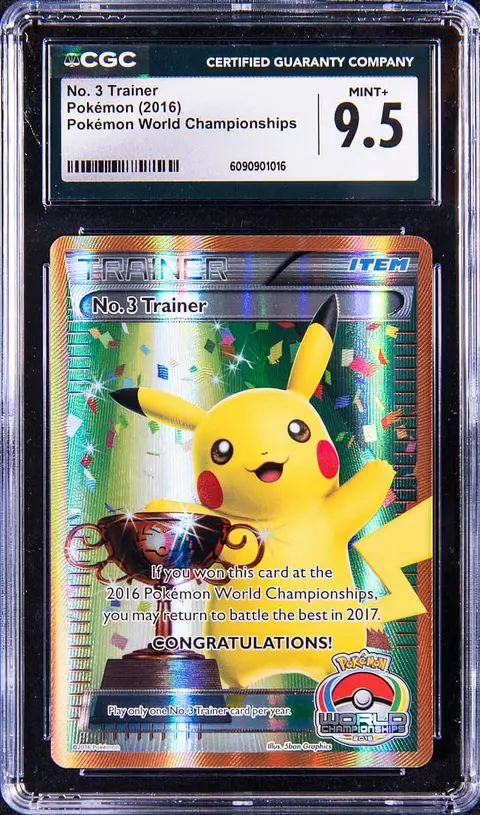
2016 Pokemon World Championships No. 3 Trainer Pikachu Trophy Card - CGC MINT+ 9.5 - Pop 1
Sale Price
Platform
Goldin2016 Pokémon World Championships No. 3 Trainer Pikachu Trophy Card – CGC 9.5 Pop 1 Sells for $27,924
Ultra-rare Pokémon trophy cards continue to define the high end of the hobby, and the latest example comes from Goldin. On February 16, 2026 (UTC), a 2016 Pokémon World Championships No. 3 Trainer Pikachu Trophy Card, graded CGC MINT+ 9.5 and noted as a population 1, sold for $27,924.
For newer collectors or those returning to the hobby, this sale is a useful case study in how rarity, event history, and grading all intersect at the top of the Pokémon market.
Card Breakdown: What Exactly Sold?
Let’s start by clearly identifying the card:
- Year: 2016
- Event / Set: Pokémon World Championships (trophy card, not a regular set release)
- Card Name / Type: No. 3 Trainer Pikachu Trophy Card
- Character: Pikachu in a special event-specific trophy artwork
- Category: Ultra-rare prize card awarded at the World Championships
- Rookie or key issue?: Not a “rookie card” in the sports sense, but absolutely a key issue within the Pokémon trophy-card lane
- Grading Company: CGC Trading Cards
- Grade: CGC MINT+ 9.5
- Population: Pop 1 in this exact grade at CGC at the time of sale
Unlike mass-produced set cards, World Championships “No. 1 / No. 2 / No. 3 Trainer” cards are prize cards given to top finishers in the tournament. They are not pulled from packs and generally exist in very low quantities.
Why Trophy Pikachu Cards Matter to Collectors
Trophy cards occupy a distinct niche in the Pokémon hobby:
- Event-only distribution: These cards were awarded to top competitors at the World Championships, making them closer to medals or trophies than typical trading cards.
- Very low print runs: Exact print numbers are often not publicly confirmed, but they are tiny compared to regular set releases.
- Historical significance: Each World Championships card reflects a specific year’s event, giving it historical and narrative weight.
- Character choice: Featuring Pikachu, the franchise mascot, adds another layer of desirability compared with more obscure characters.
From a collector’s standpoint, this 2016 No. 3 Trainer Pikachu falls into the “ultra modern trophy” category: recent enough to have modern grading and documentation, but scarce enough to function more like pre-release prize memorabilia than normal cards.
Understanding the CGC 9.5 MINT+ Pop 1 Designation
Grading matters a lot more when the total available copies are already low.
- CGC MINT+ 9.5 is a high-end grade, just shy of “Gem Mint” in many grading scales.
- Pop 1 (population 1) means that, as of the time this sale was recorded, there was only one copy of this specific card in this exact grade in CGC’s population report. A population report, or “pop report,” is the grading company’s public tally of how many copies of a card exist in each grade.
For ultra-low-print-run trophy cards, even small differences in grade or eye appeal can matter to advanced collectors, especially when they are chasing the “best known” example in the hobby.
Market Context: How Does $27,924 Fit In?
The realized price on Goldin was $27,924.
Because this is a very specialized card with very few public transactions, there usually are not many direct, apples-to-apples “comps” (comparables). Comps are recent, similar sales that collectors use to get a sense of current price ranges.
When looking at market context for a card like this, collectors typically:
- Compare to the same card in other grades or with other grading companies (if any have surfaced recently).
- Look at related trophy cards from the same event year (No. 1 / No. 2 Trainer) or from adjacent years (other World Championships Pikachu trophies).
- Track the broader trophy-card lane, where key cards have historically sold from the mid-five figures into six figures, depending on year, art, and grade.
For this specific 2016 No. 3 Trainer Pikachu in CGC 9.5 MINT+ pop 1, public sales are limited and often spaced far apart in time, if they appear at all. That means this Goldin result effectively becomes a fresh reference point for future buyers and sellers.
Within the wider high-end Pokémon environment, a sub-$30,000 realized price for an ultra-rare, pop 1, World Championships trophy Pikachu sits in a lane that many serious collectors consider the “entry tier” of true top-end tournament prizes, beneath the very earliest or most famous trophy cards but still squarely in prestige territory.
What Makes the 2016 World Championships Era Distinct?
The 2016 World Championships fall in the ultra modern era of Pokémon, but that does not mean the cards are easy to obtain:
- Better documentation: Compared with earlier years, the modern World Championships have more accessible coverage and records, which helps newer collectors understand what the cards represent.
- Established competitive scene: By 2016, Pokémon’s organized play was mature, and World Championships trophies had well-known prestige within the competitive community.
- More hobby awareness: The broader trading card hobby was already paying attention to Pokémon trophy cards by the mid-2010s, which tends to limit “lost” or forgotten copies.
Unlike 1990s Japanese trophy cards that can feel almost mythical, the 2016 trophies are part of a more documented era. Still, supply remains extremely small, and condition-sensitive surfaces and edges make high grades tough.
Why This Sale Matters for Collectors
For active collectors, small sellers, and returning hobbyists, here is what this Goldin sale can signal:
Confirmation of demand for modern-era trophies
Even outside earlier, headline-making cards, there is sustained interest in more recent World Championships Pikachu prizes.Growing role of CGC in high-end Pokémon
Seeing a CGC MINT+ 9.5 pop 1 card reach $27,924 at a major auction house underscores how CGC-graded examples are participating in serious trophy-card results.A benchmark for the 2016 No. 3 Trainer lane
With limited sales data, each public auction becomes a reference point. Future buyers and sellers are likely to look back at this February 16, 2026 Goldin result when talking about price history.Illustration of how rarity can outweigh age
Many newcomers assume only the oldest Pokémon cards reach significant prices. This card shows how event-based scarcity and prestige can compete with age in shaping demand.
Takeaways for Different Types of Collectors
Whether or not you collect trophy cards, there are a few practical lessons from this sale:
- Document your comps carefully. For niche items, even one or two auction results can shape expectations for years. Saving auction links, dates, and grades can be valuable.
- Look past the release date. Ultra modern cards can be key issues when they are tied to major events and have very limited distribution.
- Study pop reports. For cards with tiny print runs, knowing whether you are looking at a pop 1, pop 3, or pop 10 in a certain grade helps you understand how competitive the chase might be.
- Consider the story. A World Championships No. 3 Trainer Pikachu is not just cardboard—it’s a visible artifact of a specific tournament year, with a built-in narrative that many high-end collectors care about.
Final Thoughts
The February 16, 2026 Goldin sale of the 2016 Pokémon World Championships No. 3 Trainer Pikachu Trophy Card – CGC MINT+ 9.5 (Pop 1) at $27,924 is another reminder that the upper tier of the Pokémon market is shaped as much by tournament history and rarity as by age alone.
For those studying the market, this result adds a clear data point to the evolving price picture around modern trophy Pikachu cards. For collectors, it highlights how focused, event-specific pieces continue to carve out their own quiet but important corner of the hobby.