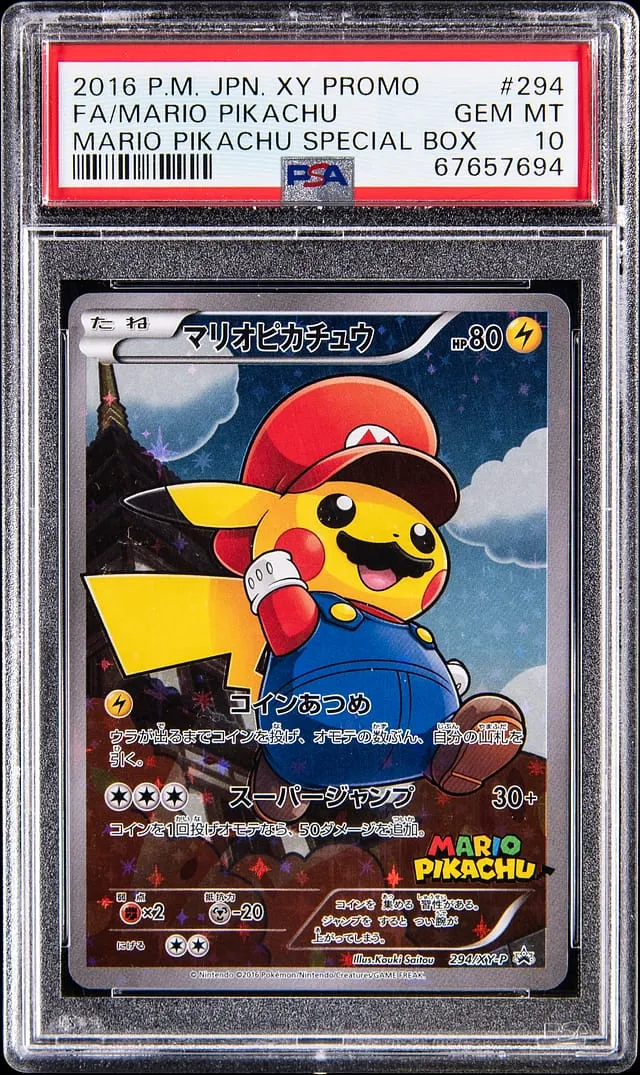
2016 Mario Pikachu PSA 10 Sells for $26.8K at Goldin
Goldin sold a 2016 Japanese XY Promo Mario Pikachu Full Art #294 PSA 10 for $26,840 on May 18, 2026. See what this means for Pokémon collectors.
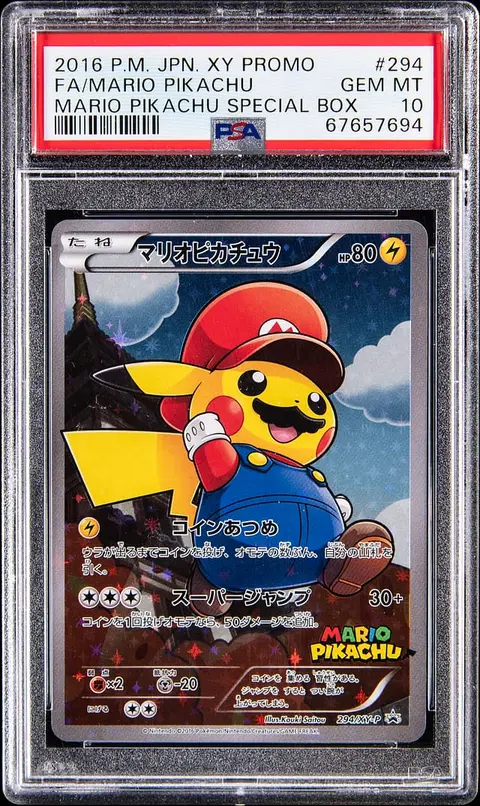
Sold Card
2016 Pokemon Japanese XY Promo Mario Pikachu Special Box Full Art #294 Mario Pikachu - PSA GEM MT 10
Sale Price
Platform
Goldin2016 Mario Pikachu PSA 10 Sells for $26,840 at Goldin
On May 18, 2026, Goldin sold a 2016 Pokémon Japanese XY Promo Mario Pikachu Special Box Full Art #294 Mario Pikachu, graded PSA GEM MT 10, for $26,840.
For a modern-era Pokémon promo, that is a serious result and a reminder of how strong demand remains for Nintendo crossover cards and character art–driven pieces.
The card at a glance
- Card: 2016 Pokémon Japanese XY Promo Mario Pikachu Special Box Full Art
- Card number: #294
- Character: Pikachu (Mario cosplay)
- Language/Region: Japanese
- Release: XY era, 2016
- Distribution: Special Box / promo release in Japan
- Grading company: PSA (Professional Sports Authenticator)
- Grade: GEM MT 10 (their highest standard grade)
- Attributes: Full art, Japanese exclusive promo, Nintendo crossover
- Rookie / key issue? Not a rookie card in the sports sense, but widely treated as a key modern promo in the Pokémon hobby.
The Mario Pikachu and Luigi Pikachu promos were released only in Japan through special boxes that quickly sold out. They combine two major Nintendo franchises—Pokémon and Super Mario—on one officially licensed card, which is a big reason collectors treat them as modern Pokémon “grails” (highly sought-after, centerpiece cards).
Why the 2016 Mario Pikachu promos matter
Nintendo crossover appeal
This card sits at the intersection of:
- Long-time Pokémon collectors
- Nintendo and Mario franchise fans
- Promo and illustration collectors who focus on unique artwork rather than game playability
Because it’s a full art promo with Pikachu literally dressed as Mario, the card feels more like a small piece of pop-culture art than a standard set card. That broader appeal has helped keep demand resilient even as other segments of the Pokémon market have cooled.
XY-era, not vintage—but not easily replaced
The XY era (2013–2016) is considered modern, not vintage, and it was printed during a time when Pokémon’s popularity was already strong. However, the Mario Pikachu and Luigi Pikachu promos were distributed in limited-run boxes sold in Japan. Those boxes contained multiple promo cards and memorabilia, and they weren’t reprinted.
Two key effects:
- Unopened supply is thin. It’s not like a main set booster box that can be reprinted or that was mass-distributed worldwide.
- Condition risk. Many copies were handled, stored in binders, or opened by non-graders long before grading became mainstream for these promos.
So while this is not a “low-print vintage card,” it does have a constrained and aging supply of clean, gradable copies, especially at the top grade.
Population and grading context
When collectors talk about “pop” or “pop report,” they mean the population report: how many copies of a card a grading company has encapsulated at each grade.
For the 2016 Japanese XY Promo Mario Pikachu Full Art #294:
- The total PSA population is meaningful but not massive compared with base Pikachu or modern Charizard cards.
- The PSA 10 population is relatively limited. It is not a one-of-one rarity, but there are far fewer PSA 10s than raw copies in binders or ungraded collections.
High grade matters more than usual here because:
- The card’s colored borders and full art design make whitening, edge wear, and print defects very visible.
- Many of the boxes were opened years ago, before modern penny-sleeve-and-toploader habits were standard for every promo.
That combination has pushed the PSA GEM MT 10 version into a separate price tier from 9s and raw copies.
Market context and recent sales
In the hobby, “comps” are comparable recent sales that help collectors understand current price ranges.
Recent public sales for the 2016 Mario Pikachu Full Art #294 (Japanese promo) show a few consistent patterns:
- PSA 10s typically command a strong premium over PSA 9 and raw copies.
- PSA 9s and BGS 9/9.5s have sold for noticeably less, often at a fraction of the 10 price depending on timing and venue.
- The strongest results tend to appear on well-known auction platforms when timing, marketing, and bidding line up.
The $26,840 result at Goldin on May 18, 2026, sits at the upper end of the recent range seen for this exact card and grade in public data. It is not an outlier in the sense of being ten times higher than anything before it, but it does land among the more aggressive outcomes for a Mario Pikachu PSA 10 in the current cycle.
This tells us a few things about the market right now:
- Top-grade copies remain thinly traded. When a fresh PSA 10 appears at a large auction house, it can attract focused competition.
- Collector conviction is still present. Bidders were willing to pay a premium for a clean, graded example rather than hunting raw copies and taking condition risk.
- Cross-collectible IP still plays well. Cards that connect franchises—like Pokémon and Mario—seem to maintain interest even when broader market enthusiasm fluctuates.
How this sale fits into the broader Pokémon market
In the last few years, we’ve seen a normalization in some parts of the Pokémon market:
- Certain modern chase cards have retraced from peak pandemic-era highs.
- Ultra-common cards in high grade are more closely tracking their actual scarcity.
Yet, within that quieter environment, some segments have stayed relatively firm:
- Key vintage: 1st Edition Base Set holos, Gold Stars, early EX-era hits.
- Character-defining modern cards: iconic Pikachu, Charizard, and illustrator-focused promos.
- Crossovers and special promos like Mario Pikachu that appeal beyond set builders.
This Mario Pikachu PSA 10 sale fits into that last category. Rather than representing speculative “heat” in random modern cards, it reflects continued demand for what many collectors see as an iconic promo from the XY era.
Factors collectors are watching
A few practical angles that collectors and small sellers might consider when looking at this sale as a data point:
1. Grade gaps
The value gap between PSA 10 and PSA 9 on this card is significant. That’s because:
- Visual imperfections stand out more on full-art promos.
- Collectors often treat 10s as long-term “keeper” cards for this kind of art-driven promo.
For anyone considering grading raw copies, this sale reinforces how much the top grade can matter.
2. Venue and timing
This card sold at Goldin on May 18, 2026 (UTC). Large auction houses can:
- Put cards in front of a wide bidder pool.
- Provide marketing and exposure that smaller marketplaces can’t always match.
That doesn’t mean every copy will achieve this result, but it does show how venue and presentation can influence final prices at the margin.
3. Cross-collectors
The Mario Pikachu promos often attract:
- Pokémon collectors who focus on Pikachu or promo history.
- Mario/Nintendo collectors who rarely buy trading cards but want a unique display piece.
That extra layer of demand—people entering from outside traditional Pokémon grading—helps support pricing on the best examples.
Takeaways for collectors and small sellers
Some grounded lessons from this sale:
- Iconic art and cross-brand IP matters. Cards that capture recognizable characters in a memorable way can have durable collector appeal.
- Condition and grading strategy are crucial. For mid-2010s promos, most surviving copies are not PSA 10; careful screening before submitting can make a large difference in outcome.
- Use multiple comps, not just one sale. This $26,840 result is a useful reference point, but it should be weighed alongside other recent PSA 10, PSA 9, and raw sales.
For many collectors, the 2016 Japanese Mario Pikachu Full Art #294 is less about chasing short-term upside and more about owning a flagship crossover piece from the XY era. The Goldin sale underlines how strongly that story still resonates in 2026.
As always, prices can move both ways. The healthiest approach is to treat sales like this as context, not guarantees, and to focus on cards you enjoy owning—especially when they feature a yellow mouse in blue overalls.