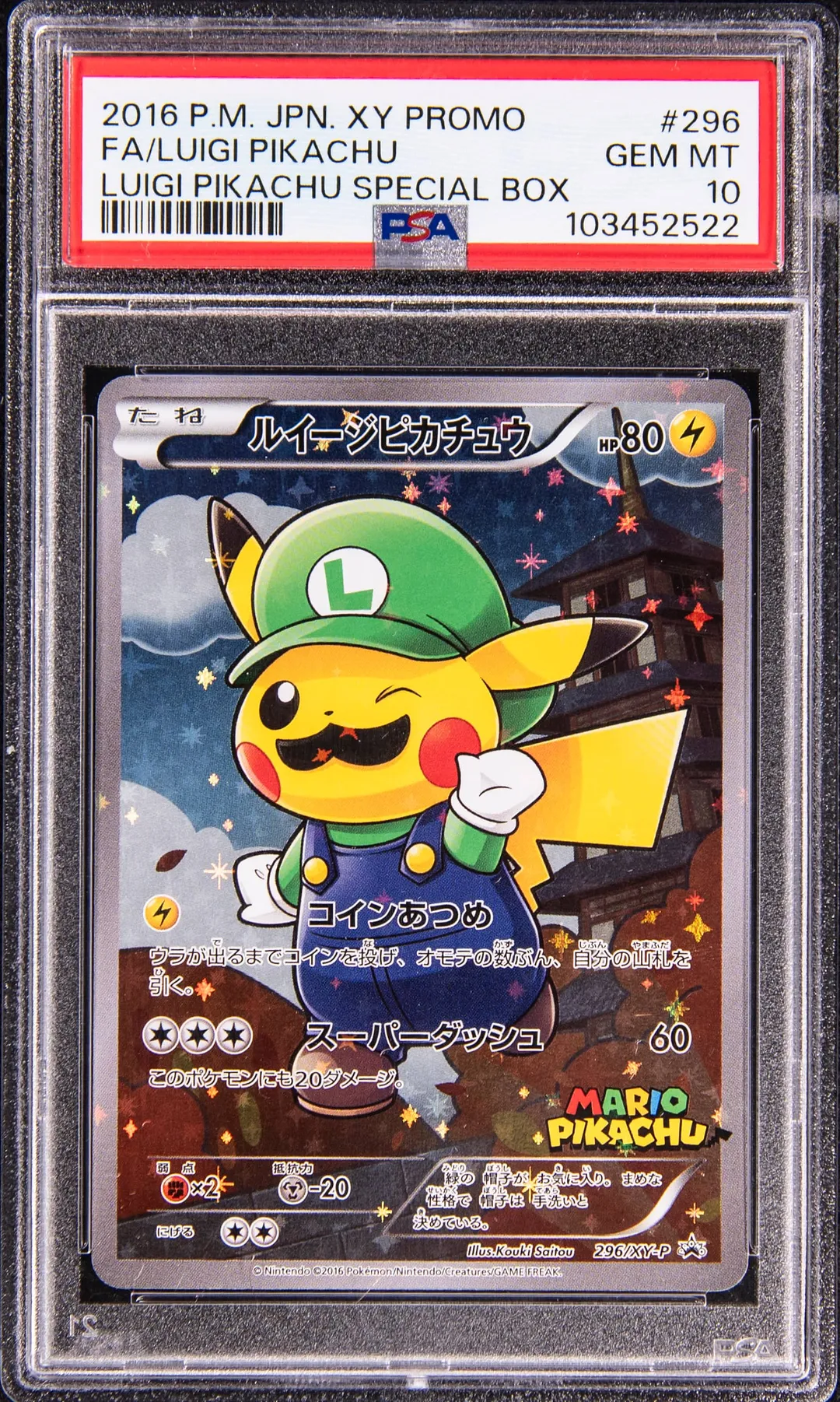
2016 Luigi Pikachu PSA 10 Sells for $12,400
Goldin sold a 2016 Japanese Luigi Pikachu XY promo PSA 10 for $12,400. See the market context, comps, and why this crossover card matters.
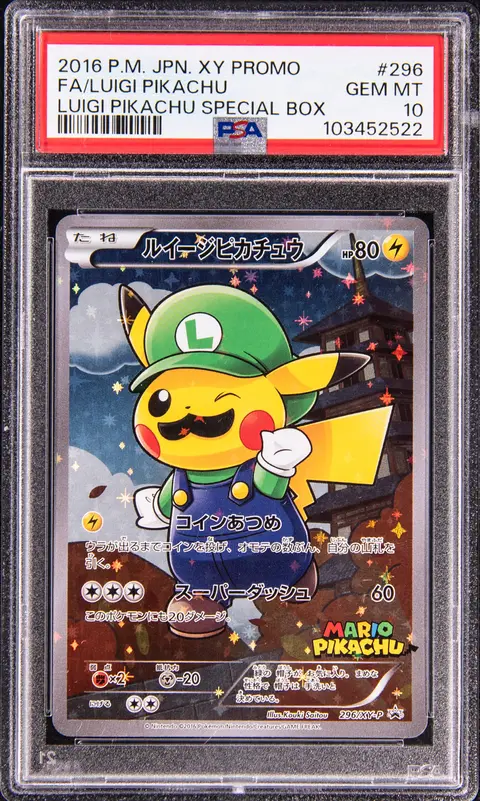
Sold Card
2016 Pokemon Japanese XY Promo Luigi Pikachu Special Box Full Art #296 Luigi Pikachu - PSA GEM MT 10
Sale Price
Platform
Goldin2016 Japanese Luigi Pikachu PSA 10 Sells for $12,400 at Goldin
On February 16, 2026, Goldin closed a notable sale for one of the most recognizable modern Pokémon promos: a 2016 Pokémon Japanese XY Promo Luigi Pikachu Special Box Full Art #296, graded PSA GEM MT 10, which realized $12,400.
For collectors who track character promos, crossover art, and pop-culture-driven cards, this Luigi Pikachu is a useful reference point for where the market currently sits.
The Card at a Glance
- Card: Luigi Pikachu (Full Art)
- Year: 2016
- Language/Region: Japanese
- Set/Issue: XY-P Promotional – "Luigi Pikachu Special Box"
- Card number: 296/XY-P
- Character: Pikachu dressed as Luigi (Super Mario Bros. crossover)
- Type: Full Art, Japanese promo
- Grading company: PSA
- Grade: GEM MT 10 (PSA’s highest standard grade)
- Key issue? Yes – part of the limited Super Mario Bros. crossover promotion
This is not a rookie card in the sports sense, but within Pokémon it functions as a key character promo: a recognizable, one-time crossover that combines two massive Nintendo franchises.
What Makes Luigi Pikachu #296 Special?
A Nintendo Crossover That Actually Matters
The Luigi Pikachu Special Box was part of The Pokémon Company’s 2016 collaboration with Nintendo’s Super Mario Bros. franchise. Pikachu appears in full Luigi cosplay on this card, with a matching Mario version in a parallel product. For many collectors, these cards sit at the intersection of:
- Pokémon nostalgia
- Mario/Super Nintendo nostalgia
- Japanese exclusive promos
Unlike standard set cards, these promos came from a specific product (the Luigi Pikachu Special Box) sold in limited quantities in Japan. Once the product disappeared from shelves, supply effectively became fixed, and sealed boxes and high-grade singles have been tightly held by collectors.
Ultra Modern, But Not Mass-Printed Like Base Sets
This card comes from the ultra modern era (roughly mid‑2010s onward), where print quality is generally higher but demand for certain promos far outstrips supply. The Luigi/Mario Pikachu promos are often mentioned alongside other premium Japanese promos when collectors talk about character-driven chase cards rather than competitive play staples.
PSA GEM MT 10: Why the Grade Matters
PSA grades on a 1–10 scale, with GEM MT 10 reserved for cards with virtually no visible flaws:
- Clean surfaces and edges
- Strong corners
- Centering within PSA’s top tolerance
For modern and ultra modern cards, many copies are submitted, but not all reach GEM 10. Japanese full-art promos can show print lines, edge wear from the original packaging, or centering issues, so pristine GEM 10 copies carry a meaningful premium over 9s and lower.
Market Context and Recent Sales
When collectors talk about “comps” (short for comparables), they mean the most recent, relevant sales of the same or very similar cards. These help frame whether a new auction result is high, low, or roughly in line with the current market.
For this Luigi Pikachu #296 PSA 10, recent public sales and auction data leading into 2025–2026 have generally shown:
- A clear premium for PSA 10 over PSA 9 and raw (ungraded) copies
- Strong, but somewhat range-bound, pricing compared with its Mario counterpart
- Occasional spikes when a top copy surfaces at a major auction house
At $12,400, this February 16, 2026 Goldin sale sits in the higher band of what’s been seen for this card in GEM MT 10, reflecting:
- The card’s established status as a marquee Nintendo crossover promo
- Solid demand from both Pokémon and broader Nintendo collectors
- The visibility of selling through a large auction platform rather than a quiet fixed‑price listing
Without overstating it, this sale reinforces the Luigi Pikachu PSA 10’s role as a premium, character-driven Pokémon promo, rather than indicating a sudden, speculative run‑up.
How This Compares to Related Cards
To understand this result in context, collectors often look at nearby cards:
- Mario Pikachu Full Art (companion promo): Shares similar art style and release context. Depending on art preference and pop (population) figures, Mario Pikachu can trade in a comparable or slightly higher band, but the two are often discussed together.
- PSA 9 Luigi Pikachu: Typically sells at a noticeable discount to PSA 10. The GEM 10 premium reflects how tightly held the best copies are.
- Other Japanese character promos (e.g., Poncho Pikachus, Gyarados/Charizard promos): These provide a benchmark for how character, artwork, and limited distribution can anchor long‑term collector demand.
The exact population ("pop report") – PSA’s count of how many copies exist at each grade – changes over time as more cards are submitted. Generally, a more limited pop in PSA 10 helps support stronger prices relative to more common ultra modern chase cards.
Why Collectors Care About This Card
Several themes drive interest in the Luigi Pikachu Full Art:
Cross-Franchise Nostalgia
It merges two of the most recognizable video game brands: Pokémon and Super Mario Bros. For collectors who grew up with both, the artwork tells a story beyond competitive play or set completion.Japanese Promo Appeal
Japanese promos have a long history of being more experimental, quirky, or art-driven than many standard releases. This card fits that pattern and feels distinctly “Japanese” in its presentation and product origin.Distinctive Full Art Design
The full-art treatment, featuring Pikachu in full Luigi outfit across the entire card, gives it clear display value. It’s instantly recognizable from a distance, which can matter for both PC (personal collection) displays and social sharing.Established Track Record
This is not a brand-new hype card. It has multiple years of sales and graded population history behind it, which helps collectors benchmark demand over time instead of relying on a single hot month.
What This Goldin Sale Suggests (Without Overpromising)
The $12,400 PSA 10 sale at Goldin on February 16, 2026 doesn’t rewrite the Luigi Pikachu market on its own, but it does:
- Confirm that high-end buyers still prioritize key Japanese promos from the XY era
- Show that strong copies consigned to major auction houses can find competitive bidding
- Provide an updated comp that both buyers and sellers can refer back to in the near term
For collectors and small sellers, this can be useful in several ways:
- For owners of PSA 10 copies: This result helps anchor expectations for future auction or private sale discussions.
- For owners of PSA 9 or raw copies: It highlights the gap that can exist between near-mint and true gem copies, especially for in-demand promos.
- For buyers watching the market: It’s a reminder that timing, venue (auction house vs. peer‑to‑peer marketplace), and eye appeal all matter when interpreting a single realized price.
Practical Takeaways for Collectors
If you’re considering this card or similar promos:
Check multiple comps, not just one sale.
Look at a mix of auction results and fixed-price sales where possible, and pay attention to grade, grading company, and visual centering.Review the pop report.
On PSA’s site, you can see how many Luigi Pikachu #296 cards exist in each grade. A concentrated pop in PSA 9 or lower can help explain why PSA 10s achieve a strong premium.Evaluate the copy in front of you.
Even within PSA 10s, eye appeal can vary. Centering, print lines, and minor chipping (especially on full arts) can make one GEM 10 more desirable than another.Separate long-term appeal from short-term moves.
Character promos with multi-franchise nostalgia often have staying power, but individual sale prices can fluctuate with auction timing, availability, and collector attention.
Final Thoughts
The February 16, 2026 Goldin sale of the 2016 Pokémon Japanese XY Promo Luigi Pikachu Special Box Full Art #296 in PSA GEM MT 10 at $12,400 is another data point confirming the card’s place among the more respected ultra modern Japanese promos.
For those building a Pokémon or Nintendo-focused collection, it remains a centerpiece-level card. For market watchers, it’s a clean, high-visibility comp that helps frame conversations about character promos, Japanese exclusives, and where nostalgia-driven cards sit in today’s hobby landscape.