2015 No. 4 Trainer Pikachu Trophy CGC 8.5 Sale
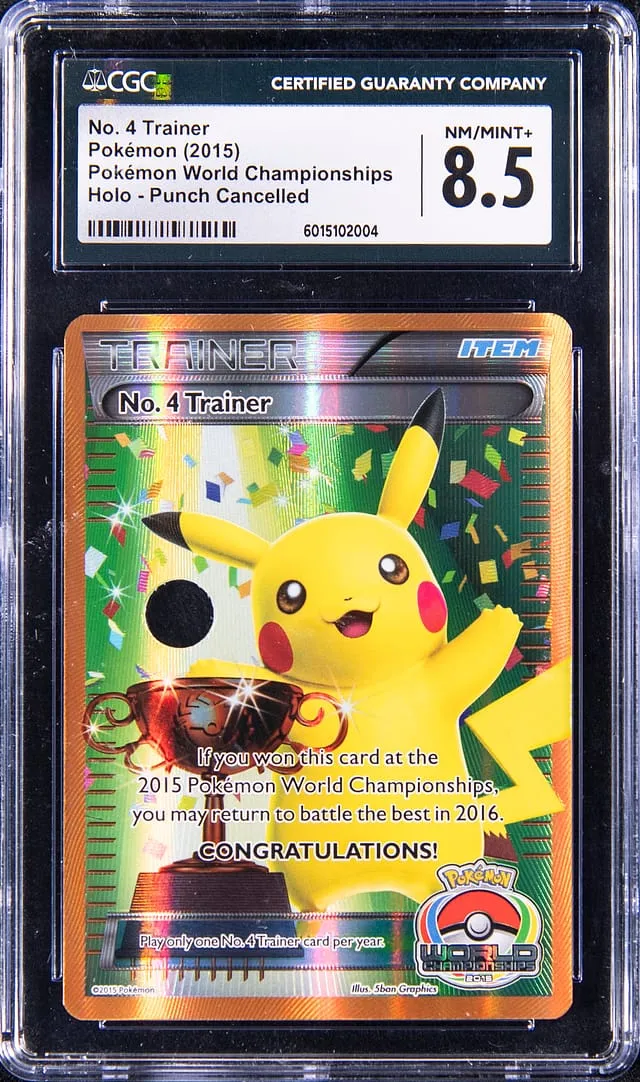
A CGC 8.5 2015 No. 4 Trainer Pikachu trophy card sold for $12,207 at Goldin. We break down the card’s rarity, punch cancel, and price context.
Sold Card
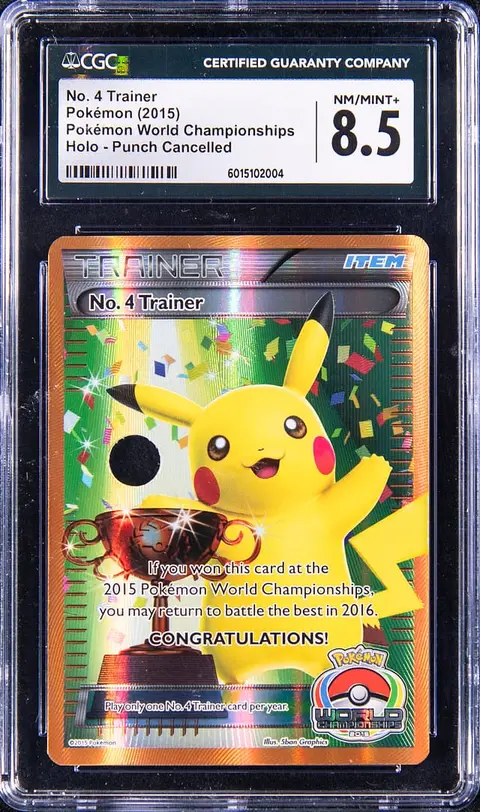
2015 Pokemon World Championships No. 4 Trainer Pikachu Trophy Card, Punch Cancelled - CGC NM-MT+ 8.5 - Pop 3
Sale Price
Platform
Goldin2015 Pokémon No. 4 Trainer Pikachu Trophy Card Sells for $12,207 at Goldin
On May 11, 2026, a 2015 Pokémon World Championships No. 4 Trainer Pikachu Trophy Card, graded CGC NM-MT+ 8.5 and noted as “punch cancelled,” sold at Goldin for $12,207. For a niche but highly respected lane of the hobby—Worlds-era Pokémon trophy cards—this is a useful data point for how mid-grade examples are currently being valued.
In this breakdown, we’ll look at what this card actually is, why collectors care, and how this sale fits into recent price context.
What exactly is this card?
Card: 2015 Pokémon World Championships No. 4 Trainer Pikachu Trophy Card
Character: Pikachu
Event: 2015 Pokémon TCG World Championships
Position: No. 4 Trainer (4th place finish)
Type: Trophy / Prize card (not pack-issued)
Era: Ultra-modern (2010s trophy card)
Grading details
- Grading company: CGC (Certified Guaranty Company)
- Grade: NM-MT+ 8.5 (Near Mint–Mint Plus)
- Special note: “Punch cancelled” – the card has a hole-punch as an official cancellation mark from The Pokémon Company / tournament organizers, indicating it has served its prize function and is no longer an active, transferable prize.
This card is not a standard set release and has no pack odds. It was awarded at the 2015 Pokémon World Championships to competitors placing 4th in their division. That makes it a non-rookie, key-issue trophy card tied to a specific World Championship year.
Why the 2015 No. 4 Trainer Pikachu trophy matters
1. Trophy cards: the top of the Pokémon rarity pyramid
Trophy cards are prize cards given to top finishers at major official tournaments—especially the World Championships. They are among the scarcest Pokémon cards because:
- They were never sold in packs or boxes.
- They were only awarded to a very small pool of players.
- Some stayed in player collections, were lost, or never made it into grading holders.
Compared with even rare pack-inserted cards, Worlds trophies are in a different category of scarcity entirely. For many collectors, these cards represent the “high art” end of Pokémon: history, competition, and rarity all in one.
2. 2015 Worlds and the Pikachu trophy line
The 2015 World Championships continued the long-running tradition of Pikachu-themed trophy cards. While earlier trophy Pikachu cards (particularly 1990s and early 2000s examples) tend to be the headline-makers, the modern World Championship Pikachu trophies are still:
- Extremely limited in print relative to anything pack-issued.
- Tightly connected to actual competitive achievements.
- A focused collecting lane for people who chase World Championships history year-by-year.
The “No. 4 Trainer” position card marks a 4th-place finish in one of the World Championship divisions. It sits just behind the better-known No. 1, 2, and 3 Trainer trophies, but remains part of the same elite prize card family.
Population and grade context
The listing notes this card as CGC NM-MT+ 8.5 – Pop 3, meaning:
- Pop report (population report): A grading company’s count of how many copies of a specific card they’ve graded at each grade level.
- Pop 3: Only three examples in CGC’s census at 8.5.
For a Worlds trophy card, even a small pop number like this has to be read in context:
- The total number of copies printed/awarded is already tiny.
- Not every card ends up graded, and some may be in other grading company slabs (PSA, BGS, etc.).
- For many trophy issues, the combined graded population across all companies still remains low in absolute terms.
Because these cards were often handled as actual tournament prizes—not immediately sleeved as investments—surface and edge wear are common. That means high grades can be particularly challenging, but even mid-to-high grades like CGC 8.5 can represent some of the better-conditioned copies in existence.
What does “punch cancelled” mean?
The “punch cancelled” notation is important for understanding both history and value.
In some official Pokémon Organized Play processes, prize cards were hole-punched to indicate they had been redeemed or were no longer valid as active prize items. This is similar to how tickets or certificates can be physically cancelled.
For collectors, this creates two parallel lanes:
- Non-cancelled copies (no punch) – often viewed as cleaner, closer to an unaltered state.
- Punch-cancelled copies – carry a very visible physical mark but can also be seen as more directly tied to tournament procedure and history.
Whether a punch-cancelled card is preferred or discounted depends strongly on individual collector preferences. Some see it as “damage”; others see it as a legitimate, official part of the card’s story.
Market check: how does $12,207 fit in?
The Goldin hammer at $12,207 places this CGC 8.5 example in an interesting range for modern trophy cards.
Because this is a specialized card with very low supply and infrequent public auctions, you typically won’t find a smooth curve of recent sales. Instead, pricing tends to be built from:
- Occasional auction results at major houses (Goldin, Heritage, PWCC, etc.).
- Private sales and brokered deals that don’t always become public comps.
- Cross-card comparisons to nearby positions (No. 1–3 Trainer) and nearby years.
In this kind of ultra-low-pop segment:
- “Comps” (comparable sales) are sparse and may be months or years apart.
- Single results can be influenced by who showed up to bid, not only by broader market sentiment.
Within that context, a five-figure result for a mid-to-high grade, punch-cancelled No. 4 Trainer aligns with how modern World Championship trophies have generally been treated: not at the extreme peaks of 1990s Japanese trophy grails, but still firmly in the serious high-end collector territory.
If you compare across the broader category:
- Earlier-era Pikachu trophies and higher-placing positions (No. 1 / No. 2) have historically commanded significantly stronger prices, especially in top PSA or BGS grades.
- Modern-era No. 4 and similar positions tend to sit a tier or two lower, but still reflect the rarity and prestige of being a true Worlds prize.
Because different grading companies, punch vs. non-punch status, and small grade differences can meaningfully impact what a collector is willing to pay, it’s more accurate to treat $12,207 as one data point in a narrow, thinly traded lane rather than a firm “market value.”
What collectors can take away from this sale
For collectors, returning hobbyists, and small sellers, this Goldin result offers a few practical takeaways:
Trophy cards occupy a different market structure.
Pricing isn’t anchored by a big supply of recent eBay sales. Instead, it’s driven by a small group of informed buyers, slow-moving supply, and occasional auction appearances.Grade and status both matter.
- CGC 8.5 places this example in a respectable condition tier for a card that started its life as a tournament prize.
- The punch-cancelled status makes it different from intact copies and should always be clearly disclosed and understood.
World Championships history still commands attention.
Even in a more mature, data-aware hobby environment, genuine Worlds trophy cards remain objects of long-term interest—whether held as centerpieces in a binder or as part of a graded collection.Context is key for pricing.
Any attempt to value another 2015 No. 4 Trainer Pikachu (in a different grade, or from a different grading company, or non-punched) should treat this Goldin sale as one reference point among several, not a universal benchmark.
How this fits into the broader Pokémon market
The wider Pokémon market in recent years has shifted from the rapid, speculative spikes of 2020–2021 toward a more measured, research-driven environment. Within that setting:
- Core demand has remained strong for historically important items: early WOTC-era cards, iconic promos, and meaningful trophies.
- Ultra-rare, event-tied pieces like Worlds trophies are generally less affected by short-term hype cycles than mass-printed set cards.
The 2015 No. 4 Trainer Pikachu trophy sits squarely in that “specialist” category. It’s not a broad-audience card like a Base Set Charizard, but among collectors who track Worlds history year-by-year, it’s a recognizable target.
Final thoughts for collectors and small sellers
If you’re considering entering the trophy lane—or deciding what to do with a piece you already own—this sale highlights a few principles:
- Document everything. Provenance, event details, punch status, and clear photos matter more in this niche than in most others.
- Use multiple data points. One auction can be helpful, but looking at similar positions, years, and grading outcomes will give a more complete picture.
- Know your audience. Cards like this are best understood—and often best realized in value—when offered where serious Pokémon trophy collectors are actively watching, such as established auction houses or trusted consignment platforms.
For now, the $12,207 Goldin result on May 11, 2026, stands as a clean, public benchmark for a CGC 8.5, punch-cancelled copy of the 2015 Pokémon World Championships No. 4 Trainer Pikachu trophy card—another data point in the slowly written price history of modern Worlds prizes.