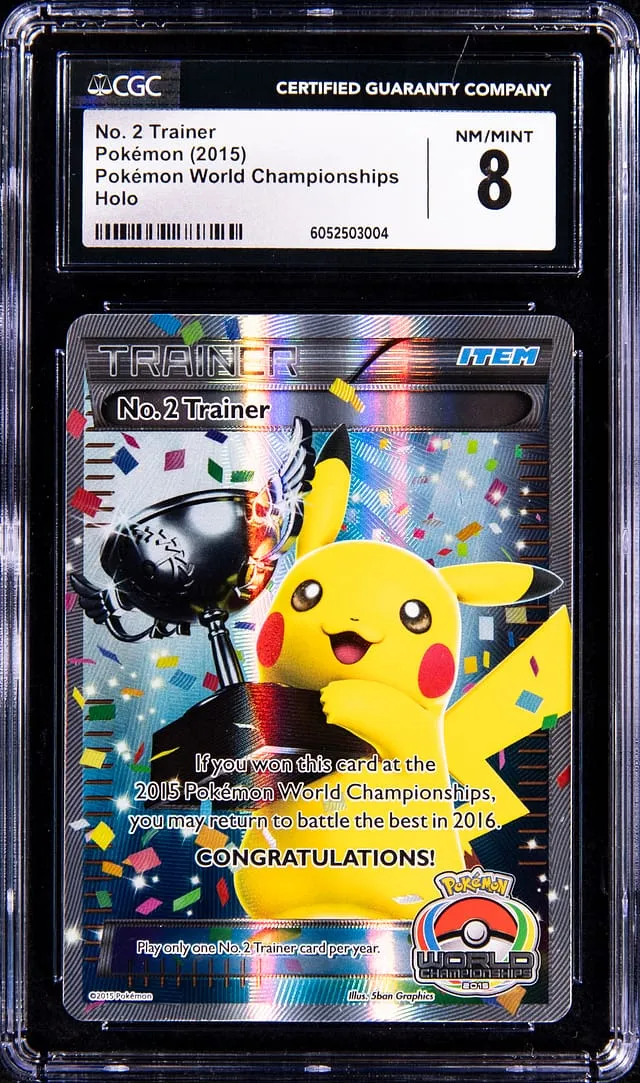
2015 No. 2 Trainer Pikachu Trophy CGC 8 Sells for $32k
Goldin sold a 2015 Pokémon No. 2 Trainer Pikachu Trophy Card CGC 8 for $32,874 on Feb 16, 2026. Here’s what the sale means for collectors.
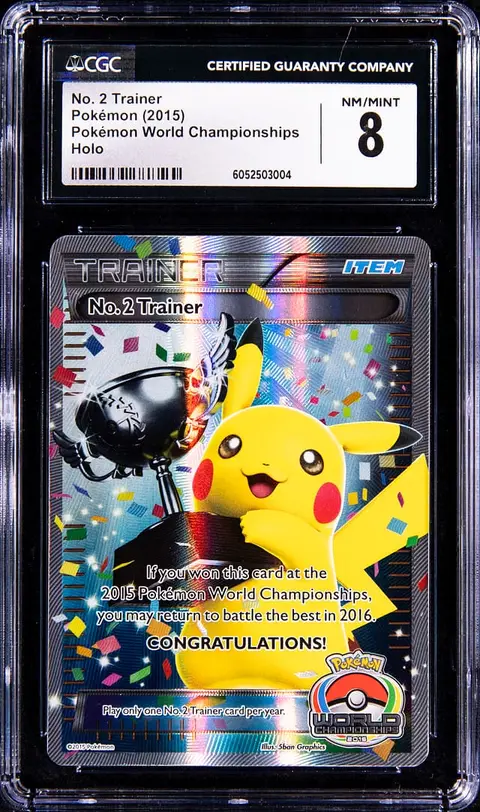
Sold Card
2015 Pokemon World Championships Holo No. 2 Trainer Pikachu Trophy Card - CGC NM-MT 8
Sale Price
Platform
Goldin2015 Pokémon World Championships Holo No. 2 Trainer Pikachu Trophy Card (CGC 8) Sells for $32,874
On February 16, 2026, Goldin closed a notable Pokémon TCG sale: a 2015 Pokémon World Championships Holo No. 2 Trainer Pikachu Trophy Card graded CGC NM-MT 8 realized $32,874.
For a niche, ultra-high-end segment of the hobby, this is an important data point. Below, we’ll walk through what this card is, why it matters to collectors, and how this sale fits into recent market context.
What exactly is this card?
Card details
- Character: Pikachu (illustrated in a World Championships trophy design)
- Year: 2015
- Event: Pokémon World Championships
- Card type: No. 2 Trainer Trophy Card (Holo)
- Category: Prize card / trophy card, not a standard set release
- Parallel / variant: World Championship trophy variant (extremely limited prize card)
- Rookie / key issue: Not a rookie, but a key “trophy Pikachu” issue from the mid‑2010s era
- Era: Ultra‑modern (2010s+)
- Grade: CGC NM-MT 8
- Grading company: CGC Trading Cards
This is not a pull-from-a-pack card. The various “No. 1 / No. 2 / No. 3 Trainer” cards are awarded to top finishers at the official Pokémon World Championships. They are effectively trophy cards—ultra-limited prize items with distribution tied to high tournament placement, not retail packs.
The 2015 World Championships trophy Pikachu cards continue a lineage that dates back to the original Japanese Trophy Pikachu cards of the late 1990s. While the artwork and language differ across years and regions, the through-line is the same: performance at the world’s premier Pokémon tournament earns you a card that most collectors will never see in person.
Why collectors care about trophy Pikachu cards
From a collector’s point of view, this card sits at the intersection of three important themes:
Tournament history – Trophy cards document who succeeded at the highest level of organized play in a given year. They are physical mementos of competitive history, much like championship rings in sports.
Extremely low print runs – Exact print quantities aren’t always published, but these awards are typically given only to a small number of finishers across age divisions at a single event. That combination of low production and limited distribution makes them fundamentally different from normal chase cards in booster boxes.
Pikachu iconography – Pikachu is the face of the Pokémon brand. Trophy Pikachu cards blend a top-tier character with elite competitive provenance, which keeps long-term interest strong among high-end collectors.
For newer or returning collectors, it helps to think of trophy Pikachu cards as the Pokémon equivalent of championship memorabilia rather than ordinary set cards. They tend to sit in long-term collections and show up for sale only occasionally.
Understanding the CGC NM-MT 8 grade
CGC’s NM-MT 8 (Near Mint–Mint) grade typically indicates a clean, presentable card with minor wear—maybe a small corner touch, slight edge chipping, or a faint surface flaw that keeps it out of the 9+ range.
With ultra-limited cards like this, the grade distribution can be unusual:
- Some copies stay raw (ungraded) because they are in collections of former players who are not active in the grading space.
- Others may have handling wear from being personally awarded and stored casually before grading was considered.
In segments like trophy cards, a CGC 8 can still be quite desirable, especially when the total graded population—what collectors call the “pop report,” or population report—is small.
Market context: how does $32,874 fit in?
The hammer plus buyer’s premium on Goldin’s February 16, 2026 sale came to $32,874. To understand whether that is typical, low, or high, it’s useful to look at comps—short for comparables, meaning recent sales of the same card or close variants.
Based on available public information on past trophy Pikachu and World Championships No. 1 / No. 2 / No. 3 Trainer sales across major auction houses and marketplaces:
- Exact-card comps are limited. These cards do not transact frequently, especially in the same year, same placement (No. 2), and same grade.
- Related sales of other modern-era World Championship trophy cards (various years and positions) often show a pattern where:
- Higher placements (No. 1) tend to command a noticeable premium over No. 2 and No. 3.
- Higher grades (9s and 9.5s, and especially 10s) can push prices significantly higher because of the already tiny supply.
- Historical top-end trophy Pikachu sales from earlier eras (notably late 1990s Japanese trophy cards) have reached far higher levels, reflecting both their age and their near-mythic status among Pokémon collectors.
Within that framework, $32,874 for a 2015 World Championships No. 2 Trainer Pikachu in CGC 8:
- Sits in what can reasonably be described as a strong, high-end range for an ultra-modern trophy card.
- Reflects the typical premium that collectors place on:
- Named World Championship provenance.
- Pikachu trophy artwork.
- The difficulty of finding any copy available at auction, let alone in a graded slab.
Because public sales for this precise card are sparse, it’s more accurate to treat this result as one of a small handful of reference points rather than a stable market “average.” Future sales may trend above or below this depending on grade, auction venue, timing, and how motivated specific buyers are.
How scarcity and grading shape the market here
Unlike mass-released booster set cards, World Championships trophy cards involve multiple scarcity layers:
- Print scarcity – Only a limited number are produced for winners.
- Distribution channel – Awarded in-person to players at a single World Championships event.
- Collector behavior – Many recipients either:
- Keep them as personal mementos, or
- Sell to a small circle of high-end collectors rather than listing on open marketplaces.
Grading adds another layer. Even if, for example, a dozen copies exist, not all will be graded, and not all graded copies will achieve high marks. That’s why pop reports for trophy cards can look deceptively low compared to actual “in the wild” counts.
For buyers and sellers, this means:
- Prices are more dependent on who shows up on a particular auction night than on a thick, liquid market with many bidders and constant comps.
- Each public auction—like this February 16, 2026 Goldin sale—becomes an important reference point for future negotiations.
Where this card sits in the broader Pokémon market
In the broader Pokémon landscape, the 2015 No. 2 Trainer Pikachu Trophy Card occupies a niche but influential role:
- It is not a mainstream chase like a Charizard from a flagship expansion.
- It is a marker of how the high-end Pokémon segment values:
- Event-linked cards.
- Pikachu-focused artwork.
- The “story” attached to a specific year’s World Championships.
While the wider Pokémon market experiences cycles—new sets, nostalgia waves, media releases—trophy cards tend to move on a slower, collector-driven timeline. Buyers here are often:
- Long-term Pokémon enthusiasts,
- Competitive players turned collectors,
- Or specialized high-end hobbyists who focus on rarity and provenance over short-term pricing swings.
Takeaways for collectors and small sellers
If you’re newer to this side of the hobby, here are a few practical observations drawn from this sale:
Trophy cards are a different lane. Their price behavior doesn’t always track standard set cards. Thin supply and niche demand can result in large jumps between individual auction results.
Comps are guides, not rules. With so few transactions, any one sale—like this $32,874 CGC 8 at Goldin—should be treated as a data point, not a binding benchmark.
Provenance matters. Auction houses that specialize in high-end collectibles, such as Goldin, often attract the kinds of bidders who actively seek out trophy pieces. That can influence realized prices for cards at this level.
Condition is still important, but availability comes first. In ultra-limited segments, many collectors will compromise on grade (e.g., an 8 instead of a 9) simply because a card surfaces so rarely.
Final thoughts
The February 16, 2026 Goldin sale of the 2015 Pokémon World Championships Holo No. 2 Trainer Pikachu Trophy Card, CGC NM-MT 8, for $32,874 underscores how selective and event-driven the market for trophy Pokémon remains.
For most collectors, this card will be something admired from afar rather than targeted directly. But tracking these results helps build a clearer picture of how the top of the Pokémon market values rarity, story, and history—insights that can inform how you think about your own collection, even if you never bid on a trophy Pikachu yourself.