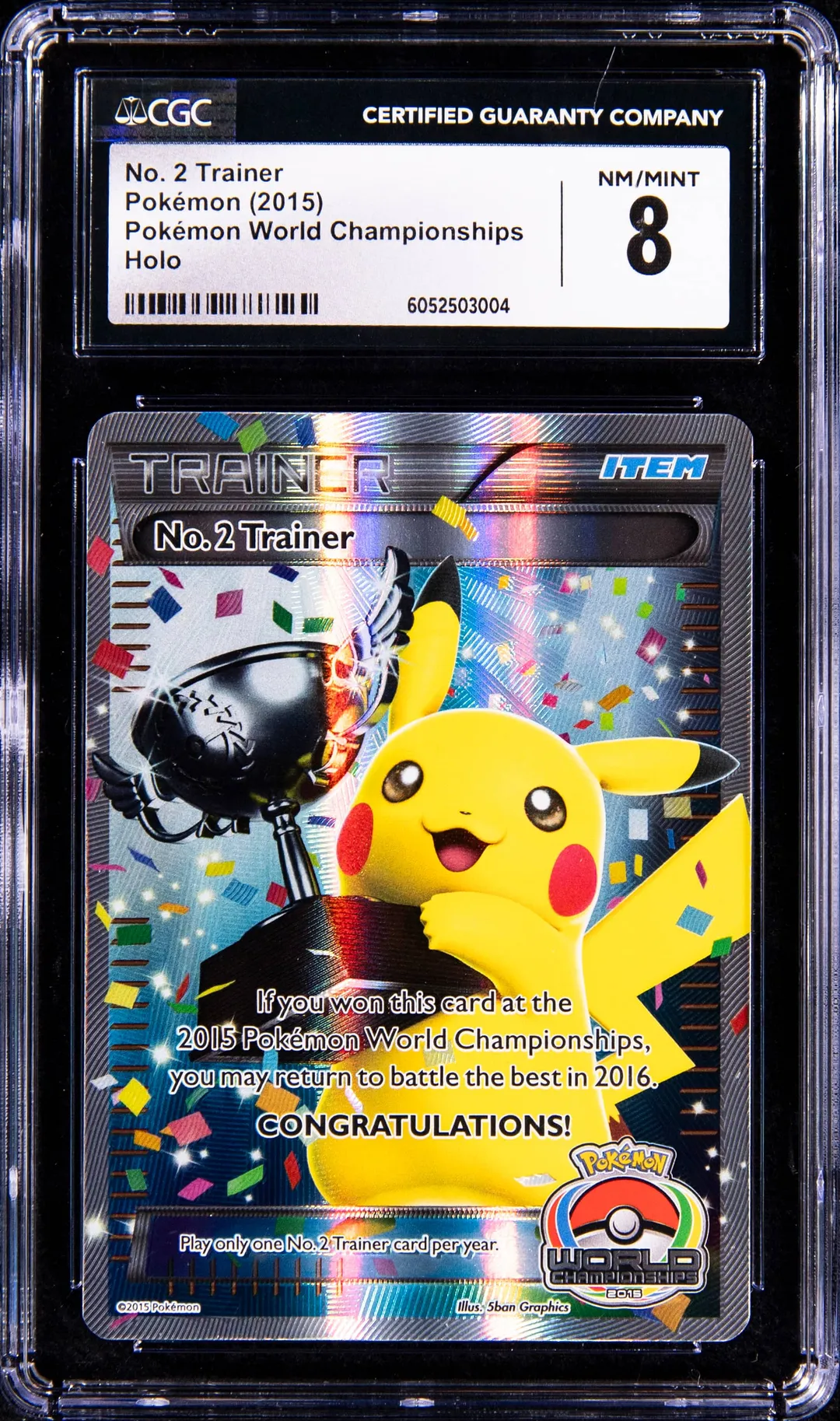
2015 No. 2 Trainer Pikachu Trophy CGC 8 Sells at Goldin
A 2015 Pokémon World Championships No. 2 Trainer Pikachu Trophy Card CGC 8 sold for $32,874 at Goldin on Feb 16, 2026. Here’s the market context.
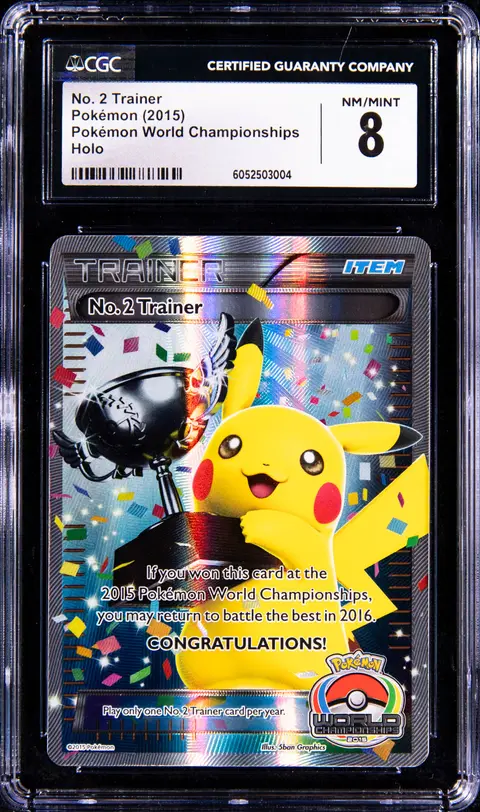
Sold Card
2015 Pokemon World Championships Holo No. 2 Trainer Pikachu Trophy Card - CGC NM-MT 8
Sale Price
Platform
Goldin2015 Pokemon World Championships Holo No. 2 Trainer Pikachu Trophy Card - CGC 8 Sells for $32,874
On February 16, 2026, Goldin closed a notable sale for one of the hobby’s more elusive modern trophy cards: a 2015 Pokémon World Championships Holo No. 2 Trainer Pikachu Trophy Card, graded CGC NM-MT 8, realized at $32,874.
For collectors who follow high-end Pokémon, this type of sale is less about chasing a quick headline and more about understanding how rare, event-awarded cards are being valued compared to standard pack-issued cards.
Card Breakdown: What Exactly Sold?
Let’s start by identifying the card clearly:
- Game/TCG: Pokémon
- Year: 2015
- Event/Set: Pokémon World Championships (trophy/prize card, not a regular booster set)
- Card Type: Holo No. 2 Trainer Pikachu Trophy Card
- Character: Pikachu (special event artwork, traditionally featuring Pikachu as a champion or trophy mascot)
- Role: “No. 2 Trainer” – typically awarded to 2nd place finishers in a specific division at the World Championships
- Rarity: Extremely limited, event-awarded trophy card (not sold in packs)
- Grading Company: CGC (Certified Guaranty Company)
- Grade: NM-MT 8 (Near Mint–Mint)
Trophy cards like this are fundamentally different from most chase cards in booster boxes. They are awarded to a handful of top finishers at the Pokémon World Championships, meaning the print run is very low and tracking exact population numbers can be tricky. They are key issues within the niche of competitive Pokémon collecting.
Why the 2015 No. 2 Trainer Pikachu Matters
This card sits at the intersection of three important collecting themes:
Worlds Trophy Lineage
Since the late 1990s, Pokémon has awarded trophy cards to high-placing competitors at its major tournaments. These cards are often viewed as the pinnacle of competitive achievement collectibles. The 2015 No. 2 Trainer Pikachu continues that tradition.Pikachu as a Trophy Icon
Pikachu trophy cards are historically some of the most chased items in the hobby. While early Japanese trophy Pikachu cards are better known, modern Worlds-era Pikachu trophies build on that same appeal: iconic character plus extremely low distribution.Ultra-Modern Trophy Era
The 2015 card belongs to the ultra-modern era, where print quality and grading standards are high, but release quantities for these trophies remain tiny. Unlike mass-produced chase cards, their scarcity is based on invite-only competition, not pack odds.
Market Context: How Does $32,874 Fit In?
This sale at $32,874 (Goldin, February 16, 2026) fits into a broader pattern: serious but measured pricing for ultra-rare Pokémon trophies.
Because population is so low, exact comparisons (“comps”)—which are recent, comparable sales collectors use for price context—are often sparse. For this specific 2015 No. 2 Trainer Pikachu CGC 8, public auction records are limited, and many transactions may occur privately.
However, we can still frame this sale using three angles:
1. Cross-Grade and Cross-Year Comparisons
When direct comps are scarce, collectors often look at:
- The same card in different grades (e.g., 8.5, 9, or 9.5) across CGC, PSA, and BGS.
- Similar placement cards (No. 1, No. 2, No. 3 Trainer) from nearby World Championship years.
Historically, Worlds-era Pikachu trophy cards in strong grades (8–9.5 range) have:
- Sold in the mid five-figures for mid- to high-end examples.
- Reached higher levels for top grades or especially iconic years.
Within that general framework, a CGC 8 at $32,874 slots in as a serious but not record-breaking result. It’s consistent with the idea that:
- Grade 8 captures clear value as a high-end, presentable copy.
- Top-tier gem copies, when they appear, are expected to command meaningful premiums over an 8.
2. Trophy vs. Pack-Issued Chase Cards
Compared to widely known chase cards from booster sets—like Charizard variants or high-rarity alternate arts—trophy cards have a different pricing logic:
- Supply: Trophy cards often have single- or low-double-digit copies awarded, versus thousands of pack-pulled chase cards.
- Demand: Demand is narrower but very focused—often competitive players, long-term Pokémon historians, and high-end collectors.
The $32,874 result underscores that the market continues to assign a premium to event-awarded scarcity relative to even very tough pack hits.
3. CGC Grading and Grade 8 Positioning
CGC has earned a reputation for stricter surface and centering standards in Pokémon grading. For a CGC NM-MT 8:
- You’re typically looking at a card with strong eye appeal, but with one or more noticeable flaws under close inspection.
- In the context of a low-population trophy, many collectors prioritize owning any graded example over hunting for the absolute top grade, especially when total known supply is small.
This can compress the price gap between mid-high grades (8–9) relative to what we see in mass-produced, heavily graded modern sets.
Collector Significance
A few reasons this result matters for active hobbyists and small sellers tracking the upper tiers of the Pokémon market:
Confirmation of Ongoing Trophy Demand
Even as broader market cycles fluctuate, Worlds Pikachu trophies continue to command meaningful prices. That doesn’t mean prices will always go up—it simply shows that this niche retains engaged bidders.Data Point for Ultra-Rare Non-Booster Cards
For collectors trying to understand how to compare trophy cards, staff promos, and other non-pack-issued rarities, this sale provides a reference for what the market is willing to pay for a modern Worlds trophy in a mid-high grade.Insight into CGC in the High-End Space
A strong five-figure result in a CGC 8 slab reinforces that collectors are willing to pay up for CGC-graded Pokémon when the card itself is truly scarce and important.
How This Helps Different Types of Collectors
For New or Returning Collectors
If you’re newer to the hobby, this sale highlights a key concept:
- Not all rare cards come from packs.
Some of the most coveted Pokémon cards were never sold at retail. They were awarded, often in tiny numbers, at official events.
Understanding this helps you:
- Read auction listings more confidently.
- Recognize why some relatively simple-looking cards sell for far more than intricate modern chase cards.
For Active Hobbyists
If you’re already familiar with grading and auction cycles, this sale gives you:
- Another anchor point for pricing modern Worlds trophies in general.
- A reminder that trophy liquidity is thin; a single result should be seen as one data point among many, not a definitive price guide.
When evaluating a trophy card, many collectors look at:
- Event significance (Worlds vs. smaller events)
- Character (Pikachu and key legendaries tend to draw more attention)
- Placement tier (No. 1 vs. No. 2 vs. No. 3)
- Condition and grading company
For Small Sellers
Most small sellers won’t handle a Worlds Pikachu trophy regularly, but this sale is still useful:
- It shows that documentation and provenance (clear event identification, year, placement) matter a lot for non-pack-issued cards.
- It emphasizes the importance of strong photography and accurate descriptions when listing rare promos or staff cards that may be unfamiliar to some buyers.
Final Thoughts
The $32,874 sale of the 2015 Pokémon World Championships Holo No. 2 Trainer Pikachu Trophy Card in CGC NM-MT 8 at Goldin on February 16, 2026, is another measured, data-rich signal from the upper end of the Pokémon market.
Rather than a runaway outlier, it reads as a solid, context-consistent result for a genuinely rare, event-awarded Pikachu trophy in a strong, but not gem, grade.
For collectors who care about the long story of Pokémon—competitive play, Worlds history, and trophy lineage—this card is a reminder that the most important pieces of the game’s history were sometimes handed across a stage, not pulled from a pack.
As always, this is a snapshot of one sale, not a prediction. It’s best used as one reference point among many when you’re studying the high-end side of the hobby.