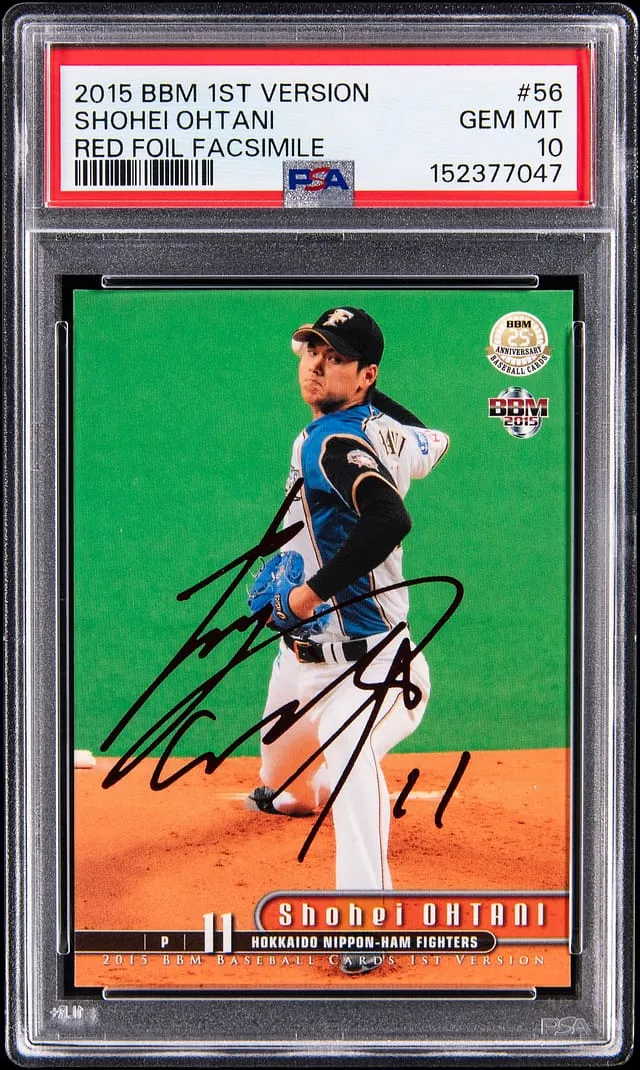
2015 BBM Red Foil Shohei Ohtani Rookie Sells for $15.8K
Goldin sold a 2015 BBM 1st Version Red Foil /25 Shohei Ohtani rookie PSA 10 for $15,860. Learn the card’s context, scarcity, and what this sale suggests.
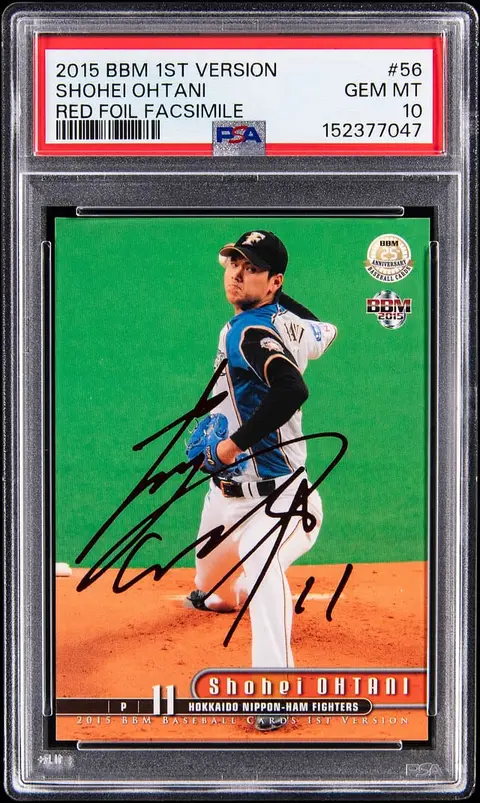
Sold Card
2015 BBM 1st Version Red Foil Facsimile #56 Shohei Ohtani Rookie Card (#05/25) - PSA GEM MT 10 - Pop 5
Sale Price
Platform
Goldin2015 BBM 1st Version Red Foil Shohei Ohtani Rookie Sells for $15,860
On June 7, 2026, Goldin sold a key early Shohei Ohtani card that quietly matters a lot to collectors who follow Japanese issues: a 2015 BBM 1st Version Red Foil Facsimile #56 Shohei Ohtani rookie card, serial-numbered 05/25, graded PSA GEM MT 10. The final price was $15,860.
For a card with only 25 copies made and just five in the PSA population at a perfect 10, this sale adds another useful data point to a market that is still figuring out how to value Ohtani’s highest‑end Japanese rookies alongside his MLB issues.
Card at a glance
- Player: Shohei Ohtani
- Team: Hokkaido Nippon-Ham Fighters (NPB, Japan)
- Year: 2015
- Set: BBM 1st Version
- Card number: #56
- Parallel: Red Foil Facsimile (serial‑numbered to 25)
- Rookie status: Considered one of Ohtani’s important early NPB cards; often treated as a key rookie‑year issue by Japanese‑card collectors
- Grading company: PSA (Professional Sports Authenticator)
- Grade: GEM MT 10 (PSA’s highest standard grade)
- Serial number: 05/25
- Population: Pop 5 in PSA 10 at the time of sale (meaning PSA has graded only five copies at GEM MT 10)
This is a low‑print, colored parallel from Ohtani’s early BBM run rather than an autograph or patch card. There is no game‑used material or on‑card signature here; the appeal is scarcity, early‑career timing, and condition.
Why this card matters
BBM 1st Version and Ohtani’s NPB era
BBM (Baseball Magazine) is the long‑running, flagship‑style baseball card brand in Japan. The BBM 1st Version line is roughly comparable to Topps Flagship in the U.S.: it’s the main, widely collected annual NPB release, with parallels and inserts layered on top of the base set.
By 2015, Shohei Ohtani had already become one of the most intriguing two‑way players in NPB history, but he was still years away from his MLB breakout with the Angels. His early BBM issues from 2013–2015 document that Japanese chapter and have gradually been “re‑rated” by the hobby as his global profile expanded.
Within that context, the Red Foil Facsimile parallel is significant because:
- It is serial‑numbered to just 25 copies, which is very low for a flagship‑style parallel.
- It’s tied to a core set (1st Version) rather than a niche insert or oddball issue.
- It features Ohtani in his Nippon-Ham Fighters uniform, connecting directly to his pre‑MLB history that many newer collectors are only now exploring.
For collectors trying to build a focused Ohtani collection that spans both NPB and MLB, cards like this Red Foil parallel sit in the “premium, but still recognizable” lane: they’re not one‑of‑ones or autographs, but they’re far from mass‑produced.
Condition and population
A GEM MT 10 grade from PSA indicates a card that is essentially flawless to the naked eye: sharp corners, clean edges, strong centering, and no noticeable surface issues. For modern and ultra‑modern cards, a PSA 10 is often where the steepest price premiums live, especially when the card itself is already scarce.
With this card, pop report context matters:
- Serial number: 25 copies exist, by design.
- PSA 10 population: Only five PSA 10s are recorded.
- That means a maximum of 20 copies are graded lower, ungraded, or with other companies.
In practice, not every serial‑numbered card ever gets submitted, especially older NPB cards that were originally pulled and stored in Japan. So the true availability of PSA 10 copies is extremely tight.
Market context and recent sales
Because this is a niche, low‑serial Japanese parallel, sale history is thinner than for more common Ohtani rookies like his 2018 Topps and Bowman cards. That said, we can still place this result in context using a mix of:
- Recorded auction results on major platforms, when available.
- Known pricing for related BBM Ohtani rookies (other parallels and grades).
- The broader Ohtani high‑end market.
Comps: what we can say confidently
For a card this specific—2015 BBM 1st Version Red Foil Facsimile #56, serial‑numbered to 25, in PSA 10—sales are infrequent. When copies do appear, they tend to be in:
- Japanese marketplaces (Yahoo! Auctions Japan, Japanese hobby shops), or
- International auction houses like Goldin, PWCC, and similar platforms that specialize in high‑end pieces.
Recent public sales for this exact card in PSA 10 are limited, and not every result is logged in easily searchable databases. However, looking at closely related cards reveals some patterns:
- Lower‑grade examples of hard‑to‑find BBM Ohtani parallels (including serial‑numbered versions from 2013–2015) have generally sold for four figures, sometimes pushing into the low‑to‑mid five‑figure range depending on scarcity and eye appeal.
- Non‑numbered BBM rookies and early issues, even in PSA 10, tend to sit below the pricing for the rarer serial‑numbered parallels, reinforcing the premium for numbered, color‑foil versions like this Red Foil /25.
Against that backdrop, the $15,860 result feels consistent with a market that has already “graduate‑priced” Ohtani’s better NPB cards into serious high‑end territory, but is still leaving some room for nuance between different years and parallels.
How this sale fits the broader Ohtani market
When you look across Ohtani’s card landscape:
- His MLB autographs and one‑of‑one cards occupy the very top of the market, with some sales well into six figures.
- Key MLB rookies (2018 Topps Chrome, Bowman Chrome, and premium parallels) have very active markets with deep comp history.
- NPB cards like this BBM Red Foil occupy a narrower, more specialized lane—fewer comps, more collector‑driven, and often stronger participation from dedicated Ohtani and Japanese‑card specialists.
Within that specialist lane, a PSA 10, serial‑numbered /25 parallel from a mainline BBM set trading at $15,860 at Goldin indicates that high‑end collectors are:
- Recognizing BBM 1st Version as a key Ohtani platform, and
- Rewarding both low print runs and top‑tier grading.
Because of the thin sales history, it’s difficult to call this a clear “record” or a definitive long‑term benchmark, but it is a meaningful reference point for future auction listings of the same card or similar BBM Ohtani parallels.
Why collectors care
Connection to Ohtani’s full career arc
Many collectors now build “career‑spanning” Ohtani collections, aiming to show his journey from NPB star to MLB MVP. Cards like this help fill that pre‑MLB chapter:
- The 2015 date places it firmly in his Nippon-Ham Fighters era, when the two‑way experiment was still more curiosity than inevitability.
- The design and photography are distinctively NPB, giving the card a visual identity separate from his MLB rookies.
For collectors who came into the hobby during Ohtani’s MLB rise, adding a scarce, graded‑gem BBM card is a way to deepen their collection beyond the usual 2018 Topps and Bowman hits.
Scarcity you can actually track
“Scarcity” is a word that gets used loosely in the hobby, but with this card it’s straightforward:
- The card is hand‑numbered /25 by the manufacturer.
- The population report shows only five PSA 10s currently recognized.
- The design clearly distinguishes it as a Red Foil parallel, so there’s little confusion with the base version.
That combination—known print run, low PSA 10 population, clear visual differentiator—is exactly what many advanced collectors look for when choosing a premium parallel to target.
Why PSA 10 matters specifically
For ultra‑modern cards, a PSA 9 is often plentiful. The jump to PSA 10 can be the real scarcity layer, and that appears to be the case here as well. With only five PSA 10s, there is a reasonable chance that:
- Certain high‑end Ohtani or Japanese‑card collectors have already locked away copies in long‑term collections.
- Very few remain that are both raw and likely to grade a 10.
That helps explain why a single auction result can move the perceived “going rate” for the card: when supply is this tight, every public sale counts.
Takeaways for collectors and small sellers
For collectors
If you collect Ohtani and you’re thinking about NPB issues:
- Start with the set: Understand BBM 1st Version and how it compares to other BBM and Calbee releases from the same period.
- Learn the parallels: Red Foil /25 is one of the scarcer chase versions; know how it sits next to other colors and print runs.
- Use multiple price references: Because comps are thin, don’t rely on a single sale. Look at related BBM Ohtani rookies, not just this exact serial.
For small sellers
If you’re holding BBM Ohtani cards from the 2013–2015 window:
- Check for numbering and foiling: Serial‑numbered and obvious color parallels may warrant grading, especially if they look clean.
- Review pop reports: PSA’s population report can quickly show if your card is under‑represented in high grades, which can influence how you present it in a listing.
- Tell the NPB story in your description: Many buyers know Ohtani from MLB only—explaining the NPB context can broaden the appeal of your listing.
Final thoughts
The June 7, 2026 Goldin sale of the 2015 BBM 1st Version Red Foil Facsimile #56 Shohei Ohtani Rookie Card (#05/25) in PSA GEM MT 10 for $15,860 is another reminder that Ohtani’s story is bigger than his MLB stat lines.
As more collectors chase a complete picture of his career, premium NPB issues like this low‑serial BBM parallel are finding a more solid footing in the market. With only 25 copies in existence and just five PSA 10s, every time one surfaces at a major auction house, it adds a little more clarity to how the hobby values the beginning of one of baseball’s most unique careers.