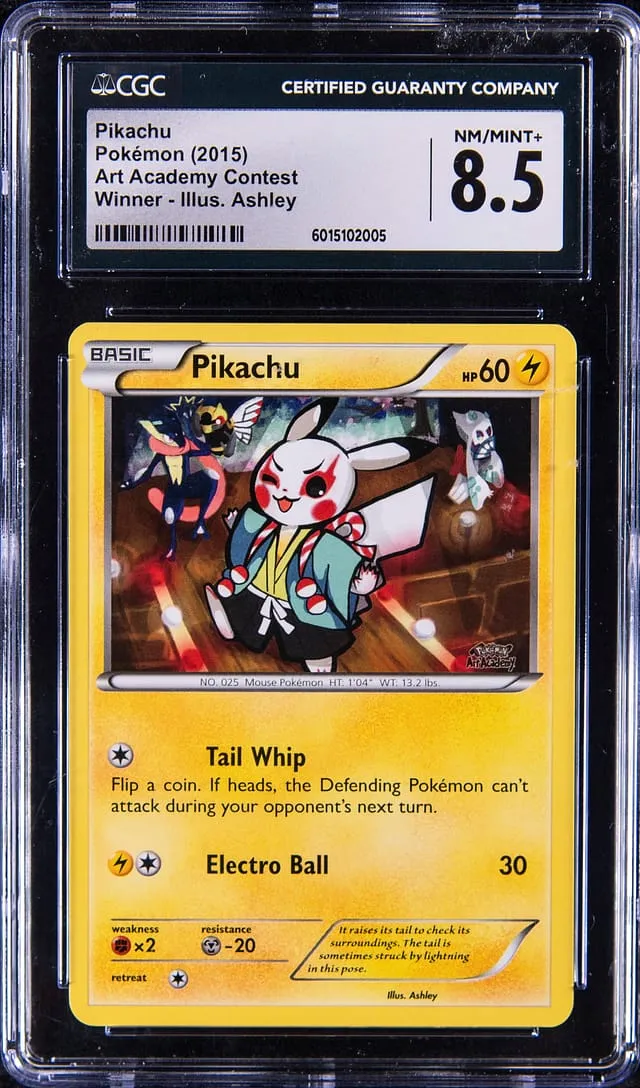
2015 Ashley Pikachu Art Academy CGC 8.5 Sells Big
Goldin’s March 9, 2026 sale of a 2015 Pokémon Art Academy Ashley Pikachu CGC 8.5 at $29,280 offers fresh insight into high-end promo card demand.
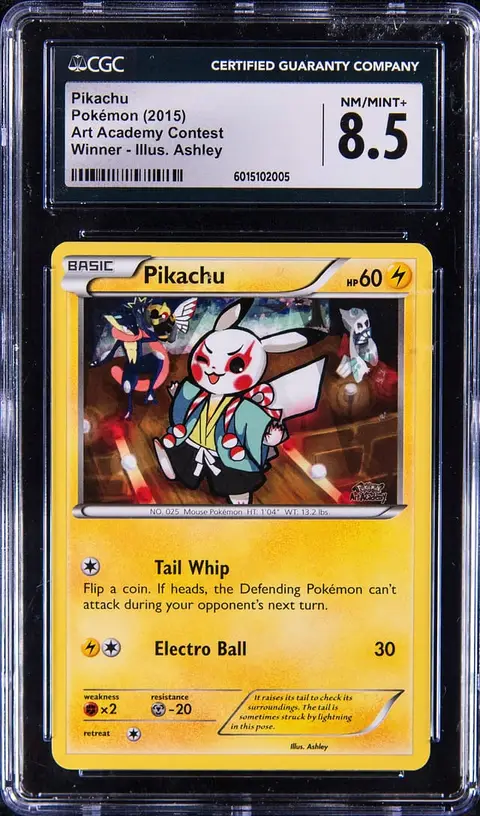
Sold Card
2015 Pokemon Art Academy Contest Winner Illustrator Ashley Pikachu - CGC NM-MT+ 8.5
Sale Price
Platform
Goldin2015 Pokémon Art Academy Ashley Pikachu CGC 8.5 Sells for $29,280
On March 9, 2026, Goldin closed a notable sale for one of the more quietly important modern Pokémon trophy-era cards: a 2015 Pokémon Art Academy Contest Winner “Illustrator” Ashley Pikachu, graded CGC NM-MT+ 8.5, realized $29,280.
For a niche, non-pack-issued promo, that kind of result always raises the same questions: what exactly is this card, how rare is it, and how does this price fit into the broader market for Art Academy and Illustrator-style cards?
In this breakdown we’ll walk through the card itself, the market context, and what this sale might signal for collectors who track high-end Pokémon promos.
Card overview: 2015 Pokémon Art Academy Ashley Pikachu
Card: 2015 Pokémon Art Academy Contest Winner – “Illustrator” Ashley Pikachu
Character: Pikachu (fan-illustrated contest winner artwork)
Set / Issue: Pokémon Art Academy Illustration Contest prize card
Year: 2015
Issuance: Contest prize / limited promotional card (not pack-pulled)
Grading company: CGC
Grade: NM-MT+ 8.5
Instead of being part of a traditional set with a checklist and card numbers, this Pikachu comes from the 2015 Pokémon Art Academy contest, where amateur artists submitted designs via the Nintendo 3DS game. Winning entries were turned into official Pokémon TCG cards and awarded to the artists in very small quantities.
While terminology can vary, these are often referred to as Art Academy prize cards or Illustrator-style promos, because they celebrate the illustration and credit the artist on the card in a way that echoes the famous 1997–1998 Japanese Pikachu Illustrator.
Key attributes:
- Ultra low distribution: These are not pack-pulled and not sold at retail. Copies were awarded directly to contest winners and sometimes a very small circle around them. Print runs are believed to be in the low dozens per design, and a portion of that never enters the grading ecosystem.
- Artist-credited Pikachu artwork: Pikachu is still the face of the brand, and fan-illustrated, officially sanctioned Pikachu cards occupy an interesting niche between art collectible and TCG piece.
- Graded CGC 8.5: A Near Mint-Mint+ grade suggests a clean example with minor flaws (edge wear, small surface issues, or centering). For exceptionally scarce promos, collectors sometimes accept slightly lower numerical grades because raw supply is so thin.
This Ashley Pikachu is not a “rookie card” in the traditional sports sense, but it is a key issue within the Art Academy and prize-card lane of Pokémon collecting.
Why the 2015 Art Academy cards matter
To understand this sale, it helps to put Art Academy promos in context.
The Pokémon Company has occasionally run illustration contests and rewarded winners with exceptionally limited cards. Over time, these have earned a place alongside other elite promos—such as the original Pikachu Illustrator, early Japanese tournament prizes, and rare Japanese school or snap promos—because they share several traits:
- Tiny, controlled distribution rather than mass-market printing.
- Artwork-first focus, often with novel or personal art styles.
- Distinct backstory, tied to specific contests, events, or communities.
The 2015 Art Academy contest falls into the ultra-modern era (roughly post-2015), but behaves more like vintage trophies from a scarcity perspective: supply is tiny, many copies stay in private hands, and population reports remain low years after release.
For collectors who like to treat the TCG as a history of Pokémon illustration, these cards capture a moment when fan art literally crossed over into official canon.
Known rarity and grading landscape
Exact print numbers for individual Art Academy winner cards—such as Ashley Pikachu—have not been publicly confirmed. However, based on hobby research and patterns from similar contests, most estimates for these prize cards land in the low double digits per artwork.
Grading population reports (often called “pop reports”, which simply count how many copies a grading company has certified in each grade) reinforce the scarcity story:
- Across CGC, PSA, and BGS, individual Art Academy winners generally show single-digit to low double-digit total pops per card.
- The number of high-grade copies (9s and above) is usually even lower, especially when accounting for crossovers and re-submissions.
For a CGC 8.5 specifically:
- It typically sits just below the most chased grade tiers, but for an Art Academy prize with such limited total supply, an 8.5 is still well within what many serious collectors would consider “investment-grade condition” in everyday language.
- The true scarcity isn’t just the grade—it’s the existence of any graded copy on the open market at all.
Market context: where does $29,280 fit?
This sale closed at $29,280 via Goldin on March 9, 2026.
Because Art Academy prizes trade infrequently and often privately, clear “comps” (short for comparable recent sales) can be sparse. That said, here’s the general pattern seen in public data for comparable items:
- Other Art Academy winners (Pikachu and non-Pikachu) have seen recorded public sales anywhere from the mid four figures up into the mid-to-high five figures, depending on character, grade, and timing.
- Pikachu-centered prize cards—especially with distinctive or beloved artwork—tend to sit at the higher end of that range, simply because Pikachu is the most globally recognizable Pokémon.
- Top grades (Gem Mint tiers), when they appear, often command a notable premium over mid-8s and low-9s, reflecting how few copies meet that standard.
Within that landscape, a CGC 8.5 Ashley Pikachu reaching just under $30,000 sits firmly in the upper tier of Art Academy and modern prize-card pricing, but not in the outlier territory reserved for the very top copies of the most famous trophy cards.
It’s also worth noting that this lane is still relatively thinly traded compared to the core WotC-era (1999–2003) hits. As a result:
- A single strong or weak auction doesn’t necessarily redefine “market price.”
- Each new public result becomes an important data point for future buyers and sellers.
Comparison with broader Pokémon promo trends
Looking beyond Art Academy specifically, there are a few broader trends that frame this sale:
High-end promos have decoupled somewhat from mass-market modern.
While sealed product and standard modern chase cards can be more sensitive to short-term hype cycles, ultra-limited promos and trophy-style cards tend to move more slowly and are influenced more by collector base depth than by a single set release.Artist- and art-focused collecting continues to grow.
As the hobby matures, more collectors are building collections around illustrators, contest histories, and promo narratives—not just set checklists. Art Academy prizes fit squarely into this trend.Non-PSA grading has gained more acceptance in niche lanes.
CGC has carved out a solid footprint in Pokémon, especially among collectors who appreciate detailed subgrades or who cross over from comic collecting. A strong CGC 8.5 result signals that buyers in this lane are willing to value the card’s underlying scarcity over strict PSA-only preferences.
What this sale may signal to collectors
Without making predictions, we can highlight a few practical takeaways for collectors and small sellers who follow this niche:
Documented price anchor: This Goldin result becomes a fresh reference point for Ashley Pikachu, and by extension, for other 2015 Art Academy Pikachu promos in similar condition. It doesn’t set a fixed “value,” but it does provide a recent and transparent data point.
Evidence of continued demand for ultra-limited promos: Even in an environment where much of the discussion centers on flagship sets and new releases, there is clearly still meaningful capital and attention aimed at truly scarce promos.
Condition vs. availability trade-off: The fact that a CGC 8.5 commanded nearly $30k underscores that, for extremely rare items, collectors often prioritize “owning a copy” over holding out for a perfect grade that may surface only rarely, if ever.
Story and provenance matter: Cards tied to specific contests and named artists often benefit from strong storytelling. For future sellers, maintaining documentation, auction pedigrees, and any original materials from the contest can be helpful.
How collectors might use this information
For newcomers or returning collectors curious about why certain promos command high prices:
- This Ashley Pikachu is a good case study in how scarcity, narrative, and character choice combine. It is not famous because of in-game playability or pack odds; it is significant because very few exist and it marks a particular moment in Pokémon’s art history.
For active hobbyists:
- Cataloging Art Academy and similar prize cards by artist, year, and language can provide structure to what otherwise feels like a scattered promo space. Tracking public auction houses like Goldin, Heritage, and PWCC for new appearances can help build a more accurate sense of the lane.
For small sellers:
- Most will never handle an Art Academy card, but the same principles apply to rarer regional or event promos: understand the backstory, check pop reports across grading companies, and use multiple recent sales (if available) to frame your price expectations without assuming linear growth.
Final thoughts
The $29,280 sale of the 2015 Pokémon Art Academy Contest Winner “Illustrator” Ashley Pikachu – CGC 8.5 at Goldin on March 9, 2026, is another data point confirming that high-end Pokémon promos with real scarcity and strong stories continue to hold the attention of serious collectors.
In a hobby where many modern cards are printed in huge numbers, these small, artist-focused releases remain one of the clearest examples of how limited distribution plus meaningful narrative can create long-term significance—regardless of whether a card ever appears in a booster pack.