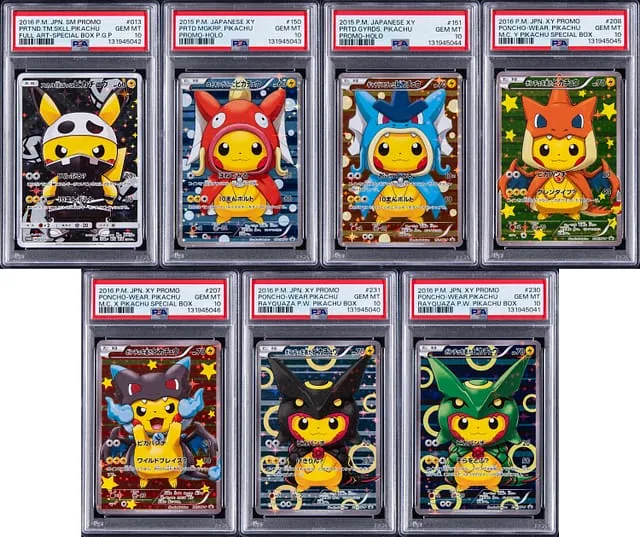
2015-16 Poncho-Wearing Pikachu PSA 10 Set Sale
Goldin sold a 7-card 2015-16 Poncho-Wearing Pikachu PSA 10 promo set for $120,280 on Feb 16, 2026. Breakdown, context, and collector takeaways.
Sold Card
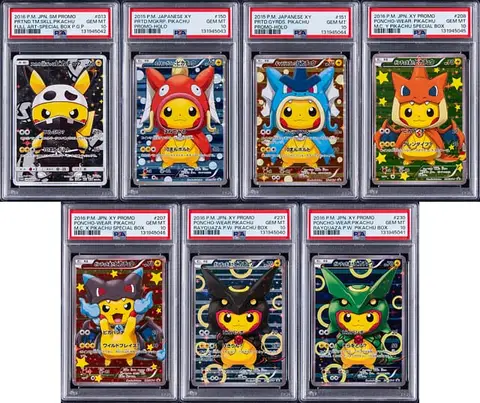
2015-16 Pokemon Japanese XY/Sun & Moon Promo Poncho-Wearing Pikachu/Pretend Pikachu PSA GEM MT 10 Collection (7 Different) - Sequential PSA Certification Numbers
Sale Price
Platform
Goldin2015-16 Poncho-Wearing Pikachu PSA 10 Set Sells for $120,280
On February 16, 2026, Goldin closed a notable Pokémon sale: a 2015-16 Pokémon Japanese XY/Sun & Moon promo bundle featuring seven different Poncho-Wearing Pikachu / Pretend Pikachu cards, all graded PSA GEM MT 10, all with sequential PSA certification numbers. The hammer price was $120,280.
For collectors tracking high-end Pikachu promos and rare Japanese releases, this result adds another clear data point to an already carefully watched niche.
What exactly sold?
Based on the auction description, the lot was not a single card, but a collection of seven different promos:
- Character: Pikachu (Poncho-Wearing / Pretend Pikachu themed artwork)
- Year: 2015–2016
- Region / Language: Japanese
- Category: XY and early Sun & Moon–era Pokémon promos
- Type: Special promo cards, not from regular booster sets
- Grading company: PSA
- Grade: GEM MT 10 on all seven cards
- Special attribute: Sequential PSA certification numbers, meaning the cards were graded together and slabbed in a consecutive sequence.
These promos are part of the broader 2015–2016 Poncho-Wearing and Pretend Pikachu campaigns in Japan. The cards typically feature Pikachu dressed as other Pokémon (for example, Eevee, Magikarp, Mega Charizard, and others) and were distributed through limited-time promotions, Center campaigns, and specialty products rather than standard packs.
While exact card numbers and promo IDs for this specific seven-card configuration weren’t outlined in the brief description, we can still place the lot within the well-known Poncho/Pretend Pikachu promo family that collectors actively pursue as a set.
Why collectors care about Poncho-Wearing and Pretend Pikachu
These promos sit at the intersection of several strong collecting themes:
Pikachu focus
Pikachu is the franchise mascot and one of the most widely collected Pokémon. High-grade, scarce, or particularly charming Pikachu cards often form the backbone of character-focused collections.Limited Japanese promos
Many Poncho-Wearing / Pretend Pikachu cards were released via Japan-only campaigns, lottery-style distributions, or limited-time Pokémon Center runs. That makes them harder to source directly outside Japan, especially in top condition.Distinctive art and concepts
Pikachu cosplaying as other Pokémon, often illustrated by popular artists, has proven to be a long-lasting theme. The artwork gives the cards strong display appeal, which supports long-term collector interest beyond pure rarity.Set-building appeal
A lot of collectors chase these cards as a run or mini-master set. Having multiple different Poncho/Pretend Pikachu promos in PSA 10, especially with matching/ sequential cert numbers, is particularly attractive for set-focused collectors.
In hobby terms, this is an ultra-modern (roughly 2010s onward) promo run. Ultra-modern can be more plentiful in raw copies, but high-grade, well-centered examples of specific Japanese promos can still be quite challenging.
The importance of PSA GEM MT 10 and sequential certs
PSA GEM MT 10 is PSA’s highest standard grade, indicating virtually no visible flaws under normal viewing. For glossy, full-bleed, or dark-background promos, hitting a 10 can be difficult due to surface print lines, chipping, and centering.
Two things matter here:
Top grade
For high-demand modern promos, the price difference between PSA 9 and PSA 10 is often large. Collectors paying a premium usually want the best available example, especially when building a display set.Sequential certification numbers
Sequential certs mean the cards were likely submitted as a group and graded in the same batch. While this does not change the technical grade, it adds a "cohesive set" feel. Some collectors are willing to pay more for a run that presents uniformly on the label, especially for themed promos.
Put simply: seven different Poncho/Pretend Pikachu promos, all PSA 10, all sequential, is a deliberately curated collection rather than a random assortment.
Market context and recent sales
When collectors talk about "comps," they mean comparable recent sales of the same card or very similar versions. For this Goldin lot, there are two levels of comps to consider:
Individual Poncho/Pretend Pikachu PSA 10 cards
Across major marketplaces, individual PSA 10 examples from the 2015–16 Poncho-Wearing and Pretend Pikachu lines have often ranged from the low-thousands to five-figure prices per card, depending on:- Which Pokémon Pikachu is dressed as
- Distribution method and scarcity
- Population report (how many exist in a given grade)
Some of the more coveted promos in this family have previously recorded strong five-figure sales in PSA 10, especially during peaks of modern Pokémon interest.
Full or partial sets in PSA 10
Bundled runs of multiple Poncho/Pretend Pikachu promos—especially all PSA 10—tend to command a premium over simply adding up the last-known price of each card. The premium reflects:- The time and effort required to assemble and grade a matching group
- The aesthetic and display value of a complete or near-complete run
For this specific Goldin lot at $120,280, the result fits within the upper tier of what collectors have seen for curated Pikachu promo groupings, especially when you factor in:
- Seven PSA 10 copies (not raw, not mixed grades)
- Sequential certs (curated submission)
- The ongoing demand for Pikachu-focused Japanese promos
At the time of writing, public data on an identical seven-card, sequential PSA 10 configuration is limited. That makes this more of a reference point for future set-level comps rather than a direct apples-to-apples comparison.
Pop reports and perceived scarcity
A pop report (population report) is the grading company’s public count of how many cards exist at each grade. For many of the Poncho/Pretend Pikachu promos, PSA’s pop reports show:
- A meaningful but not overwhelming number of graded copies
- A much smaller subset in PSA 10 compared to the total graded population
Individually, some of these promos have dozens to a few hundred PSA 10s, but building a run of different cards all in GEM MT 10—and then having them all come back in a sequential cert block—requires significant effort, timing, and grading cost.
From a collector’s point of view, the scarcity is less about each single card being nearly impossible and more about the difficulty of assembling this exact combination with this level of uniformity.
How this sale fits into the broader Pokémon market
The Pokémon market has moved through several cycles since the late 2010s. For ultra-modern promos, the trend has been:
- Very strong spikes around 2020–2021
- A reset and more selective demand afterward
- A gradual shift toward quality, curation, and specific themes (like Pikachu promos, trophy cards, and limited Japanese releases) rather than broad, undifferentiated buying
Within that context, this $120,280 Goldin result on February 16, 2026 suggests:
Sustained interest in curated Pikachu promo runs
While prices have normalized from the most intense boom years, targeted segments—like high-end Japanese Pikachu promos—continue to draw serious bidders.Preference for top-grade, ready-made sets
Collectors with the means often prefer paying a premium for a completed, graded display set instead of slowly building one card at a time. This sale fits that pattern.Ongoing respect for Japanese promo design and scarcity
Even as new sets release constantly, the 2015–16 Poncho/Pretend Pikachu era holds up well due to its art direction, thematic cohesion, and limited original distribution.
What this might mean for collectors and small sellers
This sale does not set a universal benchmark for all Poncho/Pretend Pikachu cards, but it does offer some practical takeaways:
For character collectors: High-grade Pikachu promos—especially Japanese, limited, and visually distinctive ones—remain highly targeted segments with documented high-end sales.
For set builders: Bundling related promos into a cohesive graded set can add value beyond individual card prices, especially when grades and certs are uniform.
For small sellers: If you are sitting on raw Poncho/Pretend Pikachu promos, pop reports and high-grade comps justify the time to inspect condition carefully before submitting for grading. Not every copy will justify a submission, but strong candidates in near-flawless condition can be meaningful in PSA 10.
For new or returning collectors: Use this sale as a reference point—an example of how niche, themed promo runs can build long-term interest. It doesn’t mean any Pikachu card will approach this territory, but it shows how art, scarcity, and curation come together at the top end.
Final thoughts
The 2015-16 Pokémon Japanese XY/Sun & Moon Promo Poncho-Wearing Pikachu / Pretend Pikachu PSA GEM MT 10 collection of seven different cards, with sequential PSA certification numbers, selling for $120,280 at Goldin on February 16, 2026, is a meaningful data point for high-end Pikachu and Japanese promo collectors.
It reinforces a pattern: carefully assembled, visually coherent, top-grade promo runs continue to command respect and strong prices, even as the broader market becomes more selective and data-driven.
As more curated Poncho-Wearing and Pretend Pikachu sets surface in top grade, this sale will likely serve as one of the early reference comps that collectors look back on when evaluating rarity, demand, and perceived value in this corner of the Pokémon market.