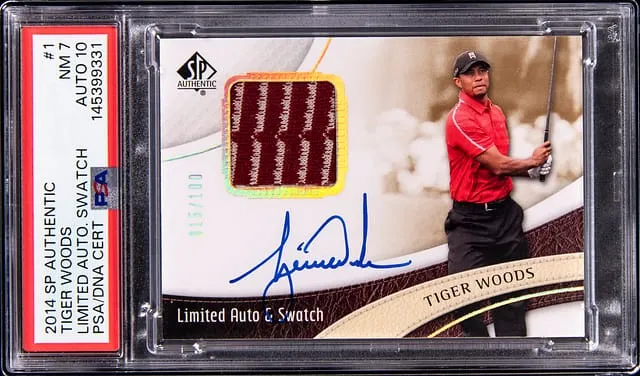
2014 SP Authentic Tiger Woods Auto Patch Sells for $12.8K
Goldin sells a 2014 SP Authentic Tiger Woods Limited Autograph Swatch /100 for $12,810. A pop 1 PSA 7 with PSA/DNA 10 auto highlights modern Tiger demand.
Sold Card
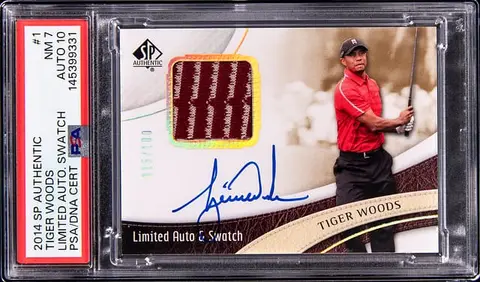
2014 Upper Deck SP Authentic Limited Autograph Swatch #1 Tiger Woods Signed Tournament-Worn Patch Card (#015/100) - PSA NM 7, PSA/DNA GEM MT 10 - Pop 1
Sale Price
Platform
Goldin2014 SP Authentic Tiger Woods Auto Patch /100 Sells for $12,810
On March 15, 2026, Goldin recorded a notable golf card sale: a 2014 Upper Deck SP Authentic Limited Autograph Swatch #1 Tiger Woods, serial numbered 015/100, sold for $12,810. The card was graded PSA NM 7 for the card and PSA/DNA GEM MT 10 for the autograph, and the population report shows it as a pop 1 in this exact configuration.
Card overview
This Tiger Woods is a premium modern golf issue with several key traits that matter to collectors:
- Year: 2014
- Manufacturer: Upper Deck
- Product: SP Authentic
- Card: Limited Autograph Swatch #1
- Serial number: 015/100 (only 100 copies made)
- Patch: tournament‑worn memorabilia
- Autograph: on‑card (signed directly on the card)
- Grading:
- PSA card grade: NM 7 (Near Mint)
- PSA/DNA auto grade: GEM MT 10 (top grade for signature quality)
- Population: pop 1 in this exact grade/auto configuration at PSA (according to the listing)
This is not a rookie card—Tiger’s hobby‑defining rookies are from 2001 (primarily 2001 Upper Deck Golf)—but it is a low‑serial, on‑card auto patch from one of Upper Deck’s most collected modern golf products.
Why 2014 SP Authentic matters
SP Authentic is a long‑running Upper Deck line known in multiple sports for:
- Hard‑signed autographs (signatures on the card, not on stickers)
- Autograph patch cards with game‑ or event‑worn pieces
- Lower print runs and stronger checklist curation compared with mass‑market sets
In golf specifically, post‑2001 Tiger Woods autograph patch cards tend to fall into the “modern premium” category: small production, visually strong design, and a narrow but committed collector base. For many collectors who missed Tiger’s 2001 rookies, cards like this function as key centerpieces of a Tiger or golf PC (personal collection).
Scarcity and pop report
Two types of scarcity apply here:
- Manufactured scarcity – the card is serial numbered /100, so by design there are only 100 copies.
- Graded scarcity – PSA’s population data in the listing identifies this PSA NM 7 with PSA/DNA GEM MT 10 auto as a pop 1.
A “pop report” (population report) is the grading company’s census: how many copies of a given card exist in each grade. Low population does not automatically mean high value, but it does give context for how often a specific graded example is likely to appear at auction.
In this case, most of the overall scarcity comes from the print run (/100) and the fact that it is a tournament‑worn patch auto of Tiger, rather than the numeric card grade itself. Collectors who prioritize autograph quality will often view a PSA/DNA 10 auto as more important than whether the card is a 7, 8, or 9, as long as the card presents well.
Market context and recent sales
Data for this exact serial number (015/100) and grade combination is very limited. Tournament‑worn SP Authentic Tiger autos from the mid‑2010s rarely appear in high volume across major auction houses and marketplaces, so “comps” (comparable recent sales used as reference points) tend to rely on:
- Other copies of the same card in different grades or ungraded
- Similar Tiger Woods SP Authentic autograph patch cards from neighboring years (for example, other 2013–2015 Upper Deck Tiger auto patches)
- Tiger auto patch cards from different Upper Deck brands with similar print runs
Across those categories, the pattern has generally been:
- Unnumbered or higher‑numbered Tiger autos (non‑patch) typically sell for significantly less.
- Low‑serial Tiger auto patch cards, especially with strong patches and on‑card autos, tend to command a meaningful premium.
The $12,810 sale price at Goldin on March 15, 2026 sits in the upper range of what collectors have been willing to pay in recent years for non‑rookie, low‑print Tiger auto patches with strong visual appeal. When filtered against:
- The /100 print run
- Tournament‑worn patch designation
- PSA/DNA GEM MT 10 autograph
this result lines up with a market that remains willing to pay for premium Tiger pieces, even when the card grade itself is NM 7.
Grade versus eye appeal
A Near Mint 7 means the card has visible but moderate flaws—often minor corner or edge wear, faint surface issues, or small print defects. For modern cards, many investors prefer higher numeric grades, but Tiger collectors often prioritize:
- Patch quality: multi‑color, visible stitching, or distinctive tournament wear
- Autograph quality: bold ink, strong placement, no smudges
- Overall presentation: centered image and clean design
Because this example carries a PSA/DNA GEM MT 10 auto grade, it reassures buyers that Tiger’s signature is both authentic and high quality. For a lot of player collectors, that can offset concerns about a 7 on the card.
Era and hobby positioning
This card sits firmly in the “modern” era rather than vintage. That usually means:
- Tighter print runs and more parallel/variant options by design
- Strong separation between base cards and true premium issues like low‑serial auto patches
- A collector base that tends to be player‑focused (Tiger fans, golf fans, or autograph/patch specialists) rather than set‑completion focused
Tiger Woods himself remains one of the few golf names with true cross‑sport hobby recognition. Even as his on‑course schedule has become more limited, his legacy as a transformational player keeps demand for his key cards relatively steady. News cycles around returns from injury, majors appearances, or Hall of Fame‑style recognition can create short spikes in interest, but the long‑term attention tends to come from his overall career impact.
How this sale fits into the Tiger market
Looking at the broader Tiger Woods card market:
- His 2001 rookies and iconic inserts remain the main benchmark for high‑end record prices.
- Low‑serial autograph patch cards from Upper Deck’s premium lines (SP Authentic, Exquisite, etc.) form a second tier of important, frequently targeted cards.
This 2014 SP Authentic Limited Autograph Swatch /100 fits squarely into that second tier: not a rookie, but a modern, limited, on‑card auto patch with a clear event‑worn tie‑in.
The $12,810 hammer at Goldin on March 15, 2026 suggests:
- Collectors continue to pay solid premiums for Tiger’s better modern patch autos.
- Autograph grades (especially GEM MT 10) and strong memorabilia pieces are key factors.
- Pop 1 status in a respected grading holder helps differentiate specific copies when they do surface.
Takeaways for collectors and small sellers
For newer or returning collectors trying to understand where a card like this fits:
- Focus on the hierarchy: rookie cards and early key issues at the top; low‑serial auto patches as core modern premiums; base and non‑auto cards further down.
- Learn the difference between serial numbering, pop report scarcity, and actual market demand. All three matter, but demand is what shows up in realized prices.
- With Tiger in particular, there is a wide gap between common issues and his best autograph patch cards. A sale like this highlights how strong that top end can be.
For small sellers, this result is a reminder that:
- Detailed listings—clear mention of serial number, patch type, autograph grade, and pop report—help the market understand what you’re offering.
- Auction houses like Goldin can be effective venues for spotlighting premium, low‑print Tiger cards to a targeted bidder base.
As always, use recent sales as context rather than prediction. The $12,810 price for this 2014 Upper Deck SP Authentic Limited Autograph Swatch #1 Tiger Woods at Goldin on March 15, 2026 is a useful data point in an evolving Tiger Woods market, and a snapshot of how collectors currently value modern, limited Tiger auto patches with top‑grade signatures.