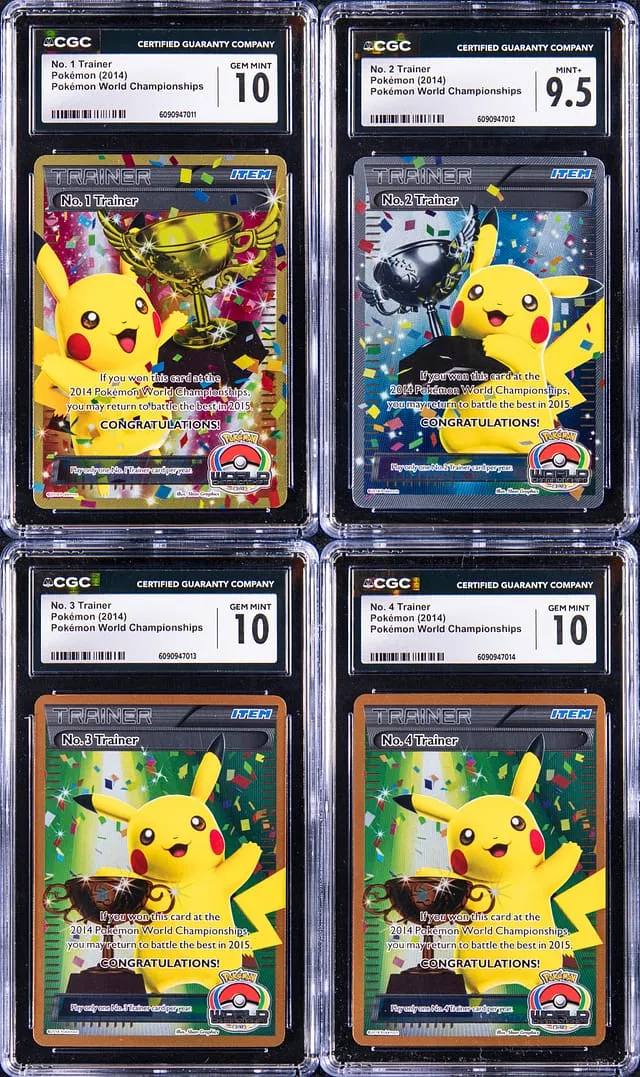
2014 Pokémon Trophy Pikachu No. 1–4 CGC Set Sells
Goldin sold a 2014 Pokémon World Championships No. 1–4 Trainer Pikachu CGC trophy set for $195,200. See why this ultra-rare run matters to collectors.
Sold Card
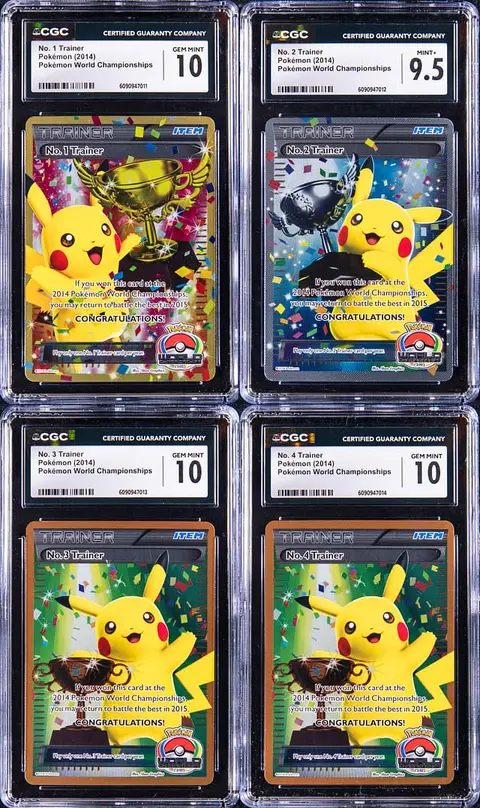
2014 Pokemon World Championships No. 1-4 Trainer Pikachu Trophy CGC-Graded Cards Collection (4 Different)
Sale Price
Platform
GoldinWhen a complete run of Pokémon Trophy cards surfaces at public auction, the hobby pays attention. On March 9, 2026, Goldin sold a 4-card CGC-graded collection of 2014 Pokémon World Championships No. 1–4 Trainer Pikachu Trophy cards for $195,200.
These are not pack-pulled cards. They are ultra-limited prize cards awarded to top finishers at the 2014 Pokémon World Championships, featuring Pikachu holding a trophy. For many competitive and high-end collectors, they sit near the top of the Pokémon card hierarchy.
What exactly sold?
Title: 2014 Pokémon World Championships No. 1–4 Trainer Pikachu Trophy CGC-Graded Cards Collection (4 Different)
Auction house: Goldin
Sale date (UTC): 2026-03-09
Realized price: $195,200
The lot contains four distinct 2014 World Championships Trainer Pikachu Trophy cards:
- No. 1 Trainer – awarded to the champion in a division
- No. 2 Trainer – awarded to the runner-up
- No. 3 Trainer – awarded to the third-place finisher
- No. 4 Trainer – a lower placing prize (introduced later than the classic No. 1–3 structure)
Each card is CGC-graded and encapsulated. While the exact numeric grades and subgrades for each card aren’t summarized in Goldin’s short title line, this type of lot typically features mid-to-high grades given how carefully many competitors have preserved these awards.
These are trophy cards: event prize cards that are not released to the general public. They are widely viewed as key issues within modern and ultra-modern Pokémon, although they are not “rookie cards” in the sports sense.
Why these 2014 Trophy Pikachu cards matter
World Championship provenance
Pokémon Trophy cards sit at the intersection of competitive play and high-end collecting. Unlike pack-issued chase cards, this 2014 set:
- Was distributed only to top finishers at the Pokémon World Championships.
- Has a fixed, very small print run determined by the number of prize winners.
- Carries built-in provenance: each copy originally belonged to a Worlds competitor.
That combination of scarcity, story, and status is why Trophy Pikachu cards are often compared to championship belts or rings in sports.
Part of a long-running trophy lineage
Pikachu trophy designs trace back to the late 1990s. Earlier Japanese No. 1, No. 2, and No. 3 Trainer cards from the original era have sold for very strong prices because they combine:
- Early Pokémon artwork
- Extremely low population (few graded copies exist)
- Direct ties to the competitive scene
The 2014 World Championships cards are much later chronologically, but they extend this same lineage into the modern era. For collectors building a long-term World Championships or trophy-focused collection, having the full run of placements (No. 1–4) from a single year is a compelling goal.
Understanding rarity and grading
Trophy card rarity is less about pack odds and more about seat count. Only so many people can place in the top four of a division at Worlds.
While exact award counts per division and category (Trading Card Game vs. Video Game) in 2014 are not always publicized in one place, you can safely describe these cards as extremely low print compared to any booster-set release. Population reports ("pop reports") from grading companies such as CGC, PSA, and BGS typically show only a handful of graded examples for each placement per year.
Because of that, even a single new appearance at auction becomes meaningful data for the market.
Market context and recent sales
Public sales data for 2014 World Championships Pikachu Trophy cards is thin compared with booster-set cards:
- Many copies are still with the original players.
- When they do sell, it is often via private deals.
- Public auctions usually feature individual placements (a No. 1 or No. 2 Trainer), not a complete set.
That makes this 4-card CGC-graded collection notable on its own.
How does $195,200 fit into the broader picture?
Public comps ("comps" are comparable recent sales used as reference points) for modern-era Trophy Pikachu cards have generally shown:
- Individual No. 1 Trainer cards in strong grades reaching well into the five-figure range.
- Lower placements (No. 3, No. 4) typically trailing No. 1 and No. 2 in price, but still commanding significant premiums due to scarcity.
When you aggregate four placements into a single lot:
- Some collectors pay a set premium for immediate completion of a run.
- Others would prefer to chase each card individually, so set premiums are not guaranteed and can vary from sale to sale.
At $195,200, this Goldin result sits comfortably in the high-end of the modern Pokémon trophy market but does not challenge the extreme record prices seen for the earliest Japanese trophy cards from the 1990s and early 2000s. It instead reinforces a tiered structure:
- Vintage and early-era Pikachu trophies at the top
- Later Worlds-era trophies like this 2014 set occupying a strong, but secondary tier
Because sales for full 2014 runs are rare, it is better to view this as a fresh reference point rather than a definitive new price level.
Why collectors chase this specific year
Several factors make 2014 appealing:
- Modern but not ultra-hyped: 2014 sits at an interesting point—modern enough that condition is often strong, but early enough in the Worlds timeline that print volume is still quite limited.
- Recognizable Pikachu artwork: Trophy Pikachu designs are highly recognizable, and 2014’s art carries the same visual identity collectors associate with earlier prize cards.
- Continuity for set builders: Collectors building a year-by-year Worlds trophy collection want 2014 to fill in their timeline.
For returning collectors who mostly know chase cards from booster sets, this sale is a reminder that event-issued cards and prize pieces form a separate, often more thinly traded layer of the market.
CGC’s role in the trophy space
Most high-end Pokémon cards have historically gravitated toward PSA, but CGC has gained traction, especially with competitive players and collectors who like detailed subgrades and transparent grading standards.
Key points about CGC-graded trophy cards:
- Populations are small, which means each new graded copy noticeably changes the pop report.
- Some collectors still prefer PSA slabs for resale, but CGC is widely accepted, especially when the focus is authenticity and preservation.
A complete 2014 Trophy Pikachu run in CGC holders does a few things for the market:
- Shows that high-end consignors trust CGC at the top of the market.
- Provides a public, auction-based data point that future CGC-graded copies will likely be compared against.
What this sale might mean for the broader Pokémon market
Without making predictions, we can outline a few practical takeaways:
Trophy liquidity is real, even in niche segments
A $195,200 result for modern trophy cards confirms that there is active, organized demand for Worlds prize cards—especially when grouped as a complete set.Completeness can command attention
It’s not just about the single top card (No. 1 Trainer). The presence of No. 1–4 in one lot makes it easy for a collector to secure an entire 2014 placement run in a single move.Data point for future negotiations
For both buyers and sellers in high-end Pokémon, this Goldin sale becomes a reference when talking about 2014 Trophy Pikachu values, even if private deals still set much of the real pricing behind the scenes.Increased awareness among newer collectors
As more people return to Pokémon and move beyond booster pulls, sales like this highlight that the hobby includes event-issued, story-rich cards that will never be reprinted or restocked.
How small collectors can use this information
You don’t need a six-figure budget to make use of data from a $195,200 sale:
- Understand the hierarchy: Trophy cards sit near the top of the Pokémon structure. Knowing where they fit helps you evaluate everything below them more clearly.
- Watch how often they appear: If you see a specific trophy year or placement show up repeatedly, that tells you something about how tightly held or loosely held those cards are.
- Use comps as a guide, not a rule: Because supply is so thin, one sale can be an outlier. Think of this result as one strong datapoint among many, not a fixed price tag.
Final thoughts
Goldin’s March 9, 2026 sale of the 2014 Pokémon World Championships No. 1–4 Trainer Pikachu Trophy CGC-Graded Cards Collection for $195,200 underscores just how important Worlds prize cards have become within the Pokémon ecosystem.
For advanced collectors, it reinforces the long-term status of Trophy Pikachu as a pillar of the high-end market. For newer and returning collectors, it’s an invitation to look beyond booster boxes and discover a side of the hobby where rarity is defined by real-world achievement, not just pack odds.
As always, this is one sale, not a forecast. But it’s a meaningful marker in the evolving story of trophy cards—and a reminder that some of the most coveted Pokémon cards were never sold in a store at all.