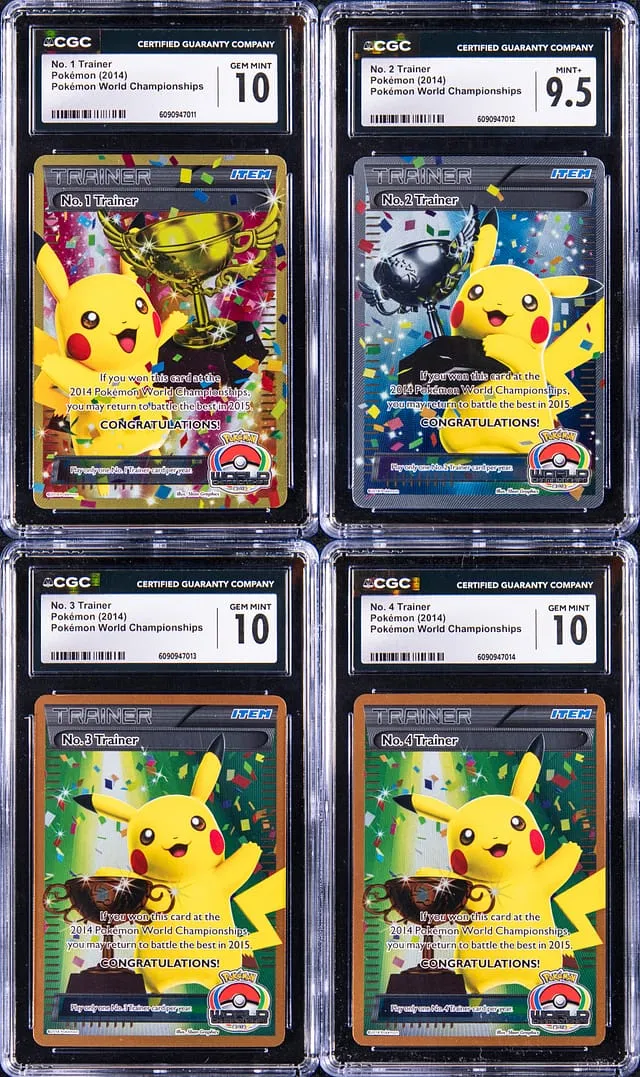
2014 Pikachu Trophy No. 1–4 Trainer Set Sells for $195k
A CGC-graded 2014 Pokémon Worlds Pikachu No. 1–4 Trainer trophy set sold for $195,200 at Goldin. Here’s what this means for high-end Pokémon collectors.
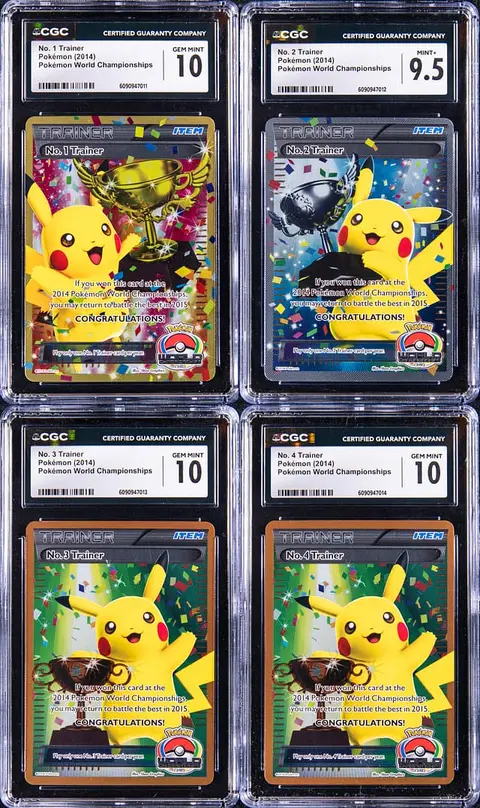
Sold Card
2014 Pokemon World Championships No. 1-4 Trainer Pikachu Trophy CGC-Graded Cards Collection (4 Different)
Sale Price
Platform
Goldin2014 Pokémon World Championships No. 1–4 Trainer Pikachu Trophy CGC Collection Sells for $195,200
On March 9, 2026, Goldin closed a major Pokémon trophy card sale: a four-card 2014 Pokémon World Championships “No. 1–4 Trainer” Pikachu trophy collection, all graded by CGC, realized $195,200.
For collectors who track high-end Pokémon, this kind of result is an important data point. It brings together several factors that define the top of the market: true scarcity, competitive prestige, and the broader narrative of World Championship trophy cards.
Below, we’ll walk through what this collection is, why it matters, and how this sale fits into recent market context.
What exactly sold?
Title: 2014 Pokémon World Championships No. 1–4 Trainer Pikachu Trophy CGC-Graded Cards Collection (4 Different)
Key identifiers:
- Character: Pikachu (trophy illustration; not a standard set Pikachu)
- Event: 2014 Pokémon TCG World Championships
- Cards:
- No. 1 Trainer Pikachu Trophy (2014 Worlds)
- No. 2 Trainer Pikachu Trophy (2014 Worlds)
- No. 3 Trainer Pikachu Trophy (2014 Worlds)
- No. 4 Trainer Pikachu Trophy (2014 Worlds)
- Category: Trophy prize cards (not pack-issued; awarded at the event)
- Era: Ultra-modern competitive trophy (2010s)
- Grading: CGC-graded set of four (individual numeric grades not specified in the sale summary)
- Attributes:
- Extremely low print and distribution
- Awarded to top finishers at the World Championships
- Regional language and division details can vary (e.g., Masters/Seniors/Juniors), but the listing groups them as a cohesive four-card trainer rank set
These are not standard booster pack cards. They are prize/trophy cards, meaning they were physically awarded to winners or top finishers in the official Pokémon TCG World Championships. That puts them in a very different category of scarcity and significance than even the rarest pack-issued Secret Rares.
Why 2014 World Championships Pikachu trophies matter
1. Trophy cards sit at the top of the Pokémon rarity pyramid
In Pokémon, “trophy cards” are cards awarded for competitive achievement, usually at high-level events like the World Championships or earlier-era Japanese tournaments.
Collectors care about them because:
- They have tiny print runs compared to normal sets.
- They are tied to historic events and real-world competitive achievement.
- Many never enter the open market, staying in the hands of the original winners.
The 2014 World Championships Pikachu No. 1–4 Trainer cards continue that long-running tradition established by the iconic 1990s and early-2000s Japanese trophy cards.
2. The full No. 1–4 run is hard to assemble
Owning all four ranks (No. 1, 2, 3, and 4) from the same World Championship year is significantly harder than owning a single trophy card:
- Each rank went to different finishers.
- Some winners keep their card permanently.
- Language, division, and category variants fragment the already tiny supply.
Seeing a complete ranked run from 2014 offered together is notable on its own, regardless of grade.
3. Pikachu trophy artwork and brand importance
Pikachu is the franchise’s flagship mascot. While that doesn’t automatically make every Pikachu card special, for trophy issues it adds a layer of cultural weight:
- Pikachu is instantly recognizable to both casual fans and serious collectors.
- High-end Pikachu cards often serve as entry points for non-Pokémon collectors who are exploring the brand.
When you combine Pikachu with World Championship-level scarcity, you get a category that many long-term collectors track closely.
Market context: how does $195,200 fit in?
The collection sold for $195,200 at Goldin on March 9, 2026.
Because these are true trophy cards, direct “comps” (comparable recent sales) are limited. Transactions are infrequent, and individual cards often change hands privately. Still, we can outline the general context:
- Liquidity is very low. In plain terms, these rarely hit public auction. Years can pass between public offerings for specific ranks, languages, or divisions.
- Past trophy Pikachu sales (mixed years and ranks) have reached six-figure levels for individual cards in strong grades, particularly for earlier Japanese issues or especially high-profile years.
- Complete or near-complete runs (for a given year) have historically commanded a premium over the sum of individual cards because of the difficulty of assembling them.
Given that:
- A four-card CGC-graded 2014 No. 1–4 Trainer Pikachu run at $195,200 sits squarely in what you’d expect for a significant high-end Pokémon trophy lot: clearly six-figure, but not at the very top of the all-time Pokémon trophy records set by earlier, more legendary 1990s/early-2000s Japanese trophies.
- The sale reinforces the idea that modern-era (2010s) Worlds trophies can still attract serious capital, even when competing with older Japanese grails.
Because public data for this exact four-card configuration and grade mix is sparse, it’s more helpful to see this sale as a fresh benchmark for 2014 Worlds trophy groupings rather than a simple “above or below comp” question.
Grading and CGC’s role
This collection is CGC-graded. CGC has built a notable presence in Pokémon grading thanks to:
- Detailed subgrades and condition analysis
- Consistent standards
In the very top of the market, some collectors still gravitate to PSA for liquidity, while others prioritize the grading standard and label they personally trust. The fact that this trophy run realized nearly $200,000 in CGC holders is another signal that serious buyers will engage with CGC-graded Pokémon trophies, especially when the cards themselves are genuinely rare.
Without the individual numeric grades, we can’t break down price-per-card or grade premiums. For now, the takeaway is that the event, rarity, and completeness of the run clearly outweighed any brand-specific grading preferences.
Collector significance
Historical importance
The 2014 World Championships were part of the modern expansion of organized Pokémon play, as Worlds solidified into a marquee annual event with global participation.
These No. 1–4 Trainer Pikachu trophies are:
- Physical artifacts of that competitive history.
- Directly tied to specific players and placements.
- A continuation of the trophy tradition that began in Japan decades earlier.
For collectors building a narrative of the Pokémon TCG—from early Japanese trophy cards to the global Worlds era—2014 trophy Pikachu cards are important connective tissue between eras.
Scarcity and survival
Unlike mass-produced set cards:
- Print quantities are tiny (only as many as there were awarded placements, plus any retained by organizers).
- Many remain in the winners’ collections, never graded or sold.
That means population reports (the grading companies’ counts of how many copies they’ve graded) are only part of the picture. The true population is small, and the available population (cards that realistically enter the open market) is even smaller.
What this sale might mean going forward
Again, this is not financial advice and not a prediction. But from a market-observation standpoint, this Goldin result suggests a few things:
Trophy market resilience
Even as broader modern and ultra-modern Pokémon prices have cooled and consolidated from peak speculative levels, true trophy cards—especially Pikachu and Worlds issues—continue to attract strong, patient bidding.Growing respect for 2010s trophies
Earlier Japanese trophies from the 1990s and early 2000s have long been established as grails. Seeing a 2014 Worlds run clear nearly $200k supports the idea that later trophy eras now have their own defined tier in the hierarchy.Emphasis on complete runs and narrative lots
Full or near-full runs tied to a single event year create a compelling story for collectors: “This is the 2014 Worlds Pikachu No. 1–4 set.” That narrative can matter just as much as technical grade splits.
Takeaways for different types of collectors
If you’re new to Pokémon trophy cards
- Think of these as event artifacts, not just shiny cardboard. Their value is partly in the story of who earned them and where.
- “Comps” (comparable recent sales) are hard to use in the usual way because auction appearances are so rare and conditions differ.
- Focus on understanding event history, print/distribution, and language/division specifics before you make any decisions about collecting or selling trophies.
If you’re a returning or active hobbyist
- This $195,200 Goldin sale is a useful anchor point for ultra-modern Worlds trophies, especially Pikachu-themed runs.
- When you see future offerings, look at:
- Division (Masters/Seniors/Juniors)
- Language
- Individual grades and subgrades
- Provenance (history of ownership)
If you’re a small seller
- Most sellers will never handle a four-card Worlds trophy run like this, and that’s ok.
- The key lessons still apply at smaller scales:
- Understand the event and context of any promo or prize card you sell.
- When comps are thin, lean more on storytelling and accurate description than on forcing a price comparison.
Final thoughts
The 2014 Pokémon World Championships No. 1–4 Trainer Pikachu Trophy CGC-Graded Cards Collection that sold for $195,200 at Goldin on March 9, 2026, is another reminder of how deep and layered the Pokémon TCG market has become.
It’s not just about chase cards from booster boxes anymore. At the very top, it’s about scarce, event-tied trophies that connect the game we play today with the history of those who played it at the highest level.