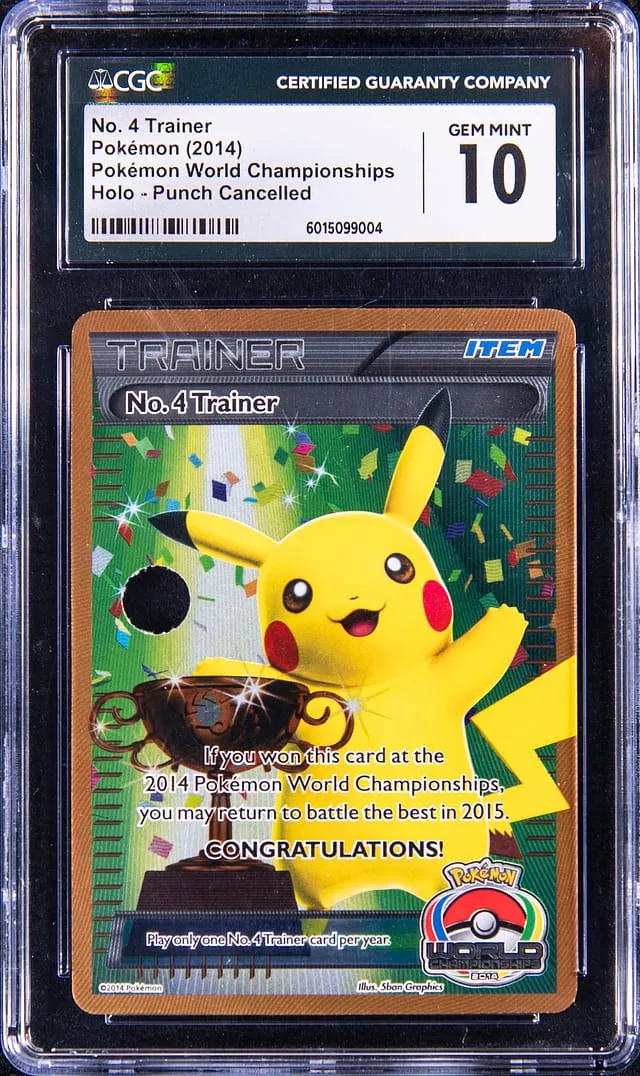
2014 No. 4 Trainer Pikachu Trophy CGC 10 Sale
A CGC 10 pop 3 2014 No. 4 Trainer Pikachu World Championships trophy card sold for $15,254 at Goldin. Here’s what it means for Pokémon collectors.
Sold Card
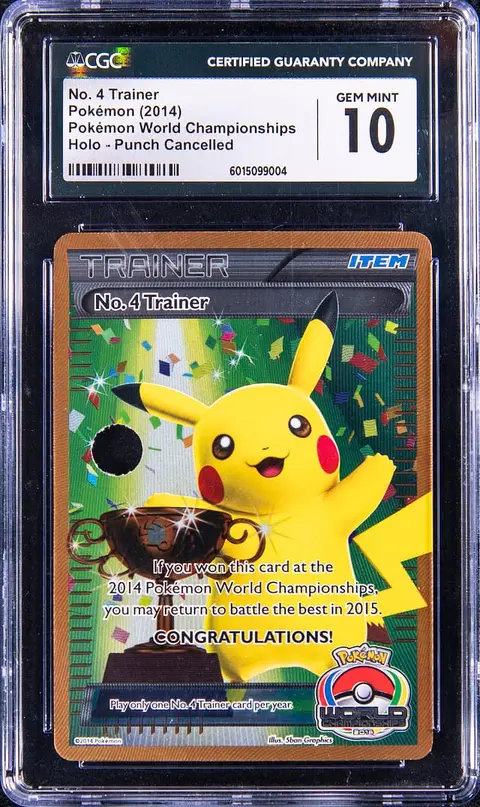
2014 Pokemon World Championships No. 4 Trainer Pikachu Trophy Card, Punch Cancelled - CGC GEM MINT 10 - Pop 3
Sale Price
Platform
GoldinA 2014 Pokémon World Championships No. 4 Trainer Pikachu Trophy Card, punch cancelled and graded CGC GEM MINT 10, just sold at Goldin on 2026‑04‑27 for $15,254. For an already niche card, this is a notable data point that helps clarify how the market is currently valuing lower‑placement World Championship trophies in top grades.
In this breakdown, we’ll unpack what the card is, why it matters to collectors, and how this sale fits into recent price context.
What exactly is this card?
Card details
- Game / IP: Pokémon TCG
- Character: Pikachu (Trainer Trophy artwork)
- Year: 2014
- Event: Pokémon World Championships
- Card type: No. 4 Trainer Trophy Card
- Special attribute: Punch cancelled (physically cancelled to prevent tournament use / re‑use)
- Era: Modern / early ultra‑modern trophy era
- Grading company: CGC (Certified Guaranty Company)
- Grade: GEM MINT 10
- Population: Pop 3 in CGC 10 for this specific card/variant (per the sale description)
This is not a pack‑pulled set card. It’s an event‑awarded trophy card from the 2014 Pokémon World Championships. Trophy cards are given to top finishers (and sometimes staff or special categories) at high‑level tournaments, usually in extremely small numbers compared with regular set cards.
The “No. 4 Trainer” designation typically corresponds to a placement or prize tier within the event structure. While 1st–3rd place trophies are the most talked‑about historically, lower‑numbered placements like No. 4 are still part of the same very limited trophy ecosystem.
The “punch cancelled” note means the card has a cancellation mark (often a hole punch or similar) applied by the organizer. This is usually done to prevent the card from being used in future sanctioned events or treated as in‑play prize material. It’s a quirk specific to certain trophy and prize cards, and collectors treat it as an inherent part of the variant rather than post‑issue damage.
Why collectors care about World Championships trophy cards
Trophy cards occupy a very specific lane in the Pokémon market:
- Ultra‑low print runs: Unlike mass‑produced set cards, trophies are printed in quantities tied to event placements (sometimes just a handful of copies per division and language).
- Direct tie to competitive history: These cards were not purchased; they were earned in high‑level competition. That gives them a built‑in story and connection to the organized play ecosystem.
- Pikachu trophy artwork: Many World Championships trophies feature unique Pikachu art that never appears in regular sets. For character collectors and Pikachu specialists, these become keystone pieces.
- Condition challenges: Event‑awarded cards may be handed directly to players, kept in binders, or transported without the same protection as pack‑fresh cards. That makes high‑grade examples disproportionately scarce.
Within this space, 1990s and early 2000s Japanese trophies are the most famous, but 2010s World Championships trophies have steadily built their own following as collectors broaden their view beyond just the earliest years.
Understanding the CGC GEM MINT 10 grade and pop
CGC’s GEM MINT 10 is its highest standard grade on the regular scale. For a card with any kind of physical punch cancellation, the grading company evaluates the card within the context of that being part of the intended state of the card (similar to how stamped or die‑cut features are treated when they are part of the original production or award process).
The auction description notes this is Pop 3 in CGC 10. “Pop” (population) refers to how many copies a grading company has recorded in a certain grade. A pop of 3 means:
- Only three copies of this exact version have achieved a 10 at CGC.
- The true total supply is even lower, because not every copy in the wild is graded.
- The card is already niche by nature (Worlds trophy), so pop counts will generally stay low.
When you combine event‑tied scarcity with a top‑of‑scale grade, you get a profile that appeals to seasoned trophy collectors and grading‑focused collectors alike.
Market context: how does $15,254 fit in?
The card sold at Goldin on 2026‑04‑27 for $15,254. To understand what that means, it’s useful to look at comps—short for “comparables,” or recent, similar sales that help frame current pricing.
Because this specific card is niche, direct matches in the same grade and variant are limited. In situations like this, collectors often look at a combination of:
- Same card, different grades – For example, prior sales of CGC 9 or PSA/BGS equivalents (where available).
- Adjacent trophy levels – Prices realized for other 2014 World Championships Pikachu trophy placements (No. 1, 2, 3, or similar staff/player trophies).
- Other modern Pikachu trophies – Later‑year Worlds trophies or national trophies with comparable scarcity and prestige.
Public auction records over the last few years show a wide range for 2010s Pikachu trophies, depending on:
- Placement (No. 1 and No. 2 often command premiums).
- Language and category (Masters vs. Juniors vs. Seniors, or staff vs. player awards).
- Grading company and grade.
High‑end 2010s Pikachu trophies in top grades have previously reached into the mid‑five‑figure range and, in some headline cases for higher placements or earlier years, beyond that. By contrast, lower placements or lesser‑known categories can sometimes sit in the high‑four‑ to low‑five‑figure area, especially in mixed or mid grades.
Within that broader landscape, $15,254 for a CGC 10, pop 3, punch‑cancelled 2014 No. 4 Trainer Pikachu sits in the lower to mid band of what modern Pikachu trophies have been known to realize, leaning toward the structured, data‑backed side rather than a surprise spike. It’s a solid, but not record‑breaking number that:
- Confirms there is still healthy demand for non‑top‑three Worlds trophies in elite grades.
- Suggests the market continues to distinguish carefully between placements, years, and specific trophy pedigrees.
Because direct, like‑for‑like comps are thin, most collectors will treat this sale as a fresh reference point rather than a definitive ceiling or floor.
How this sale fits into the broader trophy card market
A few broader trends help put this result into perspective:
Mature collector base for trophies
The buyers active at this level are typically long‑term, research‑driven collectors rather than casual speculators. That tends to keep realized prices more stable than the peaks and valleys seen in mainstream set cards tied to current hype.Shift toward grading diversity
While PSA has historically dominated high‑end Pokémon, CGC has built a substantial presence, particularly among modern and competitive‑play cards. A CGC 10 selling above $15,000 underscores that serious buyers are increasingly comfortable with high‑end pieces in CGC slabs.Event‑based provenance
Collectors continue to place a premium on cards with clear ties to specific events and achievements. A 2014 World Championships trophy sits in a sweet spot: old enough to feel established, but recent enough that provenance can often be traced and documented.
What this means if you collect or sell Pokémon trophies
This result is useful for different kinds of hobby participants:
Newcomers and returning collectors
It’s a reminder that not all high‑value Pokémon cards are Charizards or vintage set hits. Event‑awarded trophies form a parallel lane where rarity comes from how the card was obtained, not how many boxes were opened.Active hobbyists
For those tracking modern trophies, a $15K‑plus sale on a No. 4 placement in CGC 10 is a fresh marker. If you own adjacent cards (other placements, years, or similar Pikachu trophies), this gives one more data point to triangulate current demand.Small sellers and consignors
If you encounter Worlds or national trophy cards—especially those with unique features like punch cancellation—this sale highlights the importance of:- Getting them authenticated and graded by a major company.
- Researching the exact event, year, and placement before listing.
- Considering major auction houses like Goldin when comps are thin and the buyer pool is specialized.
Key takeaways
- The 2014 Pokémon World Championships No. 4 Trainer Pikachu Trophy Card (punch cancelled) is a niche, event‑awarded trophy with ultra‑low natural supply.
- This copy, graded CGC GEM MINT 10 (Pop 3), sold at Goldin on 2026‑04‑27 for $15,254.
- Within the broader market for 2010s Pikachu trophies, the price is strong but not extreme, adding a new reference point for modern, lower‑placement Worlds trophies in top grades.
- The sale reinforces ongoing collector interest in event‑tied, Pikachu‑focused trophies, and shows that high‑grade examples continue to command meaningful premiums.
As more of these niche trophies surface through major auction houses, data points like this one will keep refining how collectors understand relative scarcity and demand. For now, this CGC 10 No. 4 Trainer stands as one of the cleaner benchmarks for 2014 Worlds Pikachu trophies in the current market.