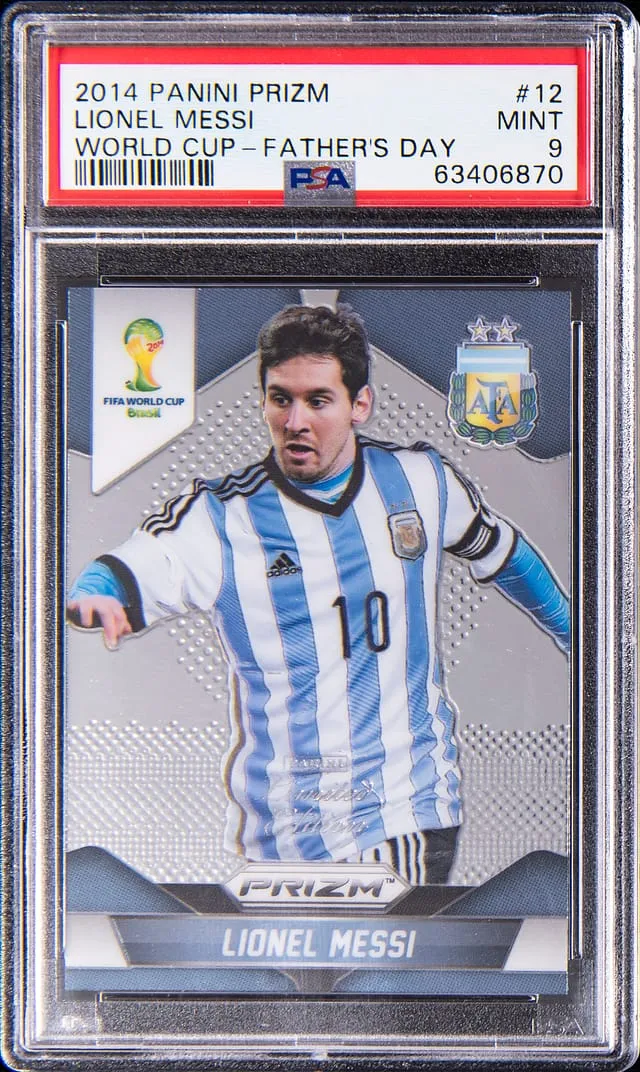
2014 Messi Prizm Father’s Day /7 PSA 9 Sells for $35K
Goldin sold a 2014 Panini Prizm World Cup Father’s Day /7 Lionel Messi PSA 9 for $35,380. Here’s what this low-printed promo means for collectors.
Sold Card
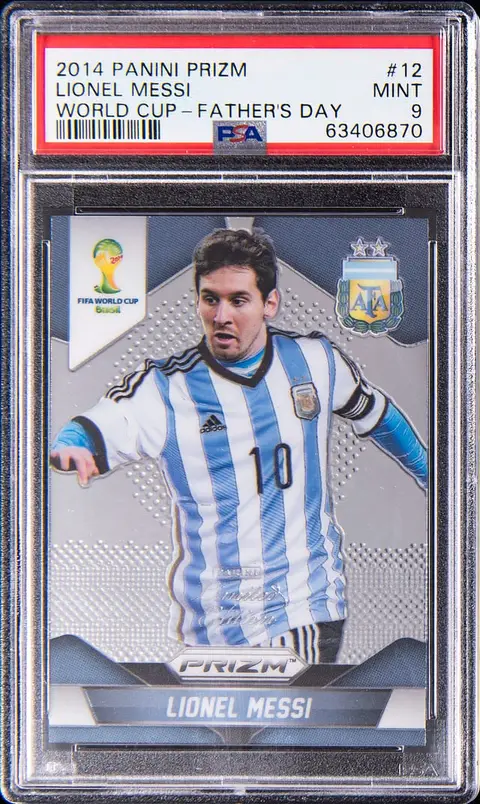
2014 Panini Prizm World Cup Father's Day #12 Lionel Messi (#5/7) - PSA MINT 9
Sale Price
Platform
Goldin2014 Panini Prizm World Cup Father’s Day #12 Lionel Messi (#5/7) – PSA 9 Sells for $35,380
On March 15, 2026, Goldin sold a 2014 Panini Prizm World Cup Father’s Day #12 Lionel Messi, serial numbered #5/7 and graded PSA MINT 9, for $35,380. For a relatively obscure Panini promotional parallel, this is a meaningful result that sits at the intersection of Messi collecting, early Prizm World Cup history, and ultra‑low serial‑number scarcity.
In this breakdown, we’ll walk through what this card actually is, how it fits into the broader Messi and Prizm World Cup market, and why a seven‑copy promo parallel can command this kind of attention.
Card snapshot: what exactly sold?
- Player: Lionel Messi (Argentina)
- Team/Country: Argentina national team
- Year: 2014
- Product family: Panini Prizm World Cup
- Subset/Promotion: Father’s Day promotional parallel
- Card number: #12
- Serial numbering: #5/7 (only 7 copies produced)
- Grading company: PSA (Professional Sports Authenticator)
- Grade: PSA MINT 9
- Attributes: ultra‑low serial, non‑auto, non‑patch, chromium stock
- Rookie status: Not a rookie; this is a key low‑print run parallel from Messi’s first Prizm World Cup cycle rather than a debut card.
This card traces back to Panini’s long‑running Father’s Day promotional program, where special packs were distributed through hobby shops and events. For soccer, and especially for 2014 World Cup content, some of these parallels are significantly scarcer than the main Prizm World Cup set most collectors recognize.
Why 2014 Prizm World Cup matters
The core 2014 Panini Prizm World Cup release has become a foundational modern soccer set:
- It brought the Prizm chromium look that was already popular in basketball and football into a global World Cup product.
- It captured an era featuring Messi, Ronaldo, Neymar, and many more stars in the same flagship‑style release.
- For many collectors, it functions as a “first big Prizm” for soccer in the same way 2012 Prizm is often viewed in basketball.
Within that context, niche off‑shoots like Father’s Day parallels can fly under the radar for years. But as collectors dig deeper into low‑print Messi cards from 2010s chromium sets, these kinds of promos are getting more attention.
Understanding the Father’s Day parallel
Panini’s Father’s Day program typically uses:
- Reworked imagery or parallels of existing stars
- Very tight print runs (often /99, /49, /25, /10, or even lower)
- Distribution through hobby shops or special promotions, not mass retail
For this Messi, the serial numbering to just 7 copies is the key driver. There is no on‑card autograph or patch here—this is strictly a scarcity and set‑pedigree play:
- Serial numbering like “#5/7” means this is the fifth copy out of a total print run of seven.
- Even if every copy were graded, each grade bucket can only ever have a handful of examples.
The card ties directly to the World Cup Prizm aesthetic and year, but sits outside the base checklist as a companion promo parallel.
The PSA MINT 9 factor
PSA’s MINT 9 grade indicates a high‑end copy with only minor, hard‑to‑see flaws such as:
- Slight edge or corner touches
- Small print or surface issues typical of chromium cards
For ultra‑low serial cards like this, collectors are often more concerned with the combination of:
- Authenticity and preservation (graded and slabbed by a major company)
- Relative condition (8 vs 9 vs 10)
- Overall pop (population) – how many graded copies exist
A pop report is simply the grading company’s census that shows how many copies of a given card have been graded at each grade level (e.g., how many PSA 8s, 9s, 10s). With only seven raw copies ever made, the PSA population for this card is necessarily tiny.
For a card this scarce, a PSA 9 is often seen as the realistic “sweet spot” between condition and availability. In many modern, ultra‑scarce issues, PSA 10s can exist but are extremely hard to secure.
Price context: $35,380 at Goldin on March 15, 2026
- Final price: $35,380
- Auction house: Goldin
- Sale date (UTC): March 15, 2026
Because this is a niche Father’s Day promo parallel with a print run of only seven, public sales data is limited. These cards do not turn over often, and when they do, it is usually through major auction houses or private deals that aren’t always fully reported.
Comps and nearby benchmarks
When collectors talk about “comps”, they mean comparable recent sales they can use to frame today’s price. For a card this specific, closest comps tend to be:
- Other 2014 Messi Prizm World Cup parallels (e.g., Gold /10, Green Crystal, or rare color parallels in PSA 9–10)
- Other Panini promo or event parallels of Messi from the early‑to‑mid 2010s
- Similar ultra‑low serial Messi cards (≤ /10) from respected chromium sets
Across those categories, recent high‑end Messi Prizm‑era cards have:
- Consistently cleared five‑figure prices in strong grades
- Occasionally pushed into the mid‑five‑figure or higher range for golds, key colors, and on‑card autos
Against that backdrop:
- A realized price of $35,380 for a /7, PSA 9, early Prizm‑related Messi is directionally consistent with what we see for other low‑print, premium Messi issues from this era.
- Because true one‑to‑one comps for this exact Father’s Day parallel are scarce or absent in the public record, it’s safer to say this price sits in a healthy, high‑end range rather than calling it definitively “cheap” or “record‑setting.”
In other words, this sale doesn’t look out of line with where serious collectors have been valuing comparable Messi cards with similar scarcity and prestige.
Collector significance: why this card matters
Several themes come together in this card:
1. Messi’s place in the hobby
By 2014, Messi was already widely considered one of the greatest players ever. Since then, he has added:
- A Copa América title
- A World Cup title
- Further club and individual honors
These achievements have pushed collectors to revisit and re‑value his earlier and mid‑career cards, especially:
- Early Barcelona and Argentina issues
- Major tournament years (World Cup, Copa América)
- Scarce parallels and short prints from respected manufacturers
This Father’s Day card fits neatly into that wave of interest in rare, mid‑career Messi cards.
2. 2014 as a turning point for soccer cards
The 2014 Prizm World Cup era is often viewed as the start of modern global soccer card collecting on a wider scale. Even though the Father’s Day cards were promotional, they share:
- Visual and design cues with the main Prizm World Cup line
- The same year and player pool
- The same general hobby memory of “where were you when soccer cards started to feel mainstream?”
That connection gives them extra weight with collectors who prioritize historical turning points in the hobby.
3. Ultra‑low serial scarcity
With only seven copies printed, this card sits firmly in the ultra‑scarce tier:
- There are far fewer copies than most gold /10 parallels.
- Many collectors who would like to own one will never even see a copy come to market.
Scarcity alone doesn’t guarantee demand, but when you combine it with:
- A global superstar
- A historically important product era
- Grading by a top‑tier company
…it becomes a clear target for focused Messi and high‑end soccer collectors.
How this sale fits the broader Messi market
Over the last several years, the Messi market has shown some consistent patterns:
- Top‑tier, low‑serial and on‑card auto cards hold collector attention even when broader markets cool.
- Key set connections (World Cup, early Prizm, early Topps Chrome/Finest‑style releases) tend to matter more than purely obscure or late‑career products.
- Grade plus scarcity tends to beat grade alone. A PSA 9 /7 can be more compelling than a PSA 10 of a much more common parallel.
This $35,380 result sits comfortably in those patterns. It signals that:
- Collectors are still willing to attach meaningful value to non‑auto, non‑patch, but ultra‑scarce Messi parallels from respected chromium lines.
- Niche promotional parallels tied to major years (like 2014 World Cup) are on the radar of serious Messi and soccer collectors, not just core base and mainstream parallels.
Takeaways for collectors and small sellers
For collectors and small sellers trying to interpret a result like this:
- Context is everything. You can’t simply look at a serial number or a PSA grade in isolation. The product line, year, and player matter just as much.
- Ultra‑low print runs change the conversation. With only seven copies, traditional comp‑based pricing becomes difficult. A few motivated bidders can move the needle.
- Promo parallels are worth a second look. As the main 2014 Prizm World Cup parallels mature, connected promo issues (like this Father’s Day Messi) are getting more scrutiny.
- No guarantees. A single auction result is a data point, not a promise. Future sales can come in higher or lower depending on who’s bidding and what else is on the market.
Final thoughts
The 2014 Panini Prizm World Cup Father’s Day #12 Lionel Messi (#5/7) in PSA MINT 9, closing at $35,380 via Goldin on March 15, 2026, underscores how deep the Messi market has become. Beyond rookies and headline World Cup inserts, collectors are now chasing the more obscure corners of the 2014 Prizm ecosystem—especially when those corners hide a global icon and a print run you can count on one hand plus two.
For those mapping out a Messi or modern soccer collection, this sale is a reminder that understanding promos, parallels, and set history can uncover pockets of value and significance that don’t always show up in the obvious checklists—but clearly matter to the most committed buyers.