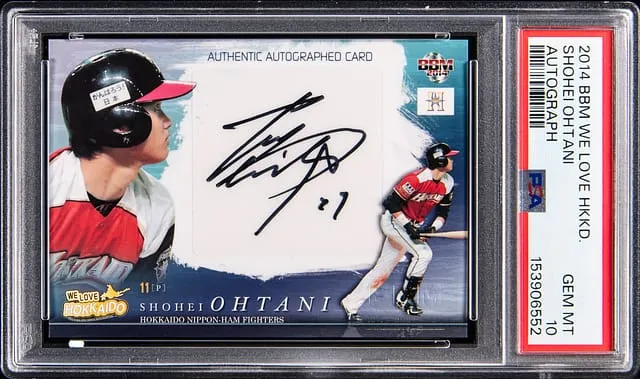
2014 BBM Ohtani Auto /30 PSA 10 Pop 1 Sells for $197K
Figoca breaks down the $197,640 Goldin sale of the 2014 BBM We Love Hokkaido Shohei Ohtani /30 PSA 10 pop 1 autograph rookie card.
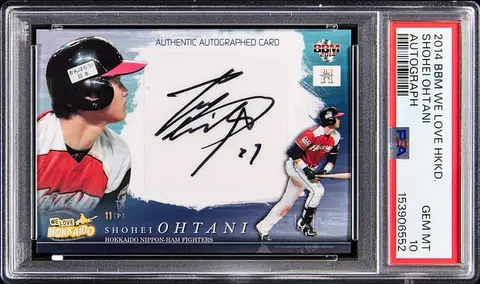
Sold Card
2014 BBM We Love Hokkaido Autograph Shohei Ohtani Signed Rookie Card (#03/30) - PSA GEM MT 10 - Pop 1
Sale Price
Platform
Goldin2014 BBM We Love Hokkaido Shohei Ohtani Autograph Rookie PSA 10 Sells for $197,640
On May 10, 2026, Goldin sold a key early Shohei Ohtani card that quietly says a lot about how the market now views his Japanese-era issues:
2014 BBM We Love Hokkaido Autograph Shohei Ohtani Signed Rookie Card (#03/30) – PSA GEM MT 10 – Pop 1
Final price: $197,640 (USD)
Auction house: Goldin
Sale date (UTC): 2026-05-10
For collectors who mainly follow Ohtani’s MLB cards, this BBM autograph can be easy to overlook. But in terms of scarcity, story, and grading population, it’s one of the sharper examples of how the market is starting to price his earliest licensed Japanese signatures.
The Card at a Glance
Let’s break down what this card actually is:
- Year: 2014
- Brand / Set: BBM "We Love Hokkaido" (Japanese issue)
- Player: Shohei Ohtani
- Team: Hokkaido Nippon-Ham Fighters (NPB)
- Card type: Certified autograph
- Serial numbering: #03/30 – only 30 copies produced
- Rookie status: Considered an early NPB rookie-era autograph, often treated as a key rookie autograph by collectors who chase his Japan cards
- Signature type: On-card autograph (signed directly on the card, not on a sticker – a notable plus for many collectors)
- Grading company: PSA
- Grade: GEM MT 10
- Population (pop report): Pop 1 – PSA has graded only one example at a 10, with no higher grade possible.
In hobby terms, “pop 1” means there is only one copy in the PSA population report at that grade. For something already capped at 30 copies to begin with, that creates a very thin supply at the top of the grading ladder.
Why This BBM Ohtani Matters
1. Early, Licensed Ohtani Ink
While Topps and Bowman chrome autographs get most of the attention in the U.S., Ohtani’s first licensed, pack-pulled autographs came in Japan with BBM. These early NPB issues capture him as a two-way phenom before the MLB transition.
For serious Ohtani collectors, there are a few key categories:
- First Japanese autographs (NPB, BBM/Calbee, etc.)
- First MLB pack-issued autos (Topps/Bowman)
- Flagship rookies and key parallels
This 2014 BBM We Love Hokkaido auto sits squarely in that first lane. It’s not just a random parallel; it’s a low-serial, on-card autograph from his true early years in professional baseball.
2. Ultra-Low Print Run
A print run of 30 copies is small by any modern standard. For comparison:
- Core U.S. rookie parallels frequently range into the hundreds or more.
- Even many “short print” or “SP” cards (intentionally printed in smaller quantities) are more common than /30 autos.
When those 30 cards are further chopped down by grading outcomes, the available supply of high-grade copies becomes extremely tight. A single PSA 10 pop 1 effectively functions as the top of the market for this specific card.
3. PSA 10 in an NPB Issue
Japanese BBM cards often present different printing and handling challenges than mainstream U.S. chromium products. Centering, edges, and surface can be tougher, and historically fewer NPB cards were submitted to PSA before Ohtani-mania fully took hold.
That combination – smaller grading pool plus real condition sensitivity – means a PSA GEM MT 10 in a low-serial NPB autograph is not trivial. The pop 1 label reflects that reality.
Market Context and Price Range
This Goldin result at $197,640 is not happening in a vacuum. For context, collectors typically look at “comps” (short for comparables) – recent sales of the same card or very close variants – to understand where the market is.
Because this specific card is:
- Serial-numbered to 30, and
- A PSA 10 pop 1,
exact 1:1 comps are extremely limited. Instead, the market usually triangulates using:
- Other grades of the same /30 BBM We Love Hokkaido auto (PSA 9, BGS 9.5, raw)
- Other 2013–2015 BBM Ohtani autographs from similar low-serial subsets
- High-end Ohtani MLB rookie autos with similar scarcity and grade
Across auction archives and major marketplaces, the pattern over the last couple of years has been:
- Lower-grade or raw copies of Ohtani’s early BBM autos (including We Love Hokkaido and comparable 2014 issues) have sold significantly below this level, with meaningful step-ups as condition improves.
- Gem-mint, low-serial Ohtani autographs – whether NPB or MLB – frequently command strong premiums, particularly when population reports are thin.
Given the low population and the lack of direct PSA 10 comps, this $197,640 sale sits toward the strong end of what has been seen for Ohtani’s early Japanese autographs, especially when framed against other NPB issues rather than his top MLB rookies.
Instead of thinking of it as a strict “record vs. non-record” number, it’s more useful to view it as:
- A clear marker for top-end Japanese Ohtani autos, and
- A data point that shows buyers are willing to value NPB pieces alongside his big U.S. rookie cards, not far beneath them.
How This Fits in the Wider Ohtani Market
Ohtani’s market has been driven by a mix of:
- On-field performance – MVP awards, two-way dominance, and the historic nature of what he’s doing.
- Narrative and global reach – a Japanese superstar succeeding at the highest level in MLB while maintaining a massive fanbase in Japan.
- Limited true rookie and early autographs – especially in comparison to many modern stars with large auto checklists.
As his MLB accomplishments stack up, collectors have increasingly:
- Revisited his NPB-era cards, and
- Differentiated between mass-printed inserts and truly scarce, certified autographs.
The 2014 BBM We Love Hokkaido auto checks several boxes that tend to hold collector interest over time:
- Early-career card from his first professional team
- Fully licensed NPB release
- On-card autograph
- Serial-numbered /30
- Gem-mint top-pop grade
All of that helps explain why it can sit in the same general conversation as some of his higher-end MLB rookie pieces, even though it comes from a domestic Japanese product line.
What Collectors Can Take Away
For newcomers, returning collectors, and small sellers, here are a few practical takeaways from this sale:
1. Understand the Role of Population Reports
A population report (or "pop report") shows how many copies of a card have been graded at each grade level by a grading company.
- A pop 1 PSA 10 in a card limited to 30 is structurally scarce – you’re combining a tiny print run with the highest possible grade and only one example at that level.
- That scarcity helps explain why the final price can sit well above sales of lower-grade or ungraded copies, even if those seem visually similar.
2. NPB Cards Are Not an Afterthought
As Ohtani’s MLB resume has grown, the hobby has been reassessing his early Japanese issues. Collectors are increasingly:
- Differentiating between base/non-numbered cards and serial-numbered, autographed, or otherwise premium inserts.
- Granting more weight to well-documented, low-serial Japanese cards when building “complete” Ohtani collections.
If you’re sorting older Japanese boxes or singles, it’s useful to:
- Look for on-card autos, serial numbers, and major subset branding (like We Love Hokkaido).
- Check whether they’ve been graded and, if not, inspect condition carefully before assuming they’re “just another insert.”
3. Auction Context Matters
This sale occurred at Goldin on May 10, 2026 (UTC), a major auction house with a strong track record for high-end modern cards.
That context matters:
- High-end buyers tend to frequent these auctions, which can help top-tier, low-pop cards find an appropriate audience.
- If you see a big price and wonder whether it’s an outlier, check where it was sold, how it was marketed, and whether similar cards have appeared in the same venue.
Final Thoughts
The 2014 BBM We Love Hokkaido Shohei Ohtani Autograph Rookie Card (#03/30) in PSA GEM MT 10 pop 1 form is a focused case study in how the hobby is valuing:
- Early, licensed NPB issues
- Genuine scarcity (both print run and grade)
- The narrative appeal of Ohtani’s two-continent career
At $197,640 via Goldin on May 10, 2026, it underscores that the market is willing to treat Japanese-era Ohtani autographs as more than side notes – especially when they sit at the absolute top of the grading population.
For collectors building an Ohtani timeline, this card represents one of the sharper, rarer early signatures connecting his Nippon-Ham Fighters years to everything that has followed in MLB.