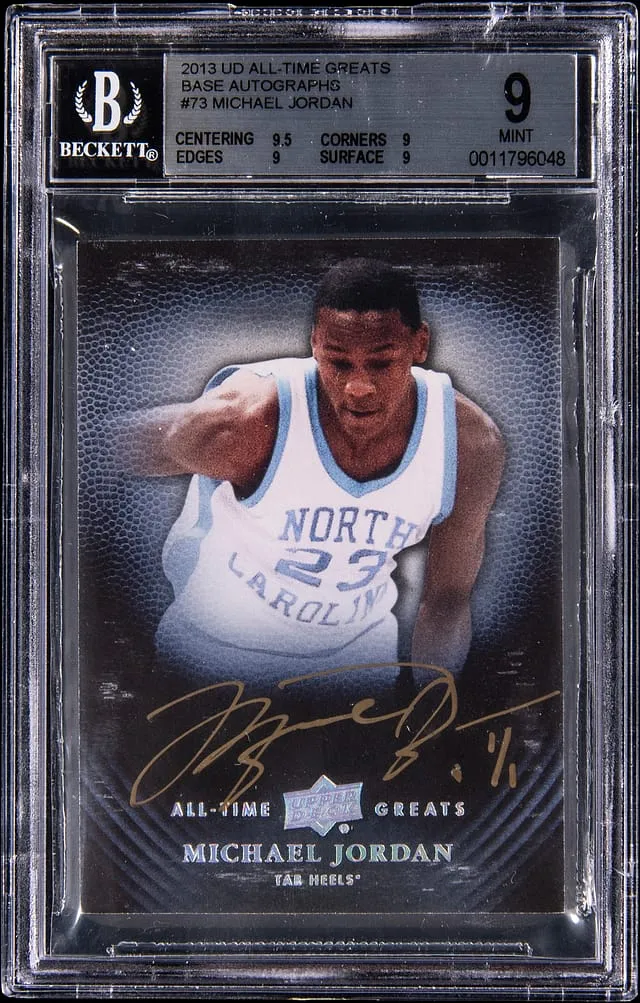
2013 UD All‑Time Greats Jordan 1/1 Auto BGS 9 Sale
A 2013 Upper Deck All‑Time Greats 1/1 Michael Jordan auto BGS 9 sold for $22,387 at Goldin. See how this sale fits into the modern MJ auto market.
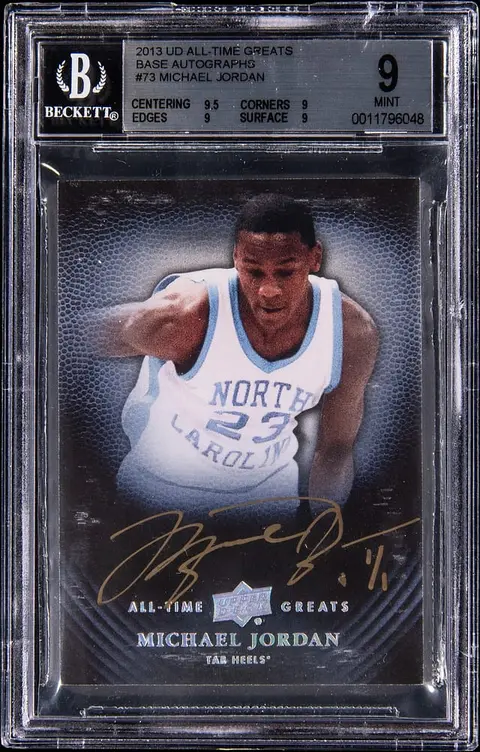
Sold Card
2013 Upper Deck All-Time Greats Base Autographs #73 Michael Jordan Signed Card (#1/1) - BGS MINT 9
Sale Price
Platform
Goldin2013 Upper Deck All‑Time Greats Michael Jordan Auto #73 BGS 9 Sells for $22,387
On May 10, 2026, Goldin sold a 2013 Upper Deck All‑Time Greats Base Autographs #73 Michael Jordan signed card, serial‑numbered 1/1 and graded BGS MINT 9, for $22,387. For collectors who like to track modern Jordan ink and high‑end serial‑numbered issues, this is a useful data point in a segment of the market that doesn’t trade often.
In this breakdown, we’ll look at what this card is, why the set matters, and how this sale fits into the broader Michael Jordan autograph market.
Card at a glance
- Player: Michael Jordan
- Team represented: North Carolina Tar Heels (collegiate uniform)
- Year: 2013
- Set: 2013 Upper Deck All‑Time Greats
- Subset: Base Autographs
- Card number: #73
- Serial numbering: 1/1 (one‑of‑one, unique copy)
- Autograph: On‑card signature (signed directly on the card, not on a sticker)
- Rookie card? No – this is a modern premium auto, not a rookie
- Era: Modern / early 2010s
- Grading company: Beckett Grading Services (BGS)
- Grade: BGS MINT 9
The card combines several traits collectors tend to value:
- On‑card auto: Many modern autographs are “sticker autos,” where the player signs a sticker later applied to the card. On‑card signatures are usually preferred because they feel more connected to the design and the signing session.
- One‑of‑one serial numbering: A 1/1 means this exact card is the only copy produced with this specific combination of design and numbering. While there are other Jordan autos in the product, this particular version exists only once.
- BGS MINT 9: Beckett’s Mint 9 is a strong grade for an autographed card from this era, especially with dark borders and foil that can pick up chipping and surface flaws.
About 2013 Upper Deck All‑Time Greats
Upper Deck released All‑Time Greats as a premium, autograph‑focused product built around legendary players rather than active‑roster checklists. Michael Jordan, as one of Upper Deck’s headline exclusive signers, is a central name in the set.
Key characteristics of the product:
- Legend‑heavy checklist: Jordan, LeBron (still under UD at the time), and other Hall of Famers and superstar names.
- Autograph‑driven configuration: The appeal is less about base cards and more about on‑card autos and low‑serial inserts.
- Collegiate and thematic imagery: Upper Deck often uses NCAA or thematic photography due to not holding the NBA trading card rights. For Jordan, that usually means UNC Tar Heels or stylized imagery rather than Bulls jerseys.
Within that context, the Base Autographs are an important core component of the product: they’re cleanly designed, on‑card, and tied to a well‑defined checklist of legends. The 1/1 treatment makes this particular Jordan stand out even within a premium‑leaning release.
Market context and comps
Because this is a one‑of‑one, identical comps (short for “comparables,” meaning previous sales of the same card) are inherently limited. However, we can still look at closely related pieces and segments:
1. Other 2013 Upper Deck All‑Time Greats Jordan autos
Public auction data from the last few years shows:
- Non‑1/1 Jordan All‑Time Greats autos (for example, serial‑numbered to /10, /15, /23, etc.) in strong BGS or PSA grades have tended to land in the mid‑four‑figure to low‑five‑figure range, depending on numbering, inscription, and aesthetics.
- Shorter‑print parallels (such as /5 or 1/1 from similar Upper Deck Jordan‑centric products) have pushed further, especially when combined with a strong grade and eye appeal.
Against that backdrop, $22,387 for a graded 1/1 from All‑Time Greats sits on the higher side of typical UD Jordan auto outcomes but under the levels we see for his absolute top‑tier pieces (Exquisite and certain 1990s inserts).
2. Comparing to Jordan’s premium autograph tiers
When you step back and look at the broader Michael Jordan auto market:
- Exquisite Collection and early 2000s UD patch autos (often with Bulls jerseys and game‑used pieces) frequently command the highest prices, especially in low serial numbers and top grades.
- Classic 1990s inserts and rare parallels (even non‑auto) can outpace modern autos in the right condition because they’re early, iconic, and heavily chased.
- Modern UD on‑card Jordan autos like this 2013 All‑Time Greats issue tend to occupy a middle tier: highly respected, often more attainable than Exquisite, yet still premium compared with mass‑produced base cards.
Within that structure, a BGS 9, 1/1 All‑Time Greats auto landing at $22,387 fits a pattern where:
- The Jordan name and on‑card auto underpin a strong baseline.
- The one‑of‑one designation provides an additional scarcity premium.
- The absence of an NBA game‑used patch or Bulls uniform imagery keeps it below the absolute top end of Jordan sales.
3. Price direction, not prediction
Because 1/1s often appear sporadically, it’s more useful to view this as one data point among many Jordan autograph outcomes rather than as a definitive “market price” for all similar cards. It shows that:
- Serious buyers remain willing to pay low‑ to mid‑five‑figure amounts for strong, modern Jordan autos from respected Upper Deck lines.
- Conditioned scarcity (one‑of‑one plus a Mint grade) continues to be recognized in bidding behavior.
This doesn’t guarantee where future prices will go; it simply helps map the current landscape for collectors who track trends.
Collector significance
Why collectors care about this card
Several factors contribute to hobby interest in this particular Jordan:
Michael Jordan’s ongoing centrality to the hobby
Jordan remains one of the two or three most important names in sports cards overall. His rookies (especially 1986 Fleer), 1990s inserts, and Upper Deck autographs anchor many long‑term collections. This broader demand spills into almost every well‑designed, authenticated Jordan auto.Upper Deck’s exclusive autograph relationship
Because Upper Deck has long held exclusive rights to Jordan’s trading‑card autographs, modern licensed Jordan signatures show up in UD products like this one rather than in current NBA‑licensed sets. That concentrates demand into a narrower set of products.On‑card autograph, not a sticker
For many collectors, on‑card autos feel more legitimate and visually clean. With a player of Jordan’s stature, on‑card signing is almost an expectation at the high end.1/1 scarcity within a structured set
One‑of‑ones are now common across many products, but they’re not all treated equally by the market. When a 1/1 comes from a clearly defined, legend‑focused release with a meaningful checklist, it tends to feel less like a random parallel and more like a focal point of the product.BGS MINT 9 grade
High‑end buyers often look for graded examples to reduce risk around condition. A BGS 9 signals a strong copy; subgrades (centering, corners, edges, surface) can matter too, especially if any approach 9.5 or 10. While pop reports (population reports – counts of how many copies exist in each grade) are less meaningful on 1/1s, the grade still affects liquidity and confidence.
Era and set positioning
This card sits in the modern / ultra‑modern crossover era (2010s), which typically features:
- More deliberate, premium‑style products.
- Heavier use of serial numbering and on‑card autos.
- A collecting audience that is very aware of grading and condition.
For Jordan specifically, it represents a post‑playing‑career, curated autograph release, different from his 1980s–90s playing‑days cards but still integral to how many collectors build out a Jordan PC (personal collection).
Factors that may be influencing interest
A few broader hobby and basketball dynamics form the backdrop for sales like this:
- Continued attention on Jordan’s legacy: Documentaries, Hall of Fame discussions about his peers, and historical comparisons in sports media keep Jordan top of mind.
- Ongoing interest in graded, authenticated autos: As the hobby becomes more condition‑ and authenticity‑conscious, graded autographs from trusted issuers like Upper Deck often see sustained demand.
- Relative scarcity of high‑quality Jordan autos in circulation: Many key Jordan autos are locked into long‑term collections. When a strong example surfaces at a major house like Goldin, it tends to attract a focused group of bidders.
None of these guarantee price outcomes, but they help explain why a modern, non‑rookie Jordan card can still command a low‑five‑figure result.
What this sale might mean for collectors
For newcomers and returning collectors:
- This sale shows that not all significant Jordan cards are rookies or 1990s inserts. Modern, well‑designed autograph issues from reputable products can be central to serious collections.
- Understanding the product line (in this case, All‑Time Greats) and the autograph type (on‑card vs. sticker) is just as important as knowing the serial number.
For active hobbyists and small sellers:
- When you evaluate a Jordan autograph, it helps to frame it within at least three layers:
- The product family (Exquisite, All‑Time Greats, SP Authentic, etc.).
- The scarcity profile (1/1 vs. /10 vs. /25, and how often it surfaces publicly).
- The grade and presentation (slab type, subgrades, centering, autograph quality).
- Comps for 1/1s will always be imperfect. Looking at parallel structures in the same set and adjacent products can provide better context than fixating on a single headline price.
Takeaways
The 2013 Upper Deck All‑Time Greats Base Autographs #73 Michael Jordan 1/1, graded BGS MINT 9, selling for $22,387 at Goldin on May 10, 2026, reinforces a few consistent themes in the Jordan market:
- Modern, on‑card Upper Deck Jordan autos from well‑regarded products continue to attract serious buyers.
- One‑of‑one serial numbering, when paired with a strong grade, commands a noticeable premium over more common print runs.
- Even outside of rookies and 1990s grails, Jordan’s signature and brand remain central pillars of the high‑end basketball card space.
For collectors building a long‑term Jordan PC or simply trying to understand where modern autograph issues sit relative to his broader market, this sale is a clear, data‑backed reference point.
As always, it’s best to use results like this as context rather than a forecast. Watch how similar Upper Deck Jordan autos perform across multiple auctions and platforms over time to build a more complete picture.