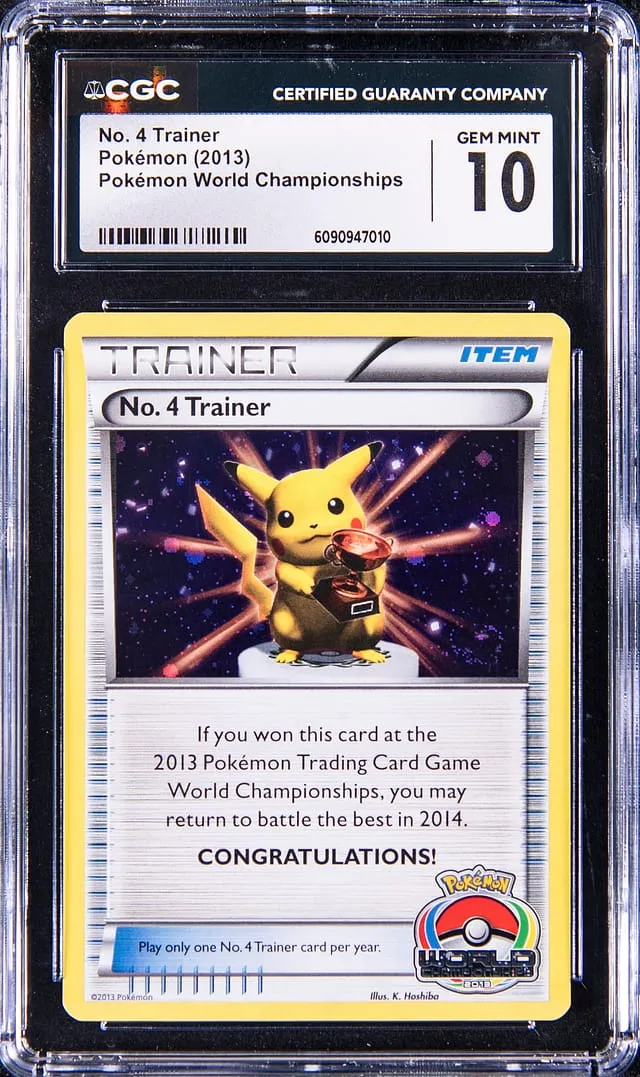
2013 Pikachu No. 4 Trainer Trophy CGC 10 sells for $43K
A CGC 10 pop 2 2013 Pokémon Worlds No. 4 Trainer Pikachu trophy card sold for $43,920 at Goldin. Here’s what that means for high-end Pokémon.
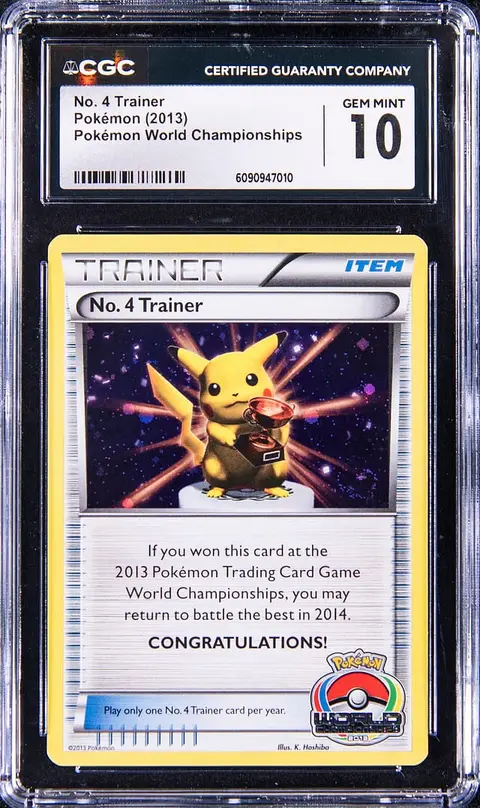
Sold Card
2013 Pokemon World Championships No. 4 Trainer Pikachu Trophy Card - CGC GEM MINT 10 - Pop 2
Sale Price
Platform
Goldin2013 Pokémon World Championships No. 4 Trainer Pikachu Trophy Card – CGC 10 Pop 2 Sells for $43,920
On April 27, 2026, Goldin quietly recorded a result that matters for anyone who follows high-end Pokémon: a 2013 Pokémon World Championships No. 4 Trainer Pikachu Trophy Card, graded CGC Gem Mint 10, sold for $43,920.
For a niche, non-pack-issued card with a population of just two in CGC 10, this sale is a useful data point in understanding how the market is currently valuing modern-era Pokémon trophies.
What exactly is this card?
Let’s start by identifying it clearly:
- Character: Pikachu (illustrated in a Worlds “Trainer” trophy design)
- Year: 2013
- Event: Pokémon World Championships
- Card type: No. 4 Trainer Trophy Card (awarded at the event; not pulled from booster packs)
- Era: Modern / early ultra-modern Pokémon (2010s)
- Grading company: CGC (Certified Guaranty Company)
- Grade: Gem Mint 10
- Population: Pop 2 in CGC 10 (only two copies graded this high at CGC at the time of reporting)
- Key traits: Ultra-low print, event-awarded trophy card; not a standard set card and not a typical “rookie,” but a core piece of competitive Pokémon history.
Trophy cards like this were typically awarded to top finishers at the World Championships (or related high-level events). They are sometimes personalized, sometimes not, but in all cases they were never mass-distributed to the public in the way regular set cards are.
Why collectors care about Pokémon trophy cards
Trophy cards sit in a different category from everyday chase cards:
- Event-issued: You could not pull this from a pack. It was given directly to a very small number of top players.
- Ultra-low print: For most Worlds-era No. 1–4 Trainer cards, the total number of copies is in the single digits or low double digits. Exact print quantities are often not fully public, but they are far below any main-set secret rare.
- Competitive history: These cards document the early and mid-period competitive scene for Pokémon TCG. For many collectors, that tournament history matters more than pack odds.
- Difficult to grade: Many copies lived in players’ hands, not in sleeves in a vault. That makes perfect or near-perfect grades especially scarce.
Within that broader trophy category, World Championships Pikachu trophy cards from the 2000s and 2010s have built a reputation as some of the most historically important Pokémon cards outside of the original 1990s Japanese trophies.
Grading, population, and why “Pop 2” matters
When collectors talk about a “pop report” (population report), they mean the grading company’s count of how many copies exist at each grade.
For this card, the key details are:
- Grader: CGC
- Grade: Gem Mint 10
- Population at this grade: 2
That “Pop 2” note means only two copies have ever achieved a Gem Mint 10 at CGC. For context:
- Trophy cards typically have very thin grading populations across all companies, not just at the top grade.
- A total population of only a handful of graded copies is normal for some Worlds-era trophies.
- Add in the fact that CGC 10 is a stringent grade, and you end up with a card that is not just rare in print, but also rare in top condition.
For high-end collectors, this kind of scarcity can matter as much as character popularity. Pikachu helps, but the combination of Pikachu + Worlds trophy + Gem Mint + Pop 2 is what really defines this card.
Market context: how does $43,920 fit in?
This Goldin sale closed on April 27, 2026, at $43,920. To understand how the market is treating that number, it helps to look at a few pieces of context:
Exact-card comps (comparable sales):
- Public, recent auction results for this exact card, in this exact grade (CGC 10), are very thin or nonexistent. Trophy cards change hands infrequently, and many deals are private.
- That makes every public sale like this one an important new reference point rather than just another data point in a large, liquid market.
Nearby comps: same card, different grades or graders:
- Historically, PSA-graded Worlds trophies have tended to command a premium, especially in PSA 9 and PSA 10, simply because PSA has been the default standard for many long-time Pokémon collectors.
- CGC has gained traction, especially for condition-sensitive cards and registry-minded collectors, but the market is still building a deeper track record for top-pop CGC trophy sales.
- Lower grades (for example, PSA 7/8 or CGC 8/9) of comparable World Championship trophy Pikachu cards have previously sold at significantly lower levels, reflecting how harshly the market separates “mint” from “gem mint” in this niche.
Wider trophy market:
- Earlier Japanese trophies from the late 1990s and early 2000s (for example, Trophy Pikachu, No. 1–3 Trainers, University Magikarp, etc.) have historically set the top-line records for Pokémon.
- 2010s trophies, including 2013 World Championships cards, typically trade at a discount to those earliest-era grails but still sit in the upper tier of modern Pokémon pricing.
Given the scarcity of direct, same-grade comps, this $43,920 result looks like a clear, high-confidence marker of what a top-condition, CGC Gem Mint 10 example can command in a competitive, public auction setting as of early 2026. It does not appear out of step with the broader trajectory of high-end Worlds-era trophies, but it does underscore that the market is willing to recognize CGC 10 as a true premium grade here.
How this sale fits into the broader Pokémon market
A few factors help frame this result for collectors and small sellers:
Modern vs vintage dynamics:
- This is not a 1999–2000 era card, but it carries a lot of the same appeal: Pikachu, trophy status, ultra-low print.
- While many modern cards from mass-printed eras struggle with oversupply, trophy cards like this one are effectively immune to that issue because of their distribution model.
Event nostalgia:
- The 2013 World Championships sit in a period where participation and streaming coverage of competitive Pokémon were ramping up, adding later nostalgia for both players and viewers.
- As participants age into higher-earning years, demand for tangible pieces of that history can grow. Worlds trophies are a direct way to collect that history.
Grading trends:
- CGC continues to build its presence in Pokémon, particularly with set collectors who appreciate detailed subgrades and stricter standards.
- Sales like this one help normalize CGC 10 as a target grade for serious collectors, not just PSA 10.
Market mood:
- Ultra-rare, historically anchored items—especially trophies—have generally held up better through hobby cycles than mass-produced chase cards.
- This sale contributes to that narrative: it shows that, in early 2026, demand for true rarity with strong provenance remains resilient.
What this could mean for collectors and small sellers
Without making predictions or giving financial advice, there are a few takeaways:
For high-end collectors:
- This result helps you benchmark what a pop-2, gem-mint Worlds Pikachu trophy can do in a major auction house environment.
- If you hold similar pieces (different years, different finish positions, or different graders), this sale is a useful anchor when you think about insurance valuations or future sale decisions.
For returning or newer collectors:
- Trophy cards are a reminder that not all Pokémon cards operate by the same rules as set cards. You’re dealing with art, history, and event scarcity, not just pack odds.
- Seeing a $43,920 sale doesn’t mean every Worlds trophy is in that ballpark, but it does underline how far the top end of the hobby can go when rarity and condition line up.
For small sellers:
- Realistically, very few small sellers will have access to a card like this. But you might encounter lower-tier prize cards, staff promos, or other event-issued items.
- This sale illustrates that provenance (where a card came from) and documented scarcity can matter as much as character when assessing potential value.
The role of Goldin and the sale date
Major auction houses like Goldin matter because they:
- Attract a concentrated pool of high-end bidders.
- Provide broad visibility to serious collectors.
- Create public, verifiable sale records that the hobby can reference later.
The timing also helps frame the result:
- Sale date: April 27, 2026 (UTC)
- Auction house: Goldin
For anyone tracking market history, citing both the date and venue is important. If a similar card sells in a different venue or a different market climate, those details help explain any price differences.
Final thoughts
The 2013 Pokémon World Championships No. 4 Trainer Pikachu Trophy Card in CGC Gem Mint 10 (Pop 2) selling for $43,920 at Goldin on April 27, 2026 is more than just a big headline number. It’s a snapshot of how the hobby currently values:
- Worlds-era trophy rarity
- Pikachu-focused competitive history
- Top-pop condition in a stringent grading standard
For figoca users—whether you’re browsing sales data, cataloging your collection, or just learning the landscape—this sale is a useful reference point for understanding where high-end modern Pokémon trophies sit in today’s market, and how condition and provenance can shape outcomes at the very top of the curve.