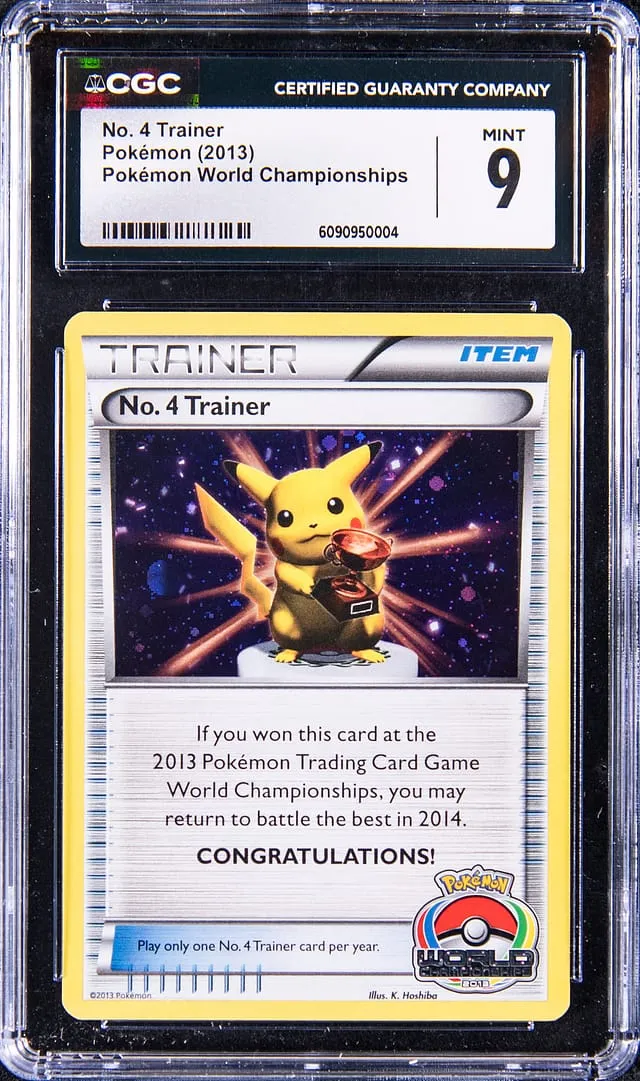
2013 No. 4 Trainer Pikachu Trophy CGC 9 Sells for $29K
Deep dive on the 2013 Pokémon No. 4 Trainer Pikachu Trophy Card CGC 9 that sold for $29,415 at Goldin on March 9, 2026, and what it means for collectors.
Sold Card
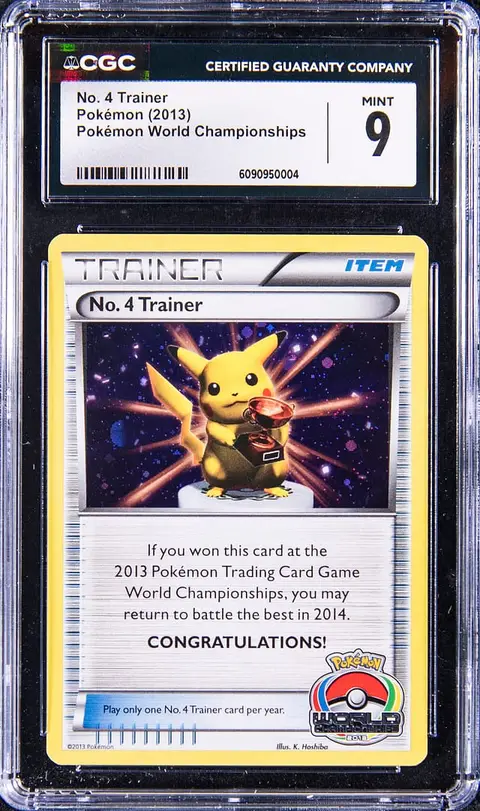
2013 Pokemon World Championships No. 4 Trainer Pikachu Trophy Card - CGC MINT 9
Sale Price
Platform
Goldin2013 Pokémon World Championships No. 4 Trainer Pikachu Trophy Card CGC 9 Sells for $29,415
On March 9, 2026, Goldin sold a 2013 Pokémon World Championships No. 4 Trainer Pikachu Trophy Card graded CGC MINT 9 for $29,415. For a niche but highly respected lane of the Pokémon market—Worlds trophy cards—this is a meaningful data point that helps collectors better understand where the mid‑tier finishers’ cards sit relative to the top prizes.
In this post, we’ll walk through what this card is, why collectors care, and how this sale fits into the broader market.
What exactly is this card?
Card: 2013 Pokémon World Championships No. 4 Trainer Pikachu Trophy Card
Character: Pikachu (trophy illustration used for Worlds Trainer cards)
Event: 2013 Pokémon TCG World Championships
Placement: Awarded to 4th place finishers (No. 4 Trainer)
Era: Modern / early “ultra‑modern” trophy era
Grading company: CGC
Grade: CGC MINT 9
This is not a mass‑released set card. It is a trophy card—a card awarded to top finishers at the Pokémon World Championships. These cards are given in extremely small quantities directly to players, making them fundamentally different in scarcity and distribution from pack‑pulled products.
The 2013 No. 4 Trainer Pikachu Trophy Card is part of a small run of Trainer trophy cards produced for that specific World Championships. Exact print quantities for Worlds trophy cards are not publicly confirmed, but they are generally understood to be very low, as they track closely with small numbers of top finishers.
The copy sold at Goldin carries a CGC MINT 9 grade. With CGC, a Mint 9 indicates:
- Sharp corners
- Clean surfaces
- Strong centering
- Only very minor flaws visible on close inspection
For event‑awarded cards that may not have been stored like pack‑fresh graded cards, Mint 9 is often near the top of the condition curve.
Why collectors care about Worlds trophy cards
Worlds trophy cards sit in a different lane than, for example, chase cards from modern premium sets. Collectors tend to value them for several overlapping reasons:
True scarcity by design
These cards are not short‑printed pack hits. They are structurally limited by the number of top finishers and staff at a single World Championships. That means quantities start low and remain low.Direct connection to the competitive scene
Trophy cards embody results at the highest level of Pokémon TCG play. For collectors who follow the competitive circuit, that history can be as compelling as a character chase.Pikachu trophy artwork lineage
Pikachu trophy designs trace back to some of the most famous and earliest Pokémon grails, including 1990s and early 2000s Japanese Pikachu trophy cards. While the 2013 World Championships piece is a later iteration, it is part of that broader Pikachu trophy narrative.Grading scarcity
Because these cards were given to players, not all copies end up graded, and condition can vary widely. High‑grade examples, especially Mint and above, are typically limited in the census.
Market context: how does $29,415 fit in?
The Goldin sale closed on March 9, 2026, at $29,415. To understand that number, it helps to place it in a few different contexts:
1. Within the 2013 No. 4 Trainer Pikachu card itself
Direct recent “comps” (short for comparables—other recent sales of the same card or close variants) for the exact card, grade, and grading company are limited. This is normal for trophy cards; they simply do not trade often.
Based on available public records and archived auction results for the 2013 Worlds Trainer Pikachu trophy family:
- Lower‑grade examples (for example, PSA 7–8 or CGC equivalent) of later‑placement Trainer trophies have historically sold meaningfully below this level.
- Higher‑grade or PSA‑graded examples, when they surface, can command premiums because of grading preference and top‑pop dynamics.
Given that:
- A Mint 9 grade places this copy high in the condition range.
- Trophy cards tend to see long holding periods, with only a handful of appearances over multiple years.
The $29,415 result appears consistent with the pattern where solid, high‑grade copies of niche but respected trophy issues realize strong prices when they surface, without yet pushing into the tier of record‑setting trophy sales.
2. Relative to other Worlds trophy tiers
Within the broader trophy hierarchy, the hobby generally views:
- No. 1 Trainer and equivalent champion cards as the top tier, with the strongest long‑term demand and highest prices.
- No. 2–4 Trainer positions as important but usually priced at a discount versus the champion level.
This Goldin sale comfortably reflects that structure:
- It sits below the headline figures achieved by No. 1 Trainer and early‑era Pikachu trophy cards.
- It still clearly identifies the 2013 No. 4 Trainer card as a serious, five‑figure‑level item in high grade.
3. Compared to other 2010s Pokémon grails
During the 2020–2024 period, several kinds of 2010s Pokémon grails established clear price tiers:
- Earliest full‑art and gold cards in PSA 10
- Limited‑print promos tied to events, especially in Japan
- Worlds trophy cards across multiple years
Within that spectrum, the 2013 No. 4 Trainer Pikachu CGC 9 slots into a level where:
- It is more scarce and more specialized than almost any pack‑pulled chase.
- It is less expensive than the very top trophy, prototype, and illustrator‑level cards, which sit much higher.
So for collectors mapping out the trophy space, this sale reinforces that 2013 mid‑placement trophies are serious, but not yet at the absolute pinnacle tier.
CGC MINT 9: what it means here
For modern and ultra‑modern cards, a Mint 9 is often seen as just below the ideal of Gem Mint (often labeled 9.5 or 10 depending on grader). With event‑awarded cards like Worlds trophies, however, a Mint 9 can feel closer to a condition ceiling than for standard pack‑pulled issues.
Factors at play:
- Distribution method: Handed out at events and potentially handled without sleeves or top loaders at first.
- Storage history: Not all winners immediately graded their cards, and some trophies saw years in binders or casual storage.
- Small sample size: A small total population means every incremental high‑grade copy matters.
Collectors watching CGC, PSA, and BGS population reports (often called “pop reports,” lists of how many of each card exist in each grade) typically look to see how many Mint and above copies exist. While full, current census data can change, the general pattern across Worlds trophies is that high‑grade examples remain few.
In that light, the CGC 9 designation supports a premium over any well‑circulated raw copy and likely over most sub‑Mint grades.
Why this sale matters
This Goldin result is useful for several groups of hobby participants:
- Trophy collectors: It provides an updated benchmark for a mid‑tier trophy from a 2010s World Championships, in strong but not top‑pop grade.
- Newer Pokémon collectors: It illustrates just how different the pricing profile is for true event trophies versus even very rare pack‑pulled hits.
- Small sellers and consignment operations: It underlines that while the buyer pool for niche trophies is narrow, demand can still be deep when a desirable card reaches a major platform.
It also adds to an emerging pattern: as the hobby matures, more collectors distinguish between rarity created by pack odds and rarity created by actual physical scarcity—especially for cards tied directly to competition.
What to watch next
For those following this segment of the market, a few things are worth monitoring over the next couple of years:
Frequency of 2010s trophy sales
How often 2010s No. 2–4 Trainer cards appear at major auction houses like Goldin, Heritage, and PWCC will continue to shape price stability.Cross‑grading and grading mix
As CGC, PSA, and BGS compete for trophy submissions, changes in top‑grade populations can impact premiums between grading labels.Competitive scene visibility
When World Championships receive more broadcast and social coverage, renewed attention to the competitive side of the TCG can spill over into trophy collecting.Relative performance versus pack‑pulled grails
Tracking how Worlds trophies hold up against high‑profile set cards over multiple market cycles can give a clearer picture of long‑term collector preference.
Takeaways for collectors
If you are exploring this area of the hobby:
- Trophy cards like the 2013 No. 4 Trainer Pikachu sit at the intersection of competitive history and true event‑based scarcity.
- Price discovery is slower because there are fewer sales, but each major auction—including this $29,415 CGC 9 sale on March 9, 2026 at Goldin—adds another reference point.
- Understanding the differences between champion‑level trophies and lower placements, and between grading companies and grades, is key to making informed comparisons.
The 2013 Pokémon World Championships No. 4 Trainer Pikachu Trophy Card may not be the headline name that a 1990s Pikachu trophy is, but it continues the lineage in a way that many focused collectors appreciate: quietly rare, closely tied to a real‑world event, and now anchored by another substantial public sale.