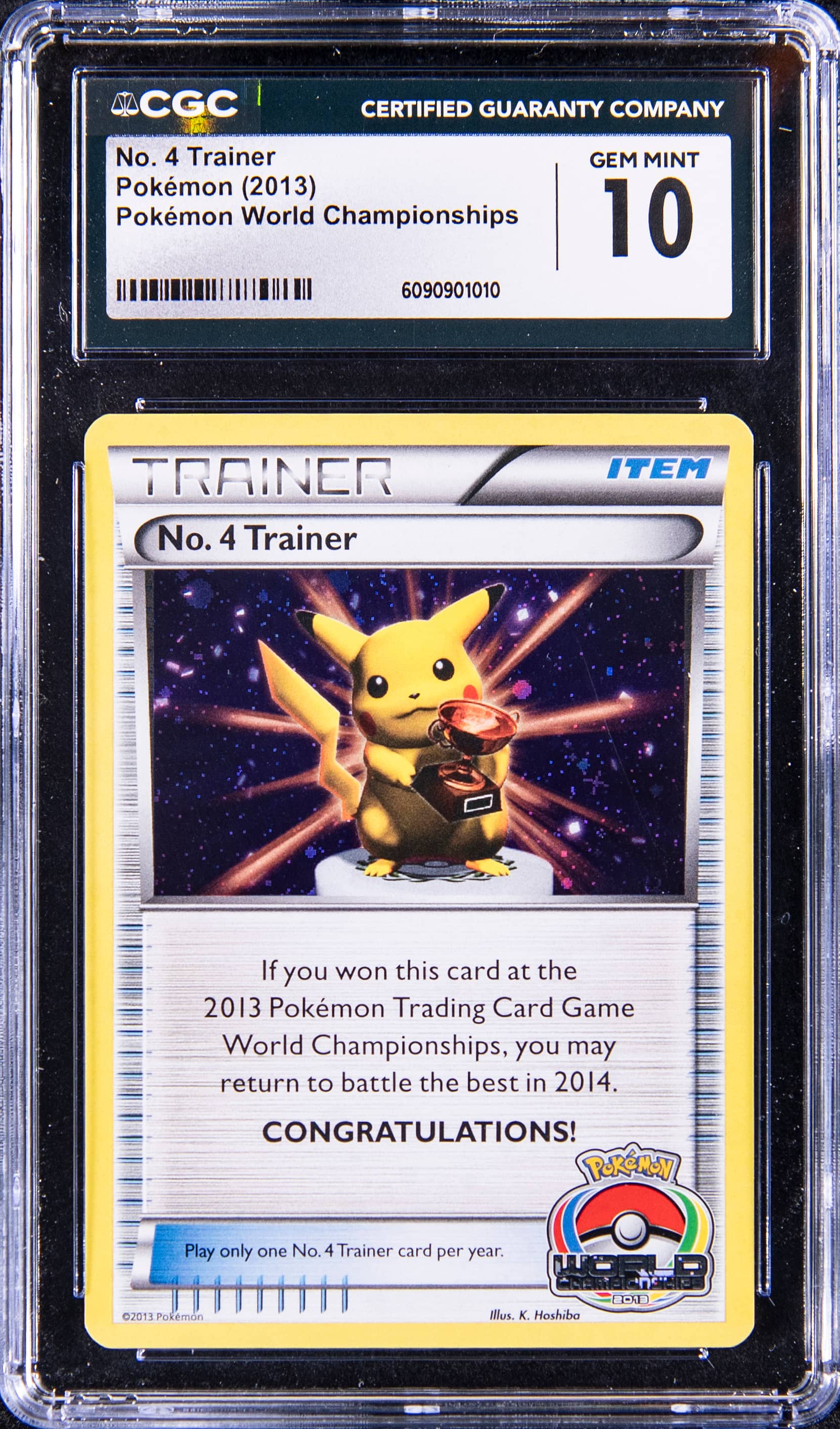
2013 No.4 Trainer Pikachu Trophy CGC 10 Sells for $36K
Goldin sold a 2013 Pokémon No.4 Trainer Pikachu Trophy Card CGC 10 Pop 2 for $36,580. See what this rare World Championships card means for collectors.
Sold Card
2013 Pokemon World Championships No.4 Trainer Pikachu Trophy Card - CGC GEM MINT 10 - Pop 2
Sale Price
Platform
Goldin2013 Pokémon World Championships No.4 Trainer Pikachu Trophy Card CGC 10 Sells for $36,580
When a World Championships trophy card comes to public auction, collectors tend to pay attention. When that trophy card is a Pop 2 CGC GEM MINT 10, it becomes a market event.
On February 16, 2026, Goldin sold a 2013 Pokémon World Championships No.4 Trainer Pikachu Trophy Card, graded CGC GEM MINT 10, for $36,580. For a niche but highly studied segment of the Pokémon market, this is a meaningful data point.
In this breakdown, we’ll walk through what this card actually is, why it matters to collectors, and how this sale fits into the broader price picture.
What exactly is this card?
Card ID:
- Character: Pikachu
- Card type: No.4 Trainer Trophy Card
- Event: 2013 Pokémon World Championships
- Year: 2013
- Set: World Championships Trophy / prize card (not a standard booster set)
- Parallel/variant: Trophy card issued only to top finishers, not a pack-pulled variant
- Rookie/key issue: Not a Pikachu “rookie,” but a key World Championships trophy issue
Grading details:
- Grading company: CGC (Certified Guaranty Company)
- Grade: GEM MINT 10
- Population: Pop 2 in CGC 10 (two copies in this grade on CGC’s population report at time of sale)
This card was awarded at the 2013 Pokémon World Championships to a competitor who finished 4th place in their division. Trophy cards like this are event prizes, not products you could buy at retail or pull from packs, which is why they are treated as some of the scarcest and most historically important cards in the Pokémon hobby.
Why World Championships trophy cards matter
For newer or returning collectors, “trophy card” can sound like just another buzzword. In Pokémon, it has a very specific meaning:
- Trophy cards are awarded to top finishers at official tournaments, most notably the World Championships and earlier Japanese events. They are not sold in stores.
- They often feature unique artwork, event-specific text, and extremely low print runs. Exact numbers are rarely published, but they’re commonly understood to be in the single digits to low double digits per language/division.
- They are anchored to a real-world competitive achievement, which gives them a historical narrative beyond simple rarity.
The 2013 No.4 Trainer Pikachu trophy card fits this pattern. It belongs to the ultra-modern era (roughly mid‑2000s onward) but still follows the long tradition of Pikachu-based trophy and prize cards going back to the late 1990s in Japan.
Within the broader Pikachu trophy family, the most famous examples tend to be earlier Japanese prints that have set record prices in high grades. The 2013 World Championships trophies, while not as publicly documented or frequently transacted, still sit in that same collecting lane: low-availability, event-issued, and heavily condition-sensitive due to how they were distributed.
CGC GEM MINT 10 and population context
Grading and population matter a lot with cards like this. A population report (often shortened to "pop report") is the grading company’s count of how many copies of a specific card they’ve graded, broken down by grade.
Key facts here:
- CGC grade: GEM MINT 10 (their highest standard grade)
- CGC population in 10: 2 copies
With so few copies graded at the top level, the “pop 2” detail becomes important. For ultra-low-print cards, the difference between a 9.5 and a 10 can translate to a sizable price gap. Collectors chasing the very best copies typically compete over the highest-pop grades (often 10s), especially when the total number of graded examples is tiny.
Because these cards rarely surface, population data should be read alongside observed sales. A card can be extremely low pop simply because few owners have chosen to grade or sell their copies, not only because of strict grading standards.
Price: putting the $36,580 sale in context
- Realized price: $36,580 (Goldin, February 16, 2026)
For context, it helps to look at:
- Any known sales of the same 2013 No.4 Trainer Pikachu trophy card in other grades or graders.
- Sales of similar Pikachu World Championships trophy cards from adjacent years (2010s era), particularly in high grade.
- Sales of other modern/ultra-modern Pikachu trophy or prize cards.
Public, verifiable sales of this exact 2013 No.4 Trainer in CGC 10 are extremely limited, which is common for this type of card. Trophy cards from the 2010s era do not trade frequently in open auctions, and many transactions (if they happen) may occur privately.
Based on available public information across major marketplaces and auction houses, a few patterns stand out:
- Sparse comps: “Comps” (short for comparables) are recent sales of the same or very similar items used to gauge current prices. For this exact CGC 10 card, there are few to no earlier widely documented sales, which makes a strict price comparison difficult.
- Related trophy pricing: Other World Championships Pikachu trophy cards from nearby years, especially in top grades from major grading companies, have realized prices in the five-figure and, in some earlier or more iconic cases, six-figure range.
- Grade premium: High-end collectors have consistently paid a noticeable premium for the top graded examples (10s) when they do appear, compared with Near Mint to Mint ranges.
Within that framework, the $36,580 result at Goldin sits firmly in the established territory for serious, low-supply Pokémon trophy cards from the ultra-modern era—significant but not out of step with what the segment has previously demonstrated for comparable items.
Because this specific card doesn’t come up for sale often, it’s more accurate to view this result as a fresh reference point rather than a confirmation of a stable long-term market level.
Collector significance
Several factors support collector interest in this card:
Event provenance
- Awarded at the official 2013 Pokémon World Championships.
- Represents a specific competitive achievement (4th place) instead of being a mass-produced insert.
Character choice: Pikachu
- Pikachu remains the face of the Pokémon brand globally.
- Pikachu-focused collections often target trophy and promo appearances, not just standard set cards.
Trophy card scarcity
- Very limited original distribution.
- Low likelihood that large quantities remain ungraded or will surface regularly.
Grading and condition
- CGC GEM MINT 10 marks it as one of the best-preserved copies known to the market.
- For cards that may have been handled, transported, or displayed by players, pristine condition is less common.
Historical continuity
- Continues the long-running lineage of tournament-awarded Pikachu cards, bridging earlier Japanese-exclusive trophies and modern World Championships issues.
Market takeaways for collectors and small sellers
For collectors or small sellers tracking high-end Pokémon pieces, this sale offers a few practical insights:
- Trophy liquidity is thin: Even popular characters like Pikachu can have extremely illiquid segments. A card like this may not see another public sale for years.
- Comps are more directional than precise: With so few data points, each sale acts more as a reference marker than a firm valuation anchor.
- Grade matters, but so does story: The GEM MINT 10 label matters, but so does the combination of World Championships provenance, Pikachu artwork, and trophy status.
- Not a guarantee of future prices: This $36,580 result from Goldin on February 16, 2026, is a snapshot of what one buyer was willing to pay at one moment in time, under specific auction conditions.
For most collectors, cards like this are less about active flipping and more about long-term collecting goals: building a focused Pikachu collection, a World Championships timeline, or a trophy card run.
How this fits into the broader Pokémon market
The broader Pokémon card market has matured into distinct layers:
- Mass-printed chase cards from modern sets.
- Early vintage staples like Base Set.
- Promos and event cards.
- Trophy and high-level competitive awards.
This 2013 No.4 Trainer Pikachu trophy card lives in the last category—the thin, high-end layer where rarity and provenance usually matter more than short-term news cycles.
As more collectors learn the difference between pack-pulled chase cards and true event-awarded trophies, sales like this help clarify the hierarchy within the hobby. They illustrate that not all Pikachu cards are created equal, even if they share the same mascot.
For anyone watching the high-end segment, the Goldin sale of this CGC GEM MINT 10, Pop 2 example adds a useful data point: serious collectors continue to allocate substantial budgets to historically anchored, low-print Pokémon trophies, especially when they surface in top grades.
At figoca, we track these kinds of results not as predictions, but as context—helping collectors understand where their favorite cards sit on the spectrum from widely available to genuinely scarce.