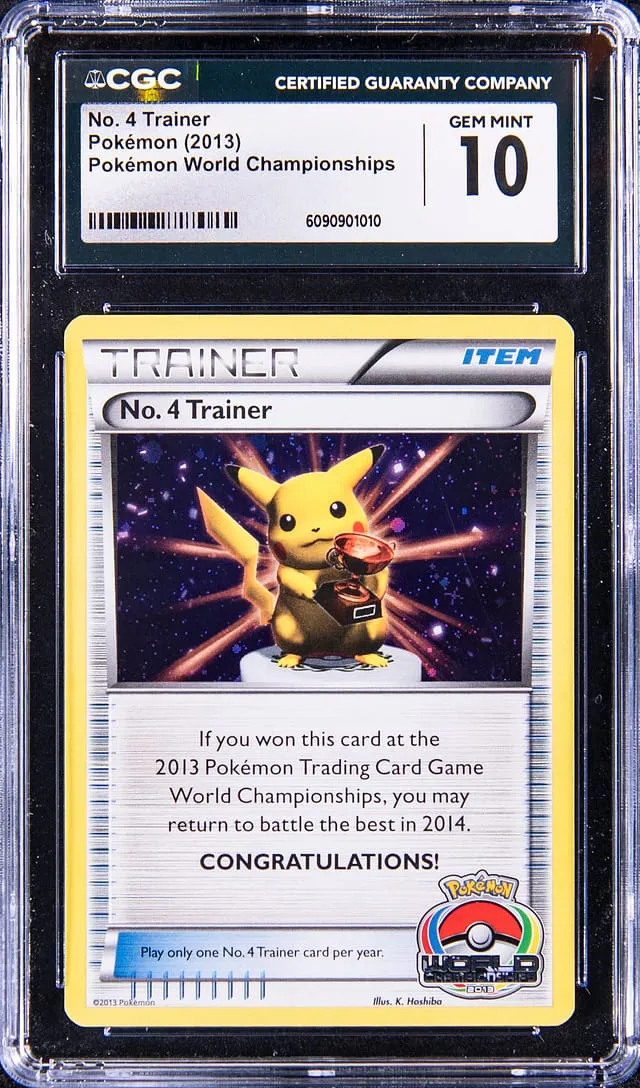
2013 No.4 Trainer Pikachu Trophy CGC 10 Sells
A CGC Gem Mint 10, pop 2, 2013 No.4 Trainer Pikachu trophy card sold for $36,580 at Goldin on Feb 16, 2026. Here’s what that means for collectors.
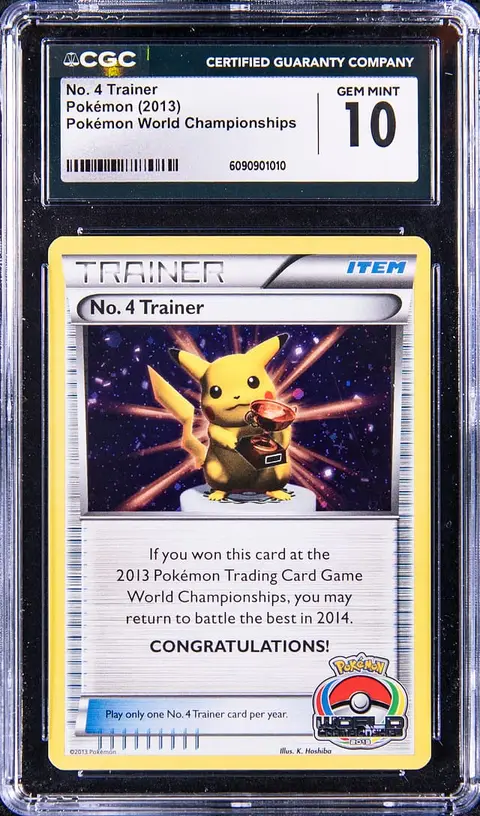
Sold Card
2013 Pokemon World Championships No.4 Trainer Pikachu Trophy Card - CGC GEM MINT 10 - Pop 2
Sale Price
Platform
Goldin2013 Pokémon World Championships No.4 Trainer Pikachu Trophy Card (CGC 10) Sells for $36,580
On February 16, 2026, Goldin auctioned one of the hobby’s true specialty cards: a 2013 Pokémon World Championships No.4 Trainer Pikachu Trophy Card, graded CGC Gem Mint 10, for $36,580.
For most collectors, these World Championships “Trainer Pikachu” cards sit on the outer edge of what we actually see in the wild. They’re not pack-pulled. They were never sold at retail. They’re part of a long-running line of ultra-limited trophy cards tied directly to competitive play. When one appears at public auction, it offers a rare look at how the market values this niche.
Below, we’ll break down what this card is, why it matters, and how this CGC 10 sale fits into the broader market context.
Card overview: what exactly sold?
Card: 2013 Pokémon World Championships No.4 Trainer Pikachu Trophy Card
Character: Pikachu (Trainer Pikachu trophy artwork)
Event: Pokémon World Championships 2013
Type: Trophy / award card (non-pack issue)
Placement: Awarded for 4th place (hence “No.4 Trainer”)
Era: Modern / ultra-modern competitive trophy
Grading company: CGC Trading Cards
Grade: CGC Gem Mint 10
Population note: Labeled in the listing as Pop 2 in CGC 10
Trophy cards like this are fundamentally different from standard set releases:
- They are awarded at events (here, the 2013 Pokémon World Championships), rather than pulled from booster packs.
- Distribution is extremely low – often in the single digits per age division, per year.
- They are key historical artifacts for the competitive side of Pokémon.
The “No.4 Trainer” designation indicates this card was awarded to a player who finished fourth in a World Championship bracket. Exact print quantities for each placement are not always officially published, but trophy Pikachu cards from this era are widely understood to exist in very small numbers.
There is no on-card autograph, patch, or serial numbering on this card. Its scarcity comes from event distribution, not pack odds or stamped numbering.
Why the 2013 Trainer Pikachu trophy matters
1. Direct link to the World Championships
For collectors, this card is part of the top layer of competitive Pokémon history. The World Championships are the pinnacle of official Pokémon Organized Play. Trophy cards given to finalists and top finishers are tangible proof that someone reached the very top of that ladder.
Owning a World Championships Trainer Pikachu is less like owning a rare chase card and more like owning a medal from the event itself.
2. Trophy Pikachu lineage
Since the late 1990s, Pikachu-themed trophy cards have become a core pillar of high-end Pokémon collecting:
- They often feature unique artwork that never appears in standard sets.
- They anchor conversations about long-term grails and “museum pieces” within the hobby.
- They bridge the gap between competitive players and pure collectors, since they originate as player awards but often migrate into private collections.
The 2013 version continues this lineage into the modern era, representing a time when Pokémon Organized Play was well-established globally but trophy cards were still relatively under-the-radar outside hardcore circles.
3. Ultra-low supply and high grade scarcity
Trophy cards are scarce in two ways:
- Very few copies exist at all. Only a handful of players per division per year receive them.
- Even fewer are graded, and fewer still reach top grades.
This copy is graded CGC Gem Mint 10 with a population of 2 in that grade at the time of sale. In pop reports (short for population reports), a “Pop 2” means only two copies have been graded at that exact grade level by that grading company.
For a card that starts with a tiny original print run, a Pop 2 in Gem Mint sits very close to the theoretical ceiling for condition.
Market context: how does $36,580 fit in?
The card sold for $36,580 at Goldin on February 16, 2026.
When we talk about “comps” (short for comparables), we mean other recent sales of the same card or very similar ones. With event-only trophy cards, comps are naturally thin because copies rarely change hands publicly.
For this specific 2013 No.4 Trainer Pikachu in CGC 10, recent public sales are extremely limited. That said, we can place this sale in context using:
- Other years’ Trainer Pikachu trophies (earlier and later years).
- Different placements (No.1, No.2, No.3 vs. No.4).
- Different grading companies and grades (PSA vs. CGC, 9 vs. 10, etc.).
Across auction archives and marketplace data, a few patterns generally hold for modern trophy Pikachu cards:
- Top placements (No.1 and No.2) typically command the highest prices, especially in PSA 10 or equivalent gem grades.
- Lower placements (like No.4) trade at a discount to No.1/No.2, but still sit in a very high-end niche because of extreme scarcity.
- Condition premiums are steep. The jump from a 9 to a 10 for trophy cards can be disproportionately large compared to standard set cards because collectors feel they may only get one chance at a true top-grade example.
Within that framework, a $36,580 result for a 2013 No.4 Trainer Pikachu in CGC 10, Pop 2, sits in the expected band for:
- A lower placement trophy (No.4) from the 2010s,
- With ultra-low supply,
- In a true gem grade.
Given how infrequently individual copies appear at public auction, it’s hard to call this definitively “high” or “low” in a statistical sense. Instead, it functions as a fresh pricing signal that helps calibrate expectations for:
- Other 2013 placements (No.1–No.3), and
- Neighboring years’ trophies in similar condition.
CGC vs. PSA and BGS for high-end Pokémon
While PSA has historically dominated high-end Pokémon auctions, CGC has carved out a strong niche, especially for collectors who value:
- Detailed subgrades (when present),
- Strict surface and centering standards, and
- A well-documented grading scale.
In some segments of the market, PSA 10 still carries a premium over equivalent gem grades from other companies. However, for specialty pieces like trophy cards, buyers often focus on:
- The card itself (trophy status, year, placement),
- Overall eye appeal, and
- The fact that it is in a recognized “Gem Mint” holder.
This CGC 10 sale at $36,580 suggests that, at least for certain high-end trophies, the market is willing to value CGC’s top grade in the same general arena as PSA’s, particularly when population numbers are this low.
What this sale suggests for collectors
For long-term Pokémon collectors
- Confirms depth at the high end. Even beyond base set Charizard and other mainstream chase cards, there is sustained demand for serious niche pieces like World Championships trophies.
- Underscores the importance of provenance. Cards tied to specific events, years, and placements carry a narrative that standard set cards can’t fully replicate.
- Highlights condition as a lever. A Pop 2 Gem Mint trophy shows how much of the value conversation now revolves around top-tier grading outcomes.
For newer or returning collectors
You don’t need to chase five-figure trophies to learn from this sale:
- Scarcity and story matter. Cards with clear, documented rarity and a meaningful story—whether a trophy card, a staff promo, or a limited event card—often behave differently from mass-produced set cards.
- Comps are sparse at the top. When researching high-end pieces, you may find only one or two public sales over several years. That doesn’t make them less real; it just means each sale carries more weight.
- Grades are not interchangeable. A jump from Near Mint/Mint to Gem Mint can mean a massive difference in realized price for true grails.
For small sellers and hobbyists
- Niche cards reward patience. If you ever handle an event-only card or niche promo, it may pay to learn its background rather than treating it like a standard rare.
- Documentation helps. Certificates, photos, and context from the original player or event can strengthen a card’s long-term appeal and support when it eventually goes to grading or auction.
Where this card fits in the broader Pokémon landscape
The 2013 No.4 Trainer Pikachu trophy card doesn’t compete with mass-market icons like Base Set Charizard for visibility. Instead, it resides in a specialist lane where collectors are often deeply embedded in Pokémon’s competitive history.
In that lane, this sale:
- Reinforces the status of World Championships trophies as top-shelf collectibles.
- Provides a new data point for modern-era trophies (2010s rather than late-90s).
- Shows continuing interest in Pikachu trophy art as a long-term theme in high-end collections.
Because of the low population and thin sales history, it’s unlikely we’ll see many direct comps in the near future. For now, $36,580 at Goldin on February 16, 2026 stands as a clear reference point for this exact grade and variant.
Key takeaways
- Card: 2013 Pokémon World Championships No.4 Trainer Pikachu Trophy Card.
- Grade: CGC Gem Mint 10, Pop 2.
- Result: Sold for $36,580 at Goldin on February 16, 2026 (UTC).
- Significance: Ultra-rare World Championships trophy card linking directly to competitive Pokémon history, with extremely few copies graded in top condition.
For collectors tracking the upper end of the Pokémon market, this sale is less about daily price moves and more about understanding how the hobby continues to value true event trophies: scarce, story-rich, and increasingly well-documented by third-party graders.
figoca will continue to monitor future offerings of Trainer Pikachu trophies and related World Championships cards as more data points emerge.