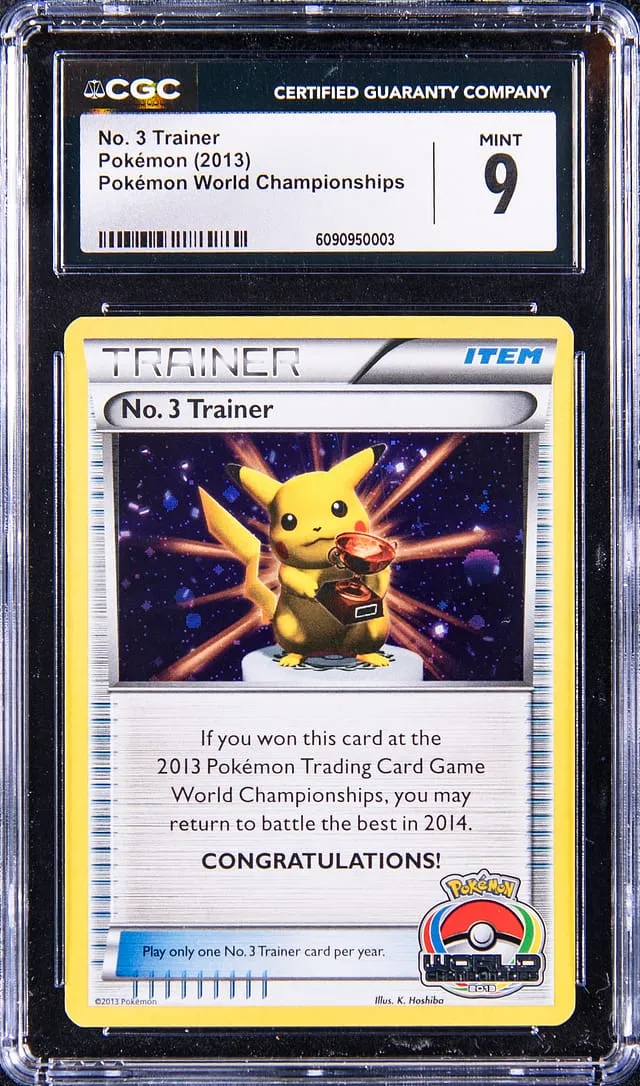
2013 No. 3 Trainer Pikachu Trophy CGC 9 Sells for $24K
Goldin sold a 2013 Pokémon No. 3 Trainer Pikachu Trophy Card CGC 9 for $24,535 on March 9, 2026. figoca breaks down the card’s context and market.
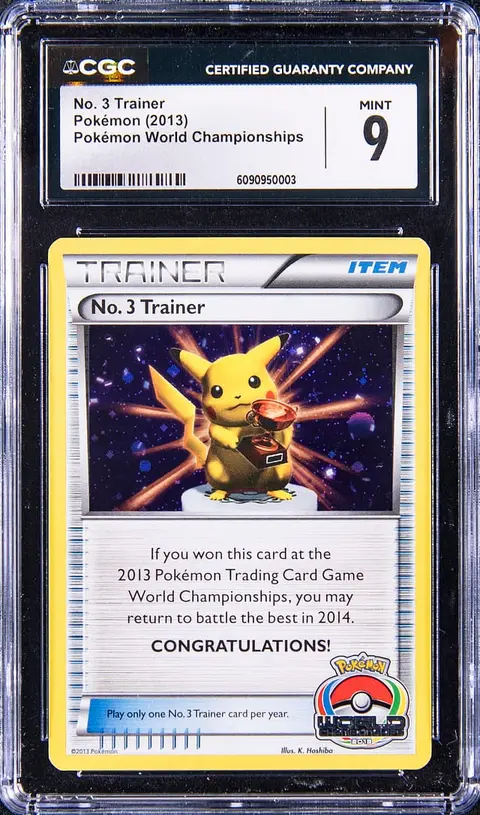
Sold Card
2013 Pokemon World Championships No. 3 Trainer Pikachu Trophy Card - CGC MINT 9
Sale Price
Platform
Goldin2013 Pokémon World Championships No. 3 Trainer Pikachu Trophy Card (CGC 9) Sells for $24,535
On March 9, 2026, Goldin sold a 2013 Pokémon World Championships No. 3 Trainer Pikachu Trophy Card graded CGC MINT 9 for $24,535. For a niche but highly respected lane of the Pokémon market—Worlds-era trophy cards—this is a meaningful data point that helps collectors recalibrate expectations.
In this breakdown, we’ll walk through what the card is, why collectors care, and how this sale fits into the broader price picture.
What exactly is this card?
Card ID
- Title: 2013 Pokémon World Championships No. 3 Trainer Pikachu Trophy Card
- Character: Pikachu (Trainer Trophy artwork, not a set Pikachu)
- Event: 2013 Pokémon World Championships
- Category: Trophy / prize card (not a regular set release)
- Publisher: Pokémon Company / Creatures / Nintendo
- Era: Modern / early “ultra-modern” competitive era
- Rookie / key issue?: Not a rookie; it is a key World Championships trophy card from its year.
Grading details
- Grading company: CGC Trading Cards
- Grade: CGC MINT 9
- Attributes: Non-serial-numbered, extremely low print run, awarded only to top finishers at the 2013 World Championships. No autograph or patch; the appeal is pure scarcity, provenance, and artwork.
These World Championships “No. 1 / No. 2 / No. 3 Trainer” Pikachu cards are prize cards given to finalists in each age division. Exact distribution numbers are small, but they are generally understood to be single-digit or low double-digit copies per placing and division, making them some of the most difficult modern-era Pokémon cards to acquire.
Why this card matters to collectors
Trophy cards and why they’re different
Trophy cards are award cards given at major Pokémon tournaments (especially Worlds). They are:
- Not pack-pulled: You couldn’t pull this from a booster pack; you had to win it.
- Extremely limited: Produced only for top finishers; typically only a handful exist per event and placing.
- Historically important: They mark a specific year, venue, and achievement in competitive Pokémon play.
For many high-end Pokémon collectors, these trophy Pikachu cards sit near the top of the hierarchy, alongside older Japanese trophy cards, early “No. 1 / No. 2 / No. 3 Trainer” cards, and unique prize promos.
The 2013 World Championships context
The 2013 Worlds continued a long-running tradition of Pikachu trophy awards that began in the late 1990s and early 2000s in Japan. Each year’s art and layout vary slightly, giving each card a distinct identity while maintaining a recognizable trophy lineage.
Because these cards were awarded to finalists, they also function as physical records of the game’s competitive history. For collectors interested in the evolution of competitive play, Worlds trophies from this era are a bridge between the earliest Japanese trophies and the more widely televised, globally followed Worlds events of the late 2010s and 2020s.
The Goldin sale: $24,535 on March 9, 2026
- Auction house: Goldin
- Sale date (UTC): March 9, 2026
- Final price: $24,535 (buyer’s premium typically included in reported hammer totals for public records)
That figure positions this CGC 9 firmly in the “high-end but not record-shattering” tier of Pokémon trophy sales. For perspective, top historic trophy cards—especially earlier Japanese examples or No. 1 placements in top grades—have reached significantly higher marks in the past. However, for a 2013 No. 3 Trainer specifically, this is a meaningful and healthy number.
Market context and recent sales
When collectors talk about “comps” (short for comparables), they’re referring to recent sales of the same card or similar versions—usually tracked across auction houses, marketplaces, and fixed-price platforms. For a card this rare, there simply aren’t many.
Scarce public data
Worlds trophy cards do not trade as frequently as modern chase cards or sealed product. Instead, they:
- Surface irregularly at major auction houses like Goldin, Heritage, and PWCC.
- Change hands privately, in collector-to-collector deals that often go unreported.
Public sales for a 2013 No. 3 Trainer Pikachu—especially in high grade from any grading company—have been sporadic. Some related patterns observed across trophy markets in recent years include:
- Higher placements (No. 1, No. 2) generally commanding noticeable premiums over No. 3.
- Older Japanese trophies (late 1990s and early 2000s) carrying a long-established premium due to age and lore.
- Top grades from PSA/BGS/CGC (Gem Mint 10 equivalents) sometimes pushing to record levels when a major copy surfaces.
In that context, $24,535 for a CGC 9 No. 3 Trainer from 2013 fits as a strong but not unexpected result. It indicates that:
- Demand for Worlds trophy Pikachu cards remains real.
- Collectors continue to treat Worlds-era trophies as a distinct, higher-tier lane compared to mass-printed ultra-modern chase cards.
Without a dense set of recent, public comps for this exact grade and year, it’s more accurate to say this sale is consistent with the broader high-end trophy ecosystem than to call it either a bargain or a record.
Grade, pop scarcity, and CGC’s role
A “pop report” (population report) is a public count, by grade, of how many copies a grading company has certified. Trophy cards usually show very low populations due to both scarcity and the fact that many winners keep their cards ungraded.
Key points for this copy:
- CGC MINT 9 is a high-end grade. Trophy cards can have handling wear from being awarded, transported, and sometimes displayed by winners.
- The total CGC population for this specific card is small, and cross-company totals (PSA, BGS, CGC combined) are also low.
- CGC has become a meaningful player in Pokémon grading, especially for collectors who like subgrade-style detail and transparent grading notes.
For a card where each individual copy is meaningful, the grading label acts as a condition snapshot and a liquidity tool, rather than the sole driver of value. Ownership and provenance (who originally won it, event stories, etc.) can also matter for some collectors, even if that’s not always reflected in the slab label.
What this means for collectors and small sellers
For newer or returning collectors
- This sale is a reminder that Pokémon is more than booster packs and mainstream chase cards. Worlds trophy cards sit in a separate lane, almost like art pieces or historical artifacts.
- Entry points into this lane are limited. Many collectors start by learning the history, art variations, and event timelines before ever trying to acquire a trophy.
For active hobbyists
- The $24,535 result provides a fresh price anchor for a 2013 No. 3 Trainer in a top-tier grade. Future public sales will likely be measured against it, even if the sample size stays small.
- It underscores the ongoing spread between true event-issued trophies and mass-printed promos from similar years.
For small sellers
While most small sellers will never handle a card like this, there are still practical takeaways:
- Know your promos: Some event or tournament promos get overlooked in bulk, even though they have meaningful followings.
- Document provenance when you can: For limited cards tied to events, holding onto documentation (photos, decks, player IDs) can add context that serious buyers appreciate.
- Track trophy comps carefully: Because sales are infrequent, each auction result—especially at a major house like Goldin—carries more informational weight than it might for a typical ultra-modern chase.
Final thoughts
The March 9, 2026 Goldin sale of the 2013 Pokémon World Championships No. 3 Trainer Pikachu Trophy Card (CGC MINT 9) at $24,535 is another confirmation that high-end, event-issued Pokémon trophies remain a distinct and resilient segment of the hobby.
For collectors who focus on history, scarcity, and competitive Pokémon culture, this card is less about chasing the latest set and more about owning a tangible piece of Worlds history. And in a market where so many cards are counted in the tens of thousands, it’s the tiny print runs and specific stories behind trophies like this that keep drawing dedicated collectors back.