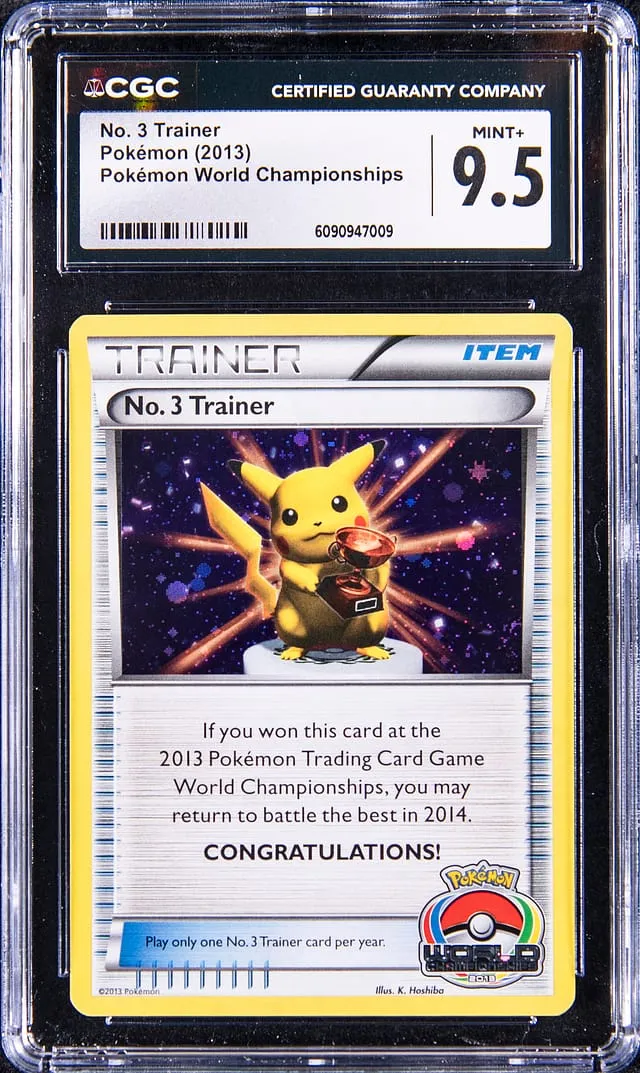
2013 No. 3 Trainer Pikachu Trophy CGC 9.5 Sale
Goldin sold a 2013 Pokémon World Championships No. 3 Trainer Pikachu Trophy Card CGC 9.5 for $30,387. See the context and what it means for collectors.
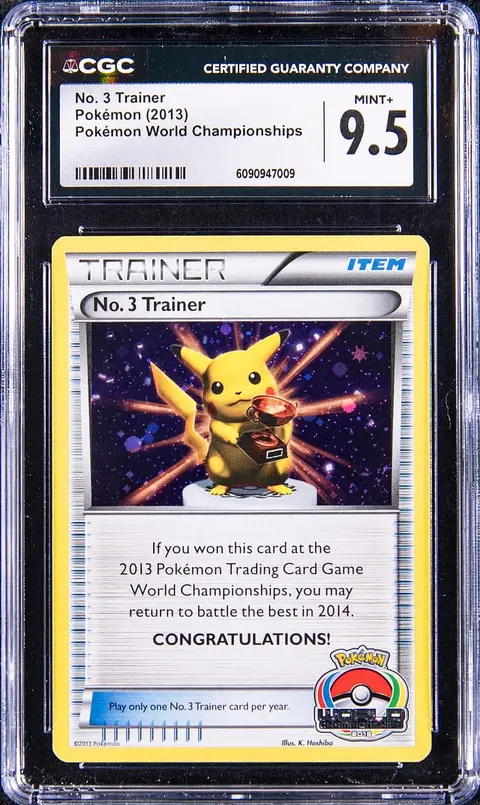
Sold Card
2013 Pokemon World Championships No. 3 Trainer Pikachu Trophy Card - CGC MINT+ 9.5
Sale Price
Platform
Goldin2013 Pokémon World Championships No. 3 Trainer Pikachu Trophy Card (CGC 9.5) Sells for $30,387
On February 16, 2026, Goldin closed a noteworthy Pokémon auction: a 2013 Pokémon World Championships No. 3 Trainer Pikachu Trophy Card, graded CGC MINT+ 9.5, sold for $30,387.
For a card that never appeared in booster packs and was only awarded to elite competitors, this is an important data point for both serious Pokémon collectors and newer hobbyists trying to understand the upper tier of the market.
What exactly is this card?
Let’s break down the basics collectors care about:
- Card name: No. 3 Trainer (Pikachu artwork)
- Character: Pikachu (special trophy illustration)
- Event: 2013 Pokémon World Championships
- Year: 2013
- Category: Trophy card / prize card, not a pack-pulled set card
- Distribution: Awarded to the third-place finisher in their age division at Worlds 2013 (not sold at retail)
- Era: Modern / early “ultra-modern” Pokémon
- Grading company: CGC (Certified Guaranty Company)
- Grade: CGC MINT+ 9.5
Unlike a standard set card, this No. 3 Trainer is a Worlds trophy card. These were given in extremely small numbers to top finishers at the Pokémon World Championships. Exact print figures are not publicly published, but trophy cards from this era generally exist in single- or very low double-digit quantities.
Because they are awards, not products, each copy also has a specific history tied to an individual competitor. That personal provenance is a key reason trophy cards hold a different place in the hobby than even the rarest pack-pulled chase cards.
Why trophy Pikachu cards are so important
For collectors, Worlds trophy cards sit at the intersection of:
- Competitive history: They mark actual high placements at the official World Championships.
- Scarcity: Very few copies exist, and not all of them enter the graded or public market.
- Pikachu focus: Pikachu trophy artwork has been a long-running thread in high-end Pokémon, which ties into one of the hobby’s most collected characters.
Cards like this No. 3 Trainer are often grouped with earlier No. 1 / No. 2 / No. 3 Pikachu trophies from the late 1990s and 2000s as part of the broader “Pikachu trophy” family. Earlier copies, especially from the original Tropical Mega Battle and early Worlds years, tend to command the highest prices, but later-year trophies still matter for collectors who track the full history of competitive play.
The CGC MINT+ 9.5 grade
CGC has built a strong reputation in trading cards, especially for Pokémon. A CGC MINT+ 9.5 generally means:
- Very clean surfaces front and back
- Sharp corners and edges
- Centering that is within strict tolerance
For ultra-scarce trophy cards, condition is a major factor because many copies lived in binders, top-loaders, or personal collections for years before grading ever became a priority.
Population and scarcity
Public population reports (often called “pop reports”—lists showing how many copies of a card a grading company has given each grade) for 2013 Worlds trophy Pikachu cards are generally very small. Even across all grading companies, the total known graded population is usually a fraction of what you’d see for popular booster cards or modern chase cards.
The combination of low total copies and only a handful in high-end grades like 9.5 or 10 is what separates this card from even rare pack-pulled alternatives.
Market context: how does $30,387 fit in?
The realized price at Goldin on February 16, 2026, was $30,387.
When we talk about “comps” (short for comparables), we mean recent public sales of the same card—or very similar cards—that help anchor current price expectations. For Worlds trophy cards, comps are limited because they trade infrequently, and some sales occur privately.
Based on available public information as of early 2026:
- Copies of 2010s Pikachu trophy and No. 1–3 Trainer cards have previously sold in a wide range, depending on year, place (No. 1, No. 2, No. 3), and grade.
- Earlier, more historically significant years and top placements (No. 1 Trainer) have achieved much higher prices, especially in gem mint grades.
- Later-year or lower-placement trophies typically trade at lower but still substantial levels, reflecting both their scarcity and the prestige of a Worlds finish.
The $30,387 result for a 2013 No. 3 Trainer in CGC 9.5 sits in the mid to high range of what many collectors would expect for a later-year Pikachu trophy in top grade, without touching the peak levels that the earliest or highest-placement trophies have seen.
Because trophy cards appear at auction only occasionally, each sale effectively helps to “reset” or update the market’s sense of value. This Goldin result now becomes an important reference point whenever another 2013 No. 3 Trainer surfaces.
Historical context: how it compares
If we look more broadly at Pokémon high-end sales:
- Top-tier trophies and early Pikachu prizes have reached six-figure territory at peak hobby moments, especially in PSA 10 or equivalent grades.
- Mid-2010s trophy cards like this 2013 No. 3 Trainer tend to slot below the earliest eras, but above most mainstream set cards from the same timeframe.
This 2026 sale doesn’t represent an all-time record for trophy Pikachu cards, but it reinforces that even the later Worlds years still command serious attention and serious bids when a strong example comes to market.
Why collectors care right now
Several ongoing hobby trends help explain the sustained interest in a card like this:
Focus on provenance and story
Collectors are increasingly drawn to cards with clear competitive or historical stories, not just pack odds. A Worlds trophy literally can’t exist without a real-world performance behind it.Shift toward quality and rarity
As more modern cards are printed in larger quantities, trophy cards stand out as the opposite: low print, direct-from-event distribution, and very few graded examples.Maturing Pokémon collector base
Many collectors who grew up with Pokémon and later followed the competitive scene are now in a position to hunt for pieces that connect them to that world stage.Recognition of CGC in Pokémon
CGC has become a go-to grader for many Pokémon specialists. A MINT+ 9.5 label on a trophy card signals that the copy meets a high bar for condition-focused buyers.
What this means for different types of collectors
Newcomers and returning collectors
If you’re newly back in the hobby, this sale is a helpful reminder that not all Pokémon cards are created equal:
- Trophy cards are at the very top of the rarity pyramid.
- They don’t behave like mass-printed chase cards from regular sets.
- Price swings can be large from one sale to the next because there are so few public data points.
Instead of trying to “chase” a trophy piece right away, many collectors start by learning the different Worlds years, trophy designs, and grading populations so they can recognize opportunities when they appear.
Active hobbyists and small sellers
If you’re already buying and selling, this Goldin sale offers a few practical takeaways:
- Comps will be thin: Expect to work with a small sample of past sales when you evaluate a trophy card.
- Grading choice matters: CGC, PSA, and BGS all have trophy copies in their slabs; how the market values each label can shift over time.
- Condition and eye appeal are critical: On ultra-scarce items, a single subgrade (centering, edges, corners, or surface) can define a large part of the premium.
When a card shows up only every few years, one strong or weak result doesn’t establish a “forever” value, but it does shape expectations until the next sale.
Final thoughts
The February 16, 2026 sale at Goldin of the 2013 Pokémon World Championships No. 3 Trainer Pikachu Trophy Card, CGC MINT+ 9.5 for $30,387 is a steady, data-rich moment for the high-end Pokémon market.
It underscores three things:
- Worlds trophy Pikachu cards remain among the most coveted corners of the hobby.
- Later-year trophies still command meaningful prices, especially in top condition.
- Every new public sale helps collectors recalibrate where these ultra-scarce cards sit relative to one another.
For collectors who track the competitive side of Pokémon or study the long arc of trophy card prices, this Goldin result is one to bookmark and revisit as future Worlds trophies cross the auction block.