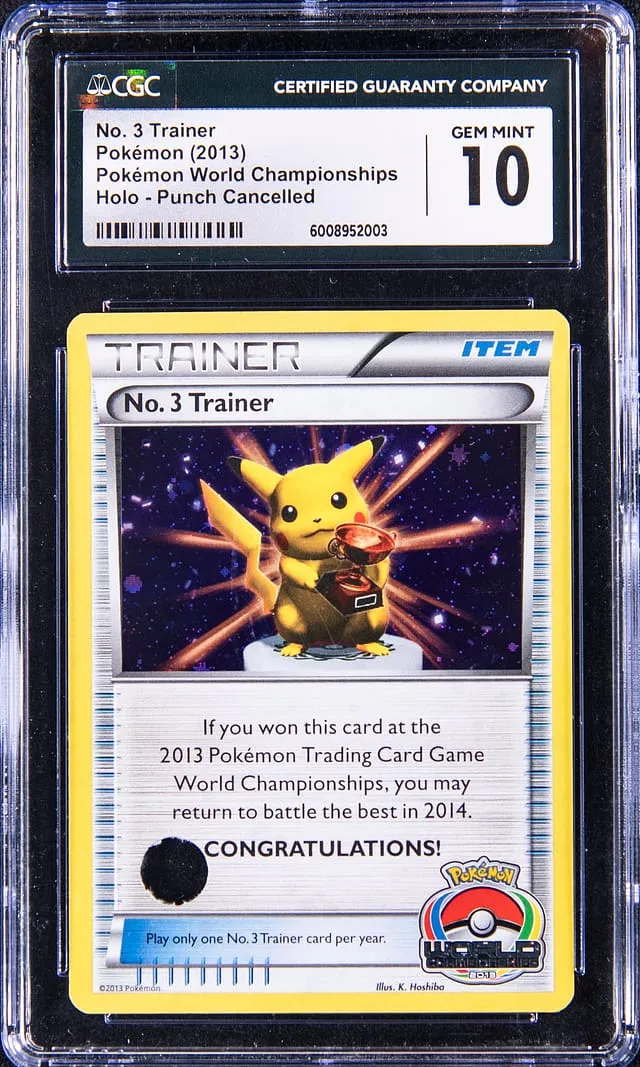
2013 No. 3 Trainer Pikachu Trophy Card Sells for $18K
Goldin sold a 2013 Pokémon World Championships No. 3 Trainer Pikachu Trophy Card, CGC 10, for $18,367. See how this rare trophy fits today’s market.
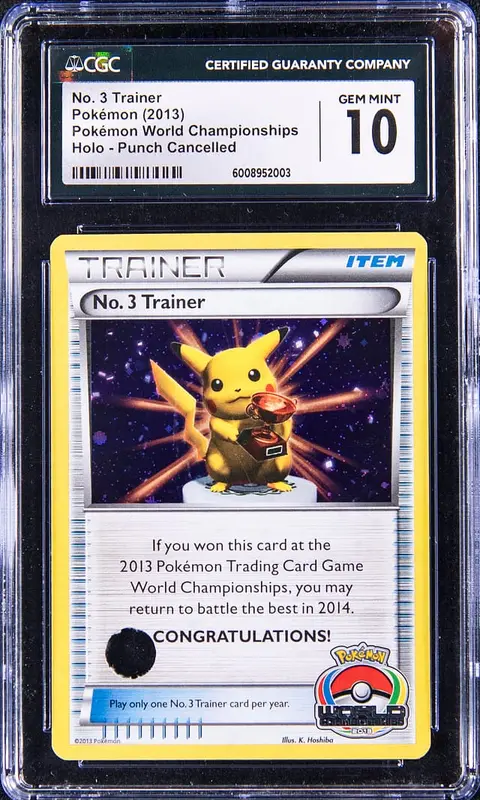
Sold Card
2013 Pokemon World Championships No. 3 Trainer Pikachu Trophy Card, Punch Cancelled - CGC GEM MINT 10
Sale Price
Platform
Goldin2013 Pokémon World Championships No. 3 Trainer Pikachu Trophy Card Sells for $18,367
On May 4, 2026, Goldin closed a notable sale for one of the more elusive pieces of competitive Pokémon history: a 2013 Pokémon World Championships No. 3 Trainer Pikachu Trophy Card, Punch Cancelled, graded CGC GEM MINT 10, realized $18,367.
For newer collectors, this type of card can look mysterious. It’s not from a regular booster set, there’s no card number printed like “15/144,” and you’ll often see terms like “trophy card” or “punch cancelled” that don’t show up on everyday releases. This sale is a good chance to unpack what this card actually is and why it matters.
What card sold at Goldin?
Key details:
- Year: 2013
- Event: Pokémon World Championships
- Card type: No. 3 Trainer Pikachu Trophy Card
- Character: Pikachu (Worlds trophy artwork, not a standard set Pikachu)
- Status: Trophy card awarded at the World Championships (not pack-pulled)
- Special attribute: Punch cancelled
- Grading company: CGC (Certified Guaranty Company)
- Grade: GEM MINT 10
“Trophy card” in Pokémon refers to cards awarded as prizes at high-level tournaments, usually the World Championships or major qualifiers. They are not sold in products; you had to earn them in competition. That makes them fundamentally different from even the rarest chase cards in standard sets.
The “No. 3 Trainer” designation indicates that this card was awarded to a third-place finisher (or team, depending on the division and year structure) at the 2013 World Championships. The Pikachu art and Japanese text tie it directly to that specific event.
The additional note “Punch Cancelled” generally refers to the way some prize cards were physically cancelled or marked by the organizer (for example, hole-punched) so they could not be re-used as entry or function as a live prize again. That cancellation can affect how collectors evaluate condition and originality, and it is part of the card’s provenance as an actual awarded trophy.
Where this sale sits in the market
A quick look at the broader market context:
- Trophy Pikachu and No. 1 / No. 2 / No. 3 Trainer cards from World Championships and earlier tournaments are widely regarded as some of the most condition-sensitive and supply-constrained Pokémon cards.
- Historically, prices scale heavily with:
- Placement (No. 1 often highest, then No. 2, then No. 3)
- Year (mid-90s and early 2000s often command premiums versus later years)
- Condition and grade (9 vs 10 is a major step for ultra-rare cards)
- Whether the card is demonstrably awarded vs. later reprints or staff copies.
Over the past few years, earlier-era Pikachu trophy cards (especially 1990s No. 1 Trainer and similar) have seen six-figure sales in top grades. Later World Championships trophy cards, including 2010s examples, tend to settle in a lower but still very strong tier, reflecting both their rarity and the fact that they sit in the “ultra modern” era.
For this specific 2013 No. 3 Trainer Pikachu, recent public auction data is limited. That’s common for trophy cards—supply is tiny and many copies never surface publicly. Instead, collectors look at a mix of:
- Past public sales of the same card in lower grades or raw (ungraded)
- Sales of No. 1 and No. 2 versions from the same year
- Earlier and later year Worlds Pikachu trophy sales as directional comps (short for “comparables,” recent sales of similar items used to anchor expectations).
Within that framework, $18,367 for a CGC GEM MINT 10 No. 3 Trainer from 2013 slots into a tier that:
- Sits well below the elite six-figure vintage trophies, which are older and often have legendary status.
- Lines up with the idea that high-grade, mid-2010s trophies are a step down from 1990s–early 2000s pieces but still comfortably above almost all pack-pulled chase cards from the same era.
Because CGC population reports (often called “pop reports,” which show how many copies exist in each grade) for this specific card and year are small and may change as more copies are submitted, exact population numbers can shift. But the underlying reality is consistent: this is a low-supply card by design.
Why collectors care about this card
Several factors make this card notable in the hobby:
True competitive provenance This is not a card printed for binders or casual play. It’s tied directly to performance at the 2013 Pokémon World Championships. That World Championship link appeals to collectors who value competitive history—similar to how game-worn items matter in sports collecting.
Trophy card status “Trophy card” has become almost its own lane in Pokémon collecting. These cards are inherently short printed; only a handful of players can finish in the top placements each year. That structural scarcity separates them from even low-serial pack-pulled cards.
Pikachu as a flagship character Pikachu-based trophies occupy a special niche. Pikachu is the face of the franchise, and many long-time collectors focus specifically on Pikachu cards that represent major moments or events. A Worlds trophy Pikachu combines character appeal with event prestige.
Ultra modern but not mass-produced 2013 sits in what many collectors call the “modern” to “ultra modern” transition. Print runs across the main Pokémon TCG line were expanding, but trophies remained extremely limited. This contrast—plenty of modern product, but very few true trophies—creates an interesting dynamic in how collectors prioritize them.
High-grade CGC example CGC’s GEM MINT 10 grade places this copy at the top of the condition scale in their system. For a trophy that may have traveled to and from an event, been stored by a player (not a professional grader) for years, and potentially been cancelled via punch at the event, achieving a 10 is not trivial.
Understanding “punch cancelled” in collecting terms
For newcomers, “punch cancelled” can sound like damage. In the context of trophy and prize cards, however, it is often part of the card’s authentic story.
Event organizers have, at times, marked or punched prize cards:
- To confirm they were awarded.
- To prevent them being redeemed again.
- To differentiate awarded copies from any unissued or staff versions.
Collectors tend to evaluate these markings differently from arbitrary damage. A clean card that shows clear, consistent cancellation from the event can be seen as more “provenanced” than a visually similar card with unknown history. Grading companies like CGC factor that context into their assessment when labeling and grading the card.
How this sale fits current Pokémon trophy trends
The broader Pokémon trophy card market has gone through several phases:
- Pre-2020: Mostly niche, with a small network of dedicated trophy specialists and limited public data.
- 2020–2021 surge: Increased attention, significant price runs, and headline sales for vintage and early-2000s trophies.
- 2022–2024 normalization: More data points, some retraces from peaks, and a clearer hierarchy forming between truly iconic early trophies and later-years examples.
By 2026, most active collectors treat trophies as a separate category from mainstream chase cards. Pack-pulled modern grails (like alt arts and secret rares) can be exciting, but they exist in far higher numbers than any Worlds trophy.
In that environment, this $18,367 Goldin sale suggests:
- Ongoing demand for competitive-history pieces, even as broader market attention shifts between sets and eras.
- A continued willingness from collectors to differentiate between trophy tiers (year, placement, art, and scarcity) rather than treating all trophies as equal.
What this means for different types of collectors
For newer collectors If you’re just getting into Pokémon and see numbers like $18,367, the key takeaway is not “this is typical for cards.” Instead, it’s that there is a top shelf of competition-based, event-issued cards that live in a different ecosystem from standard set cards.
Most collectors will never own a Worlds trophy card—and that’s fine. Understanding they exist helps you contextualize why some prices look so far removed from booster box cards.
For returning collectors If you remember early tournament promos and are now coming back to the hobby, the main shift is information. Trophy cards that once traded privately are now appearing more regularly in public auction archives, making it easier to benchmark relative values.
This sale shows that later-era trophies, especially in top grades from recognized grading companies, still command a premium. However, they sit on a spectrum: year, placement, and art matter.
For active hobbyists and small sellers For those who buy, sell, and trade regularly, this kind of result is useful as a reference point rather than a target.
A few practical implications:
- Comp structure: When you evaluate your own high-end, event-linked cards, it’s worth sorting them by true scarcity (how many could exist) rather than just by grade.
- Grading mix: CGC’s presence in significant trophy sales underscores that major trophy buyers are tracking multiple grading companies, not just PSA.
- Data discipline: With so few transactions, a single sale doesn’t define a lasting price level. Keeping a log of trophy and high-end event card sales over time gives a more balanced picture.
Final thoughts
The 2013 Pokémon World Championships No. 3 Trainer Pikachu Trophy Card, Punch Cancelled, CGC GEM MINT 10 that sold for $18,367 at Goldin on May 4, 2026, is a textbook example of how deep Pokémon collecting can go beyond main-set chase cards.
It’s not a pack hit, it’s not a standard promo, and it doesn’t fit neatly into a “set completion” binder. Instead, it represents a moment in competitive history, earned performance at the World Championships, and a very small print run by design.
For collectors who focus on the intersection of rarity, event history, and flagship characters, sales like this are less about chasing a quick flip and more about tracking how the hobby values the hardest-to-earn cards over time.
As always, any single auction is just one data point. But each public sale of a true trophy adds another piece to the long-term picture of how competitive Pokémon history is being documented and collected.