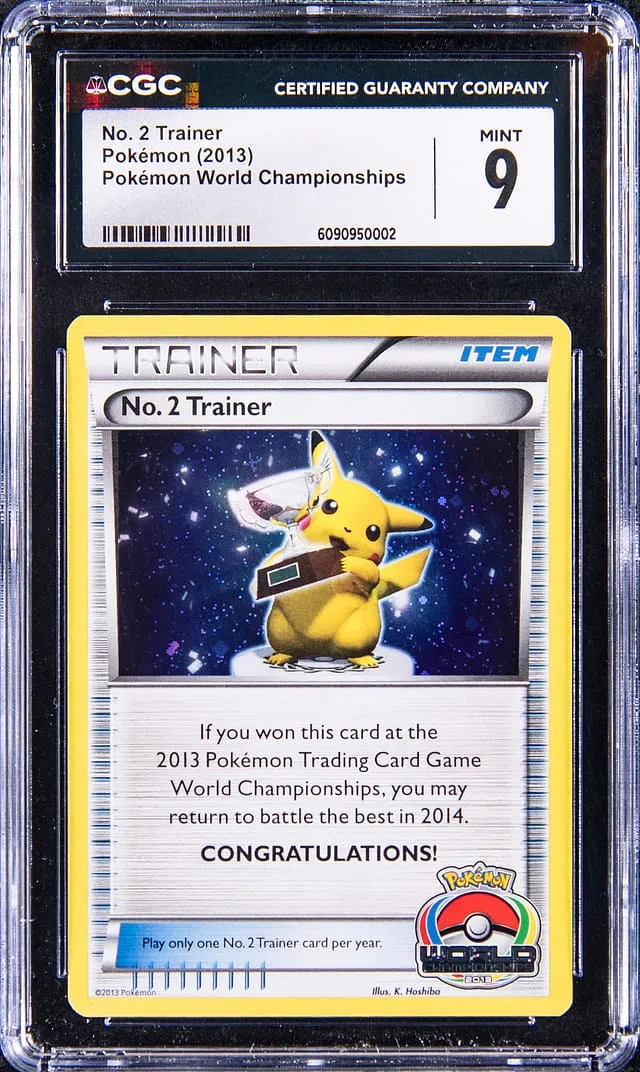
2013 No. 2 Trainer Pikachu Trophy CGC 9 Sells
A 2013 Pokémon World Championships No. 2 Trainer Pikachu trophy card CGC 9 sold for $32,940 at Goldin. Here’s what it means for collectors.
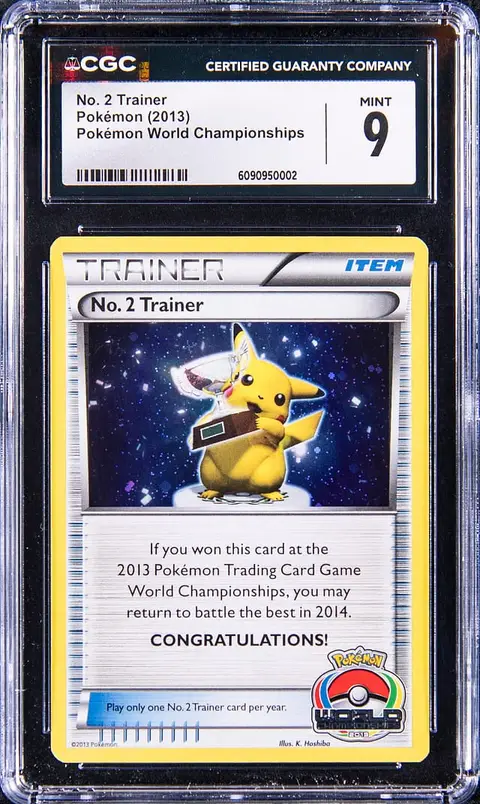
Sold Card
2013 Pokemon World Championships No. 2 Trainer Pikachu Trophy Card - CGC MINT 9
Sale Price
Platform
Goldin2013 Pokemon World Championships No. 2 Trainer Pikachu Trophy Card (CGC 9) Sells for $32,940 at Goldin
On March 9, 2026, Goldin closed a notable auction for one of the hobby’s more elusive Pokemon trophy cards: a 2013 Pokemon World Championships No. 2 Trainer Pikachu Trophy Card, graded CGC MINT 9, which realized $32,940.
For newer collectors, this isn’t a typical pack-pulled card. It’s an award card tied directly to the competitive Pokemon TCG scene, given out at the highest level of play. That combination of rarity, history, and condition is what makes this sale worth a closer look.
What exactly is this card?
Card details
- Card name: No. 2 Trainer (Pikachu Trophy Card)
- Event: 2013 Pokémon World Championships
- Character: Pikachu (illustrated in trophy/award style, not a standard set Pikachu)
- Type: Trophy / award card (not from a regular booster set)
- Year: 2013 (ultra-modern era for Pokemon, but still relatively early in the trophy-card boom)
- Grading company: CGC Trading Cards
- Grade: CGC MINT 9
- Attributes: Extremely low print run, event-only distribution, tied to top finishers in the World Championships
The No. 2 Trainer trophy cards are essentially medals in card form, awarded to players who place near the top of the World Championships. The exact print run can vary by year and division, but in all cases we’re talking about a tiny number of copies compared with anything released in packs.
Because of that, collectors generally treat these World Championships Pikachu trophies as key issues for high-end Pokemon collections. They’re not “rookie cards” in the sports sense, but they fill a similar role as foundational, grail-level items.
Why collectors care about World Championships Pikachu trophy cards
Several factors combine to make this card important:
Ultra-low supply
These cards were never for sale at retail. They were awarded to top finishers at the 2013 Pokemon World Championships. That means:- Very few copies exist in the first place.
- Many copies may still be in the hands of original winners, not actively circulating on the open market.
Direct tie to competitive history
Unlike standard set cards, trophy cards document actual tournament achievements. For collector-players, that history—who earned it, when, and at which Worlds—is a core part of the appeal.Pikachu + trophy tradition
Pikachu trophy cards have a long pedigree going back to the late 1990s Japanese events. Over time, the hobby has come to see Pikachu trophies as a kind of "throughline" for competitive Pokemon history. 2013 sits in the middle of that evolving lineage—modern enough that grading is more common, but still well before the recent explosion of interest in niche Pokemon issues.Condition sensitivity and grading
These cards were handled in the real world by players at an event, not pulled out of fresh packs into sleeves. Corners, edges, and surface can easily pick up wear. A CGC MINT 9 indicates strong eye appeal with only minor flaws, which matters in such a low-population card where high grades are difficult to replace.
Market context and price perspective
This specific sale closed at $32,940 at Goldin on March 9, 2026.
How to think about comps
"Comps" (comparable sales) are recent sales of the same card—or very similar ones—that help collectors understand what the current market is willing to pay. With a card like this, however, comps can be sparse:
- Trophy cards often go years between public sales of the exact same year/placement/grade combination.
- Copies may trade privately, which makes reliable public data harder to assemble.
Based on traceable market patterns for similar Pokemon trophy cards:
- Earlier and more iconic trophies (especially late-1990s Japanese Pikachu trophies) have shown very strong results in high grade.
- Later World Championships trophies, like this 2013 No. 2 Trainer, typically sit in a tier below the earliest grails, but still command a clear premium over mainstream cards due to their scarcity.
Publicly accessible sales data for this precise 2013 No. 2 Trainer Pikachu in CGC 9 is limited. That makes it difficult to declare this result definitively high or low versus a long run of comps. Instead, it’s more useful to view this sale as one data point in a thinly traded segment of the market:
- The price fits within the general pattern where Worlds trophy Pikachu cards in strong grades can reach mid-five-figures, with earlier or more historically prominent years sometimes exceeding that range in top grades.
- The fact that this is a No. 2 Trainer rather than a champion’s (No. 1) card matters, but the gap between placements often narrows when total supply is tiny and demand is collector-driven rather than purely performance-driven.
In short, this sale reinforces that the market continues to distinguish true event trophies from even the rarest pack-pulled chase cards.
CGC MINT 9 and grade scarcity
Grading companies assign numerical grades that describe a card’s condition. For this card:
- CGC MINT 9 is just one step below Gem Mint.
- For event-issued cards, many surviving copies may show:
- Edge wear
- Corner dings
- Light surface scratches
Because population reports (often called "pop reports"—counts of how many copies exist in each grade at a grading company) for this specific 2013 No. 2 Trainer CGC 9 are not widely publicized in detail, the exact number of CGC 9s in existence isn’t easy to state. Nevertheless, basic logic applies:
- If only a small handful of copies exist at all, the pool of candidates for high grades is inherently tiny.
- A MINT 9 copy becomes a de facto top-tier example, especially if there are few or no higher-graded copies in CGC cases.
Collectors tracking high-end Pokemon find it useful to cross-check population reports at multiple graders (PSA, CGC, BGS) to understand how many trophy cards have made it into slabs at any grade level.
Where this sale fits in the broader Pokemon card market
A few broader trends help frame this result:
Event history continues to matter
The hobby has increasingly recognized the importance of tournament-connected items—trophy cards, stamped promos, staff cards—alongside more familiar set cards. This sale fits that pattern: historical significance plus documented rarity can command sustained attention.Ultra-modern, but not crowded
2013 is “ultra-modern” by Pokemon standards, yet trophy cards from this era do not exist in mass quantities. Unlike a popular chase from a modern expansion that can appear in auctions weekly, trophy cards show up sporadically. That scarcity of opportunities to buy tends to keep collector interest steady when a good example appears.Grader diversification
While PSA has long dominated Pokemon grading, CGC has established a strong footprint in TCGs. Seeing a CGC 9 trophy reach a mid-five-figure price point at a major auction house like Goldin reinforces that serious buyers are comfortable evaluating high-end cards across multiple grading labels.Cautious, data-aware collecting
The market has gone through phases of intense speculation, but high-end trophy sales like this one often attract collectors who focus on:- Proven rarity
- Documented history
- Condition and population data
This doesn’t guarantee future price direction—nothing does—but it does suggest that demand is grounded in long-term collector interest rather than short-term hype.
Takeaways for different types of collectors
Whether you are new to Pokemon or returning after a long break, here are a few practical lessons from this Goldin sale:
- Not all rarity is the same. Pack odds and secret rare stamps are one kind of scarcity. True trophy cards have a different kind: hard caps on print run and player-only distribution.
- Comps are tools, not answers. With ultra-rare items, you might only see a handful of public sales. Use them as reference points, but recognize that each auction can be shaped by timing, bidder pool, and condition nuances.
- Grading adds structure to a tiny market. For something like a 2013 No. 2 Trainer, it’s helpful that more copies are being graded by PSA, CGC, and others. That creates a clearer picture of available supply.
- Event history is part of the card. When you evaluate trophy cards, consider where they sit in the larger story of Pokemon competition—year, format, and context can all influence collector perception.
Final thoughts
The 2013 Pokemon World Championships No. 2 Trainer Pikachu Trophy Card CGC MINT 9 closing at $32,940 through Goldin on March 9, 2026 is a reminder of how deep the Pokemon TCG rabbit hole goes beyond regular booster releases.
For most collectors, this card will always be a reference point rather than a realistic target—something you track in auction results, not in daily eBay searches. But following these kinds of sales helps build a clearer sense of how the market values true event trophies relative to more familiar chase cards.
If you’re building a collection with long-term focus, watching where cards like this trade can sharpen your sense of what rarity, history, and condition look like at the very top of the Pokemon market.