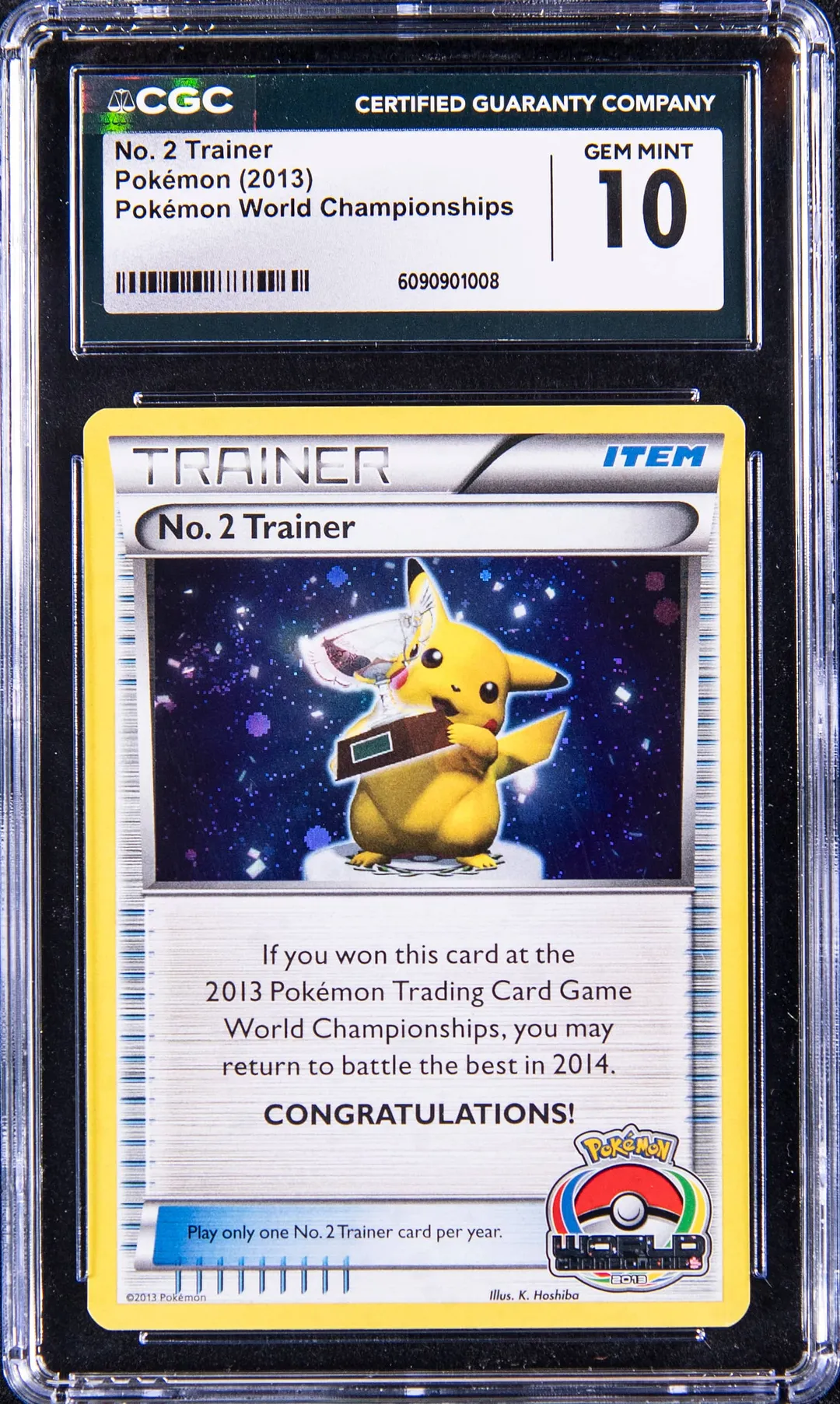
2013 No. 2 Trainer Pikachu Trophy CGC 10 Sells for $37K
Goldin sold a 2013 Pokémon World Championships No. 2 Trainer Pikachu trophy card, CGC GEM MINT 10 pop 1, for $37,200 on Feb 16, 2026.
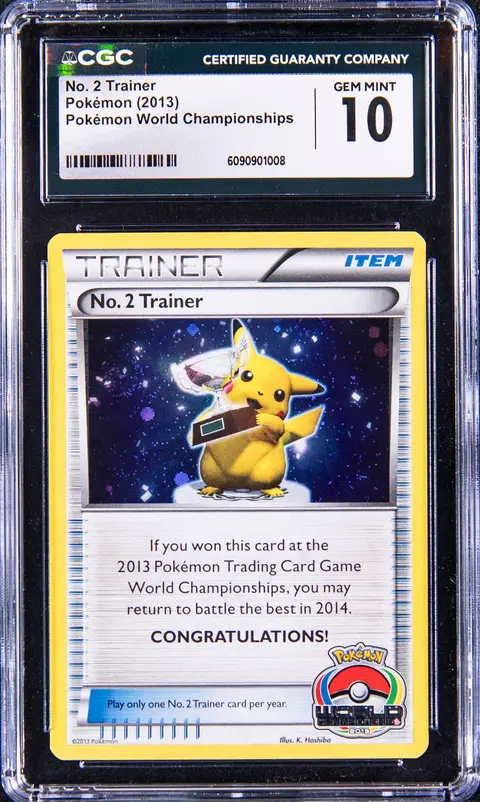
Sold Card
2013 Pokemon World Championships No. 2 Trainer Pikachu Trophy Card - CGC GEM MINT 10 - Pop 1
Sale Price
Platform
Goldin2013 Pokémon World Championships No. 2 Trainer Pikachu Trophy Card (CGC 10) Sells for $37,200
On February 16, 2026, Goldin auctioned one of the most elusive pieces of competitive Pokémon history: a 2013 Pokémon World Championships No. 2 Trainer Pikachu trophy card, graded CGC GEM MINT 10 and noted as a population 1 (the only copy at that grade, per the submitter’s information). The card realized $37,200.
For collectors who follow World Championships trophies and early Pikachu prize cards, this is a notable data point in a very thin market.
Card breakdown: what exactly sold?
Let’s start by clearly identifying the card:
- Game / IP: Pokémon TCG
- Character: Pikachu (illustrated as a World Championships trophy card mascot)
- Year: 2013
- Event: Pokémon World Championships
- Type: No. 2 Trainer Trophy Card (awarded to second-place finishers in a division)
- Release context: Prize-only; not a pack-pulled card
- Grading company: CGC Cards
- Grade: GEM MINT 10
- Population: Pop 1 in CGC 10 (the only known copy in that grade at CGC at the time of sale)
This is not a set card from a standard expansion. It’s a trophy card, given to top finishers at the 2013 Pokémon World Championships. Trophy cards are among the scarcest pieces in the Pokémon hobby because they were never sold at retail and were only awarded to a handful of players.
Because of that structure, these cards tend to be:
- Extremely low print
- Concentrated in a small number of collections
- Very slow to change hands compared with standard chase cards
Why the 2013 No. 2 Trainer Pikachu trophy matters
While early Japanese No. 1 / No. 2 / No. 3 Trainer and Trophy Pikachu cards from the late 1990s receive the most attention, modern-era World Championships trophies from the 2010s are increasingly tracked by serious collectors.
Key points of significance:
- Worlds-only prize: This card was only awarded at the 2013 Pokémon World Championships, making it tied to a specific event, year, and competitive field.
- Ultra-low supply: Each division typically has a very small number of trophy winners. That means total copies available to the public are tiny compared to even the rarest pack-pulled secret rares.
- Competitive history: No. 2 Trainer denotes a second-place finish. That links the card directly to a high-performing competitive player and a specific Worlds format.
- Era: 2013 falls into what many collectors call the “modern” to “ultra modern” bridge. Print runs for regular set cards were large, but prize-only Worlds cards remained tightly controlled.
From a collector’s perspective, the 2013 No. 2 Trainer Pikachu trophy sits in the broader lineage of Worlds trophies, which have become a dedicated niche within the Pokémon TCG.
Understanding the CGC GEM MINT 10, Pop 1 label
This copy graded CGC GEM MINT 10, which is the top standard grade given by CGC Cards for modern issues. In practical terms, that indicates:
- Centering, edges, corners, and surface are all at or near perfect
- No visible wear under normal examination
“Pop 1” (short for population 1) means there is only one example in the CGC population report at this grade, according to the information presented about this sale. Population reports aggregate how many copies of a specific card have been graded at each grade level by a given company.
For cards that already exist in tiny numbers, a pop 1 in gem mint condition adds another layer of scarcity on top of an already rare prize card.
Market context and recent sales
Trophy cards like the 2013 No. 2 Trainer Pikachu do not sell often, so the usual approach of stacking multiple “comps” (comparable recent sales used as a price reference) is difficult.
Instead, hobbyists tend to look at:
- Sales of other World Championships trophy cards from nearby years
- Cross-grades or different grading companies for the same card, when they appear
- Older Trophy Pikachu or No. 1 / No. 2 / No. 3 Trainer cards as a broader benchmark
For this specific 2013 No. 2 Trainer Pikachu in CGC 10, public, repeat sales are extremely limited or nonexistent at the time of this writing. Most movement happens quietly via private deals or infrequent auction appearances.
Within that context, the $37,200 realized price at Goldin on February 16, 2026 sits in line with how the market has historically treated:
- Modern-era Worlds trophies with documented scarcity
- High-grade examples that are at or near top-pop
Because the data set is thin, it’s more appropriate to talk about this as one more reference point in a sparse sales history rather than as a firm “market level.” It adds a new, concrete number into a category where every confirmed public sale matters.
Comparing to nearby segments of the trophy market
When collectors think about where a card like this fits, they often compare it to:
- Older Japanese trophy cards (late 1990s and early 2000s): These often command higher attention and larger historical price records, but they also operate in a slightly different tier of rarity and lore.
- Other 2010s Worlds trophies: Sales here can range widely depending on card, year, division, language, and grade.
- Pack-pulled ultra rares and modern chase cards: Even the most popular set cards typically exist in far greater quantities than a Worlds trophy card. Their markets are more liquid, but also more sensitive to supply.
The 2013 No. 2 Trainer Pikachu trophy falls into the part of the market where:
- Transaction frequency is low
- Collectors are typically long-term oriented
- Small changes in supply (a single copy coming to auction) can feel significant
What this sale might signal to collectors
Because of the thin data, it’s important not to over-interpret a single auction result. Instead, collectors can use this sale as:
- A new price reference for a 2013 No. 2 Trainer Pikachu trophy card in top condition
- A reminder of the gap between elite prize-only cards and even scarce pack-pulled cards from the same era
- An illustration of grading impact: A CGC GEM MINT 10 pop 1 label gives the winning bidder something uniquely positioned within an already small card pool
For hobbyists who are newer to Pokémon and mainly familiar with booster boxes, secret rares, or modern chase cards, this sale highlights a separate lane of collecting: event-linked trophies that function more like sports championship rings or medals than traditional trading cards.
Takeaways for different types of collectors
Newcomers and returning collectors
- Trophy cards like this are not an entry-level segment of the hobby, but they are useful for understanding the full range of what exists in Pokémon.
- Seeing a 2013 World Championships card sell for $37,200 at Goldin on February 16, 2026 gives context for why some collectors focus on event history as much as artwork.
Active hobbyists and small sellers
- You’re unlikely to handle a 2013 No. 2 Trainer Pikachu trophy card often, if ever, but tracking these auctions helps you understand how the very top of the Pokémon market behaves.
- When you see strong or stable results for high-end trophies, it can frame how you think about rarity versus popularity in your own segment (for example, low-pop promos, stamped event cards, or limited prize cards).
Final thoughts
The 2013 Pokémon World Championships No. 2 Trainer Pikachu trophy card that sold at Goldin on February 16, 2026 is a small but meaningful data point in a very quiet corner of the market. At $37,200 for a CGC GEM MINT 10 pop 1 copy, it underscores how:
- True event-only scarcity continues to be recognized
- Top-pop grades matter more when raw supply is already microscopic
- Even modern-era Pokémon can produce pieces that function more like historical artifacts than standard trading cards
For collectors building a broader understanding of the Pokémon TCG, keeping an eye on sales like this helps round out the picture beyond booster pulls and mainstream chase cards.