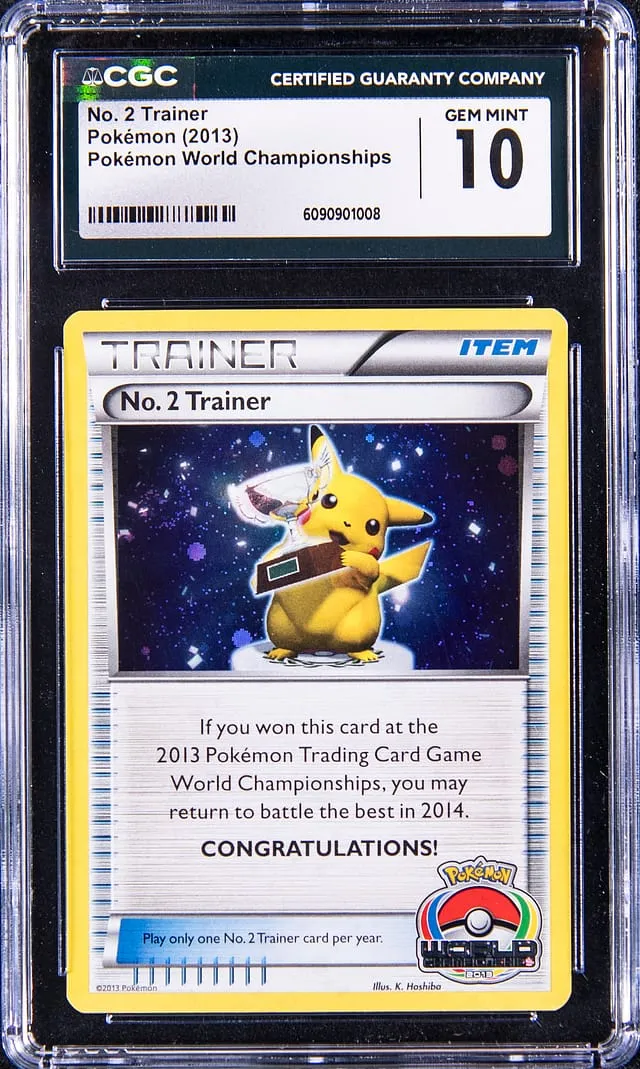
2013 No. 2 Trainer Pikachu Trophy Card Sells for $37K
Breakdown of the 2013 Pokémon No. 2 Trainer Pikachu trophy card CGC 10 pop 1 sale for $37,200 at Goldin on February 16, 2026.
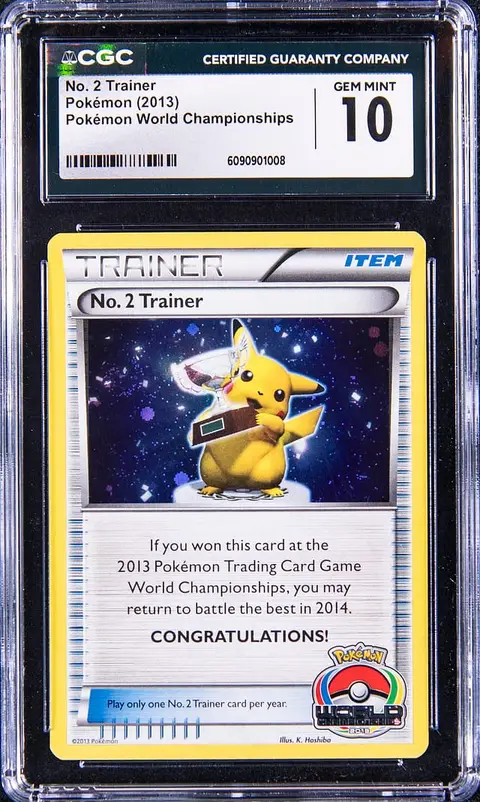
Sold Card
2013 Pokemon World Championships No. 2 Trainer Pikachu Trophy Card - CGC GEM MINT 10 - Pop 1
Sale Price
Platform
Goldin2013 Pokémon World Championships No. 2 Trainer Pikachu Trophy Card (CGC 10) Sells for $37,200
On February 16, 2026, a major piece of competitive Pokémon history changed hands at Goldin: a 2013 Pokémon World Championships No. 2 Trainer Pikachu Trophy Card graded CGC GEM MINT 10 realized $37,200.
For a niche but passionate corner of the hobby, this is the type of result that matters less as a “headline record” and more as a data point in a very thin, very specialized market.
What exactly is this card?
Card ID
- Title: 2013 Pokémon World Championships No. 2 Trainer Pikachu Trophy Card
- Character: Pikachu (Trainer trophy artwork)
- Event: 2013 Pokémon World Championships
- Type: No. 2 Trainer Trophy Card (award card, not a pack-pulled set card)
- Era: Modern / early 2010s competitive trophy era
- Grading company: CGC
- Grade: GEM MINT 10
- Population: Pop 1 (the only example in the CGC population report in this grade at the time of sale)
No. 1, No. 2, and No. 3 Trainer cards are among the most sought-after Pokémon trophies. They were given to top finishers at World Championships and other major events in extremely low quantities, often single digits per division.
Because they are award-only cards, they are not part of a standard released “set” like Black & White, XY, etc. Instead, collectors group them under trophy cards—ultra-scarce prizes that sit at the intersection of competitive history and high-end collecting.
Why the 2013 No. 2 Trainer matters
Several factors make this card important to trophy and high-end Pokémon collectors:
Worlds-level provenance
The 2013 World Championships represent the pinnacle of competitive play for that year. A No. 2 Trainer Trophy Card is tied directly to a specific top finish at Worlds, which gives it a tangible, documented competitive story—different from mass-printed chase cards.Extremely low original print and award run
While exact print numbers are not always public, No. 2 Trainer awards are understood to exist in single-digit or very low double-digit quantities per year and language. Many stay in the original winner’s hands, so far fewer ever reach the open market.Pikachu trophy artwork
Pikachu remains the face of the franchise, and trophy cards featuring Pikachu art have historically attracted strong demand from character collectors and trophy specialists. That character tie-in matters when collectors choose between different trophy issues.Grade scarcity (CGC GEM MINT 10, Pop 1)
CGC’s GEM MINT 10 is a high bar, and for niche, older trophy issues, populations are tiny. A pop 1 means this is the only example at this grade in the CGC census at the time of sale, adding another layer of scarcity on top of already low physical supply.
In short, this isn’t a rookie card or a standard set chase. It’s a niche, event-tied artifact from competitive Pokémon’s modern era.
Market context and recent trophy pricing
Trophy card markets are far thinner than those for mass-printed chase cards like Charizard or modern alt-arts. “Comps” (short for comparable sales—recent, similar items used as price reference) are scarce and often spread out across years and auction houses.
For this specific 2013 No. 2 Trainer Pikachu CGC 10 pop 1, public sales history is very limited. The card appears rarely at auction in any grade, and CGC 10 examples have extremely little recorded data.
When looking for context, most collectors zoom out and compare:
- Different years of No. 1, No. 2, and No. 3 Trainer trophies in similar conditions.
- Different grading companies (PSA, BGS, CGC) and how their top grades have been treated historically.
- Adjacent high-end trophies, like other World Championships prize cards or early Japanese trophy Pikachu issues.
Broadly:
- High-grade, Worlds-era trophy Pikachu cards have shown a pattern of strong but uneven results: they can sit quietly for a long time, then command meaningful prices when a serious collector and a scarce card finally meet.
- Prices can differ dramatically between years, languages, and art variants, so any comparison has to be taken as directional, not exact.
Within that context, $37,200 for a pop 1 CGC GEM MINT 10 sits comfortably in what many high-end collectors would consider serious but not runaway pricing for a rare trophy with Worlds provenance. It reflects:
- The difficulty of finding any copy, especially already graded at the highest level.
- A small buyer pool—far fewer people chase trophy runs than, say, Charizard—but also a small seller pool.
Because of the thin data and the unique nature of trophy markets, it’s more realistic to treat this Goldin result as one more anchor point rather than a definitive “market price” for every 2013 No. 2 Trainer across all grading companies and grades.
How grading and population shape this card’s story
For newer collectors, it’s worth unpacking why CGC 10 pop 1 matters:
- Grading is the process where a third party evaluates condition (centering, corners, edges, surface) and encases the card.
- Population report (or “pop report”) is the census each grading company publishes, showing how many copies of a card exist in each grade.
Here:
- A CGC GEM MINT 10 represents a card that CGC considers virtually flawless for the issue.
- A pop 1 at CGC means only this single example had been graded a 10 there at the time of sale.
For a card that already exists in low physical numbers, a pop 1 in the top grade amplifies the feeling of uniqueness. Some collectors prefer PSA or BGS for registry reasons, others are comfortable with CGC’s standards. Either way, top-pop trophies often attract:
- Set or theme builders (for example, collectors building a run of No. 1/2/3 Trainers across multiple years).
- Condition-focused collectors who specifically seek the top-known examples of rare issues.
Why this sale matters to the broader Pokémon hobby
Even though trophy cards sit in a niche side lane compared to mass-market hits, results like this tell us a few things about the broader hobby in 2026:
Competitive history is still valued
Collectors continue to reward cards that connect directly to how Pokémon is actually played and competed at the highest level—not just characters and artwork.Ultra-low supply markets remain thin but resilient
Trophy cards may not have weekly comps, but when they surface, they still find serious buyers at structured, public auctions like Goldin. That’s an important signal for a segment that often relies on private deals.Grading diversification is real
Seeing a CGC 10 pop 1 trophy achieve a five-figure result reinforces that multiple grading companies can host high-end cards with real demand, especially once population data becomes widely known.Data points, not predictions
Because each trophy sale is unique (year, division, grade, provenance, and timing), it’s more realistic to treat this as context rather than a forecast. It tells us what one serious buyer was willing to pay on one night in February 2026.
Takeaways for collectors and small sellers
If you’re newer to the space or returning after a long break, here are a few practical lessons this sale underlines:
Not all rarity is the same. A “short print” in a modern mass release might still have thousands of copies. Trophy cards start with single-digit or low double-digit award counts.
Comps will be sparse. For niche items like this, you may only find one or two public sales over several years. Expect wide ranges and be patient when buying or selling.
Condition and provenance matter more as supply drops. When there are only a handful of copies, the story (event, player, original owner) and preservation (grading, grade, pop) play a larger role than any price formula.
Auctions can surface true demand. A venue like Goldin on February 16, 2026 gave this card broad exposure. For thinly traded items, that kind of platform can help find the current “real world” number.
Final thoughts
The 2013 Pokémon World Championships No. 2 Trainer Pikachu Trophy Card in CGC GEM MINT 10 pop 1 selling for $37,200 at Goldin is a measured but meaningful moment for high-end Pokémon trophy collecting.
It doesn’t rewrite the record books, but it does what the best data points do: it quietly updates our understanding of where a scarce, historically rooted card sits in today’s market—one more reference for the next collector who has to decide what a true World Championships trophy is worth to them.