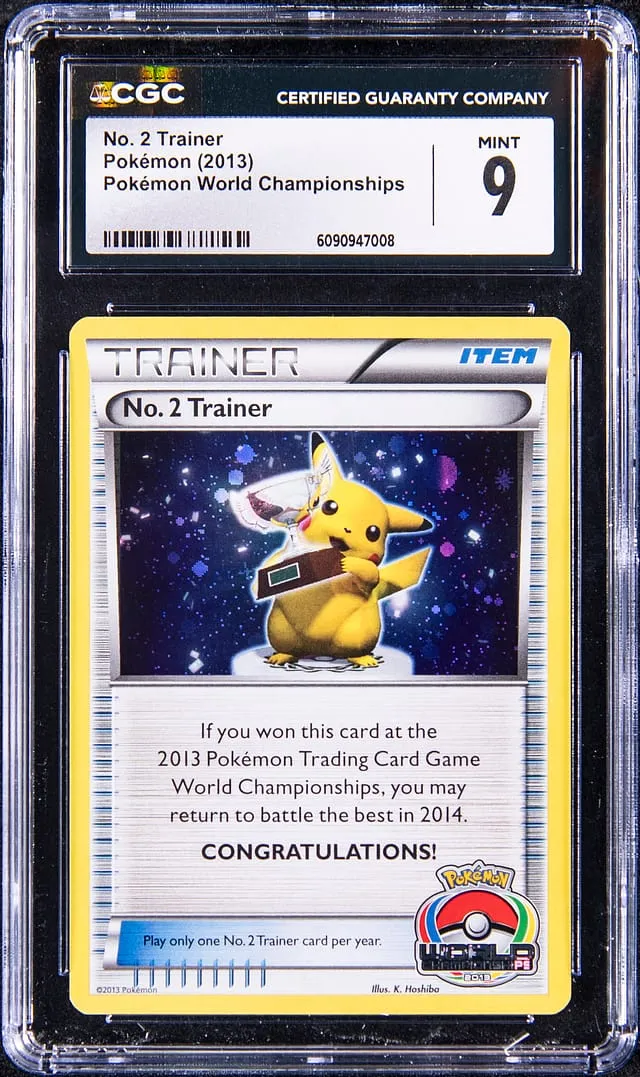
2013 No. 2 Trainer Pikachu CGC 9 sells for $37k
Goldin sold a 2013 Pokémon World Championships No. 2 Trainer Pikachu Trophy Card CGC 9 for $37,210 on April 20, 2026. Here’s the market context.
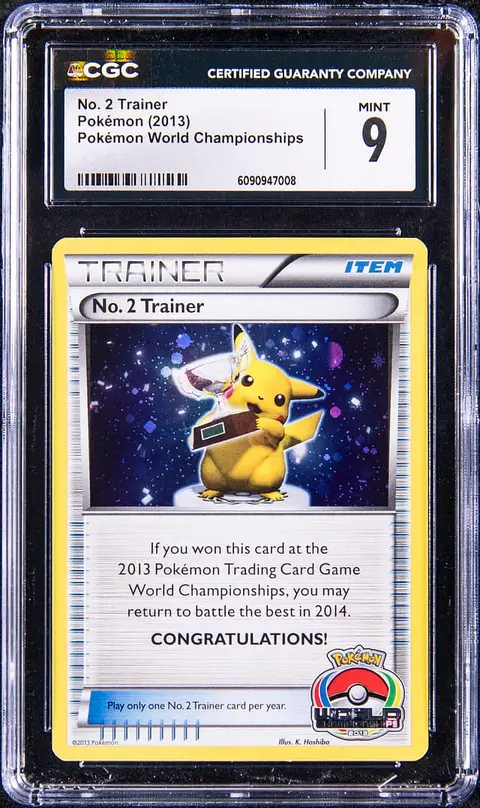
Sold Card
2013 Pokemon World Championships No. 2 Trainer Pikachu Trophy Card - CGC MINT 9
Sale Price
Platform
Goldin2013 Pokémon World Championships No. 2 Trainer Pikachu Trophy Card (CGC 9) Sells for $37,210
On April 20, 2026, Goldin closed a notable sale for one of the more elusive pieces in the Pokémon hobby: a 2013 Pokémon World Championships No. 2 Trainer Pikachu Trophy Card graded CGC MINT 9. The final price landed at $37,210.
For a niche World Championships trophy card, this result offers another useful data point in a market where true public sales are rare and often spaced years apart.
What exactly is this card?
Let’s lay out the basics collectors care about:
- Card: No. 2 Trainer Pikachu Trophy Card
- Year: 2013
- Event: Pokémon World Championships (main event trophy card)
- Character: Pikachu (Worlds “Trophy” artwork, not a main set Pikachu)
- Type: Prize / trophy card, not a pack‑pulled set card
- Rookie or key issue? Not a “rookie” in the typical sense, but absolutely a key World Championships trophy issue from the 2010s era
- Grading company: Certified Guaranty Company (CGC)
- Grade: CGC MINT 9
- Attributes: Extremely low distribution, event‑only trophy; no serial numbering on the card itself, but effectively very low print volume.
The “No. 2 Trainer” designation reflects the achievement level at Worlds. Historically, Pokémon trophy cards have been awarded to top finishers (for example, 1st, 2nd, 3rd place) at the World Championships or predecessor events in Japan. The 2013 World Championships No. 2 Trainer Pikachu is part of that trophy lineage—small print run, given directly to competitors, and rarely seen in open circulation.
Why collectors care about Worlds trophy cards
For those newer to the high‑end Pokémon niche, trophy cards sit in a different category than chase cards from booster boxes:
- Distribution: Trophy cards are awarded at events, not pulled from packs, so the number of copies is tied to how many people placed in specific divisions and categories.
- Print volume: While exact print runs are usually not published, they are understood to be very low—often on the order of a few copies per division per year.
- Pedigree: They represent a player’s performance at World Championships, which adds a layer of competitive history beyond standard set collecting.
- Art and era: This 2013 issue sits in the “modern / early ultra‑modern” era of Pokémon, but the trophy status makes it feel closer to vintage in terms of scarcity.
In practice, that combination—low supply, tournament pedigree, and Pikachu artwork—gives these cards long‑term collector significance even though they are not pack‑pulled chase cards.
Market context: how does $37,210 fit in?
Public, verifiable sales data for 2013 World Championships No. 2 Trainer cards is very thin. They surface infrequently at major auction houses or fixed‑price marketplaces, especially in high grade from a top grading company.
Because of that, most collectors look at a mix of:
- Exact‑card comps: Prior public sales of the same 2013 No. 2 Trainer card, in any high grade, when available.
- Adjacent trophy comps: Other Worlds No. 1 / No. 2 / No. 3 Trainer Pikachu cards from surrounding years, in similar grades.
- Cross‑grade / cross‑slab comparisons: Prices for the same card in PSA, BGS, or other CGC grades.
Recent trophy card results show a wide range depending on:
- Year and artwork
- Whether it’s No. 1, No. 2, or No. 3
- Grading company reputation for that segment of the hobby
- Condition variables (surface print lines, edges, centering, etc.)
Within that context, a realized price of $37,210 at Goldin on April 20, 2026 sits in the tier where:
- The card is clearly recognized as a true trophy‑level piece, not a mid‑tier promo.
- The result is meaningful but not all‑time record territory for the broad Pikachu trophy ecosystem, which includes earlier Japanese trophies and some top‑population PSA 10s that can command significantly higher numbers when they appear.
Because genuine sales for this exact 2013 No. 2 Trainer Pikachu in CGC 9 are so limited, this auction functions more as a fresh benchmark than a simple confirmation of an already well‑defined market range.
CGC MINT 9: what the grade tells us
CGC has built a following in the Pokémon segment, especially among collectors who value detailed subgrades and strict surface evaluation. A CGC MINT 9 generally signals:
- Clean surfaces with only minor flaws
- Strong corners and edges
- Acceptable to strong centering for the issue
For ultra‑low‑population trophy cards, the grade distribution is usually tight—there simply are not many copies to grade. That means a CGC 9 often lives very near the top of the available condition spectrum, even if a theoretical 9.5 or 10 exists in tiny numbers.
From a hobby perspective, this sale reinforces that high‑grade, well‑presented CGC examples of true trophy cards can sustain serious market interest, particularly when auctioned through a large platform like Goldin that reaches both dedicated Pokémon collectors and general high‑end card buyers.
How this sale fits into the broader Pokémon market
A few trends frame this result:
Trophy vs. booster‑box chases
Over the last several years, more collectors have differentiated between widely known chase cards (e.g., Charizard, Umbreon, alt‑arts) and truly scarce event cards like trophies. Even when overall hobby sentiment has cooled or stabilized, high‑end trophies have tended to trade on a separate timeline because of their limited supply.2010s Worlds era maturing
The early‑2010s Worlds events are now far enough in the rear‑view mirror that participants and spectators are returning to the hobby with more disposable income. As that happens, the symbolic importance of these particular Worlds years has become clearer—and that has drawn more attention to their trophy cards.Cross‑grading and cross‑slab collecting
Some collectors still strongly prefer PSA, others are open to CGC and BGS, especially in Pokémon. When a CGC 9 trophy realizes a healthy price, it supports the idea that card quality and scarcity can outweigh slab preference for enough bidders to establish a real market.
Takeaways for different types of collectors
This sale doesn’t offer a simple “price chart” the way a mass‑printed set card does, but it does provide a few practical insights.
For newcomers and returning collectors
- Trophy cards are a different lane. The price behavior is driven by scarcity and event history, not by how many booster boxes are being opened.
- Comps (comparable sales) are thin. You will not see daily or weekly sales; instead, a handful of auctions over several years shape expectations.
If you’re just getting oriented, this sale is best viewed as a case study in how rare, event‑earned cards are treated at major auction houses like Goldin.
For active hobbyists
- Benchmark, not a rule. $37,210 in CGC 9 is a meaningful data point, but each future sale will still be heavily influenced by eye appeal, provenance, and the specific auction venue.
- Grade flexibility. The strong result for a CGC 9 suggests that, in the true trophy lane, collectors are increasingly comfortable evaluating the card first and the label second.
For small sellers and market watchers
Most small sellers will never handle a 2013 No. 2 Trainer Pikachu, but this sale still carries a lesson:
- Event‑only promos and awards can be structurally different from pack‑pulled cards. Even lower‑tier staff or participation promos sometimes benefit from the same dynamic—very low supply and concentrated demand from people with a direct connection to the event.
Watching these high‑end auctions helps inform how you treat rarer promos and limited‑run cards in your own inventory, even if the absolute prices are on a completely different scale.
Final thoughts
The April 20, 2026 Goldin sale of the 2013 Pokémon World Championships No. 2 Trainer Pikachu Trophy Card (CGC MINT 9) for $37,210 adds another chapter to the evolving story of Worlds trophy cards.
It underscores a few key realities:
- True trophy cards remain among the most supply‑constrained items in the Pokémon hobby.
- High‑grade examples, even outside the most dominant grading brands, can still capture serious attention when they reach a large auction stage.
- Individual sales like this function more as anchors for future price discovery than as fixed guarantees of value.
For collectors who focus on the intersection of competition history and card collecting, this result confirms that the 2010s Worlds trophy Pikachu cards continue to hold a respected place in the modern high‑end Pokémon market.