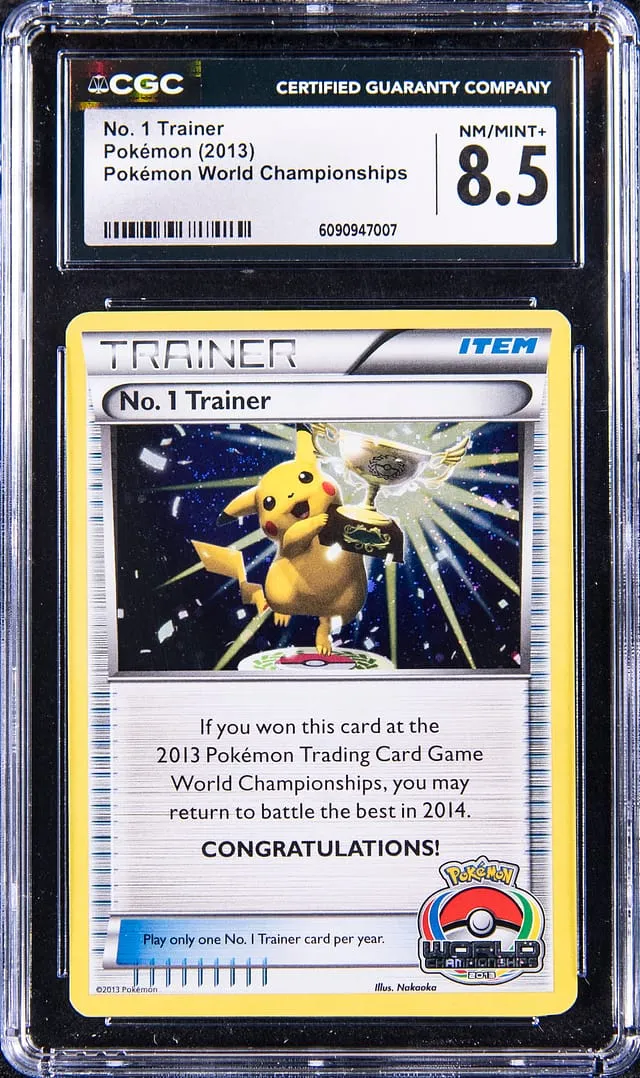
2013 No. 1 Trainer Trophy Pikachu CGC 8.5 Sale
A 2013 Pokémon World Championships No. 1 Trainer Trophy Pikachu CGC 8.5 sold for $37,824 at Goldin. Here’s what that means for trophy card collectors.
Sold Card
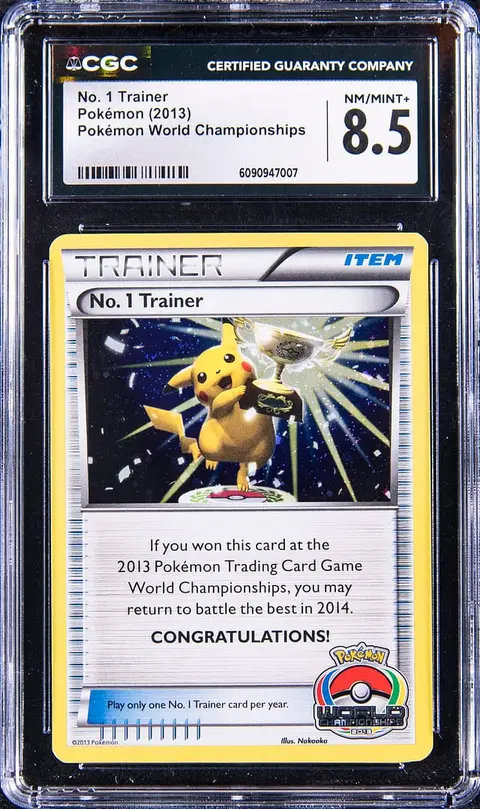
2013 Pokemon World Championships No. 1 Trainer Trophy Pikachu - CGC NM-MT+ 8.5
Sale Price
Platform
Goldin2013 Pokémon World Championships No. 1 Trainer Trophy Pikachu – CGC 8.5 Sells for $37,824
On April 6, 2026, a 2013 Pokémon World Championships No. 1 Trainer Trophy Pikachu graded CGC NM-MT+ 8.5 sold for $37,824 at Goldin. For collectors who follow high‑end trophy cards, this sale offers another data point in a niche but closely watched corner of the Pokémon market.
What exactly is this card?
Let’s start by identifying the card clearly:
- Character: Trophy Pikachu / “No. 1 Trainer”
- Year: 2013
- Event: 2013 Pokémon World Championships
- Type: No. 1 Trainer trophy card (award card, not pack-pulled)
- Rarity: Event‑only prize; extremely low population
- Grading company: CGC (Certified Guaranty Company)
- Grade: NM-MT+ 8.5
“No. 1 Trainer” cards are not part of a regular expansion set. They are trophy cards – special prizes awarded to top finishers at high‑level tournaments, in this case the 2013 Pokémon World Championships. Copies are believed to be extremely limited because they were only given to a handful of competitors.
Unlike a typical chase card from a booster pack, this card sits in the same broad lane as other World Championships and Japanese trophy issues: highly specialized, extremely scarce, and mostly traded within serious trophy‑card circles.
Why collectors care about No. 1 Trainer Trophy Pikachu
A few factors make this kind of card important to collectors:
True scarcity
Trophy cards are printed in very small quantities. They’re tied to specific events and often personalized or region‑specific. That makes them feel more like medals than traditional trading cards.Direct connection to competition
This card is literally an award from the 2013 Pokémon World Championships. For competitive TCG players, it represents the pinnacle of organized play in that era.Trophy Pikachu iconography
Trophy Pikachu has a long history in the hobby, especially for Japanese trophy cards from the late 1990s and early 2000s. While the artwork and templates change over time, the idea of Pikachu as the face of champion prizes has become a recognizable theme.Ultra‑modern event, legacy concept
The 2013 Worlds sits in what many collectors call the ultra modern era (roughly 2010s and later). Even though this isn’t a vintage or 1990s piece, it inherits the prestige of earlier trophy lines by being part of the same award tradition.
Grading, condition, and CGC 8.5
This copy received a CGC NM-MT+ 8.5 grade. In grading shorthand:
- NM-MT+ means Near Mint to Mint Plus, above an 8 but below a 9.
- For a card that likely never went through normal pack handling, the main issues tend to be minor edge wear, chipping, or subtle surface flaws.
In the trophy space, the strict focus on grade varies by collector. Some prioritize simply owning any authentic copy due to the low supply, while others pay clear premiums for top‑end grades.
CGC has continued to build its presence in the Pokémon segment, so a CGC 8.5 in a card like this is taken seriously by many collectors who track cross‑grading potential (submitting to another grading firm) or simply prefer CGC’s cases and subgrades.
Price context: the $37,824 sale at Goldin
The card sold for $37,824 at Goldin on April 6, 2026 (UTC).
When collectors talk about “comps” (short for comparables), they mean recent confirmed sales of the same or closely related cards. With a card as scarce as a 2013 No. 1 Trainer Trophy Pikachu, the comp pool is naturally small. These don’t show up every month like standard set cards.
For market context, collectors typically look at:
- Sales of the same event and title (2013 No. 1 Trainer) in different grades.
- Other years’ World Championships No. 1 Trainer cards in similar condition.
- Broader trophy Pikachu and No. 1 Trainer sales to understand the overall range for top‑end awards.
Across the last several years, high‑end trophy cards have shown wide price bands depending on:
- Year of issue and historical profile of the event.
- Whether the card is an early Japanese trophy piece or a later Worlds issue.
- Grade, personalization, language, and provenance.
Within that landscape, a mid‑to‑high grade CGC 8.5 example in the mid‑five‑figure range fits the broader pattern where:
- Top‑tier, headline trophy cards can reach six figures when the right combination of era + grade + story lines up.
- Later or less storied years and mid‑tier grades often transact in the low‑ to mid‑five‑figure range when they do surface.
Given the extremely low transaction volume for this exact card, each sale is more of an individual marker than a dense data point. Rather than calling this result definitively “high” or “low”, it’s more useful to see it as the latest public benchmark for a CGC 8.5 copy at auction in 2026.
How this sale fits into the trophy card market
Trophy cards exist in a niche that behaves differently from mass‑printed chase cards:
- Very thin supply: Many years never come up publicly, or only appear in private deals.
- Collector‑driven pricing: A small group of dedicated trophy collectors can have a large influence on realized prices, especially when they focus on particular years.
- Less tied to short‑term hype: Because of the small number of copies and long holding periods, price swings are often driven more by individual negotiations than by quick sentiment shifts.
In recent years, the broader Pokémon market has seen cycles of rapid run‑ups followed by cooling periods. Trophy cards, while not immune, tend to move more gradually due to the lower number of visible comps.
This $37,824 Goldin sale reinforces a few points:
Healthy demand for event‑level awards
Competitive‑play trophies continue to command a clear premium over most set cards of the same era.Liquidity is uneven but present
When a recognized auction house like Goldin lists a serious trophy piece, the market is willing to meet it in the mid‑five‑figure bracket when the card and timing line up.Grade still matters, but ownership matters more
For something like a 2013 No. 1 Trainer Trophy Pikachu, simply having a graded, authenticated copy is already a major hurdle. Incremental grade bumps matter, but they’re not the only story.
What collectors and small sellers can take away
For newcomers and returning collectors:
- Trophy cards like this sit at the very top of the Pokémon hierarchy. They are not an entry‑point product, but they are useful for understanding how far the top of the market can go.
- When you see terms like “No. 1 Trainer” or “trophy Pikachu”, know that you’re looking at award cards, not regular pack pulls.
For active hobbyists and small sellers:
- Use sales like this as context, not targets. They help frame the gap between event‑only trophies and even the most desirable booster‑pack cards.
- If you handle mid‑range or lower‑end cards, these results can still be helpful when explaining rarity tiers to buyers (e.g., the difference between store promos, staff promos, and true World Championships awards).
For anyone tracking high‑end Pokémon:
- Keep an eye on how often 2010s World Championships trophy cards appear at major auction houses and what grades they carry. Occasional sales like this CGC 8.5 create the sparse but important price history this niche relies on.
Final thoughts
The 2013 Pokémon World Championships No. 1 Trainer Trophy Pikachu is a clear reminder that not all Pokémon cards follow the same rules. Awarded at the top competitive level and anchored by the long‑running Trophy Pikachu tradition, it represents a small, high‑commitment segment of the hobby.
The $37,824 sale at Goldin on April 6, 2026 doesn’t rewrite the trophy market on its own, but it adds another measured data point to a slow‑moving, collector‑driven area. For those mapping the upper tiers of Pokémon, it’s one more reference marker in a market that’s defined less by volume and more by history, scarcity, and patience.