2013 No.1 Trainer Pikachu Trophy CGC 8.5 Sale
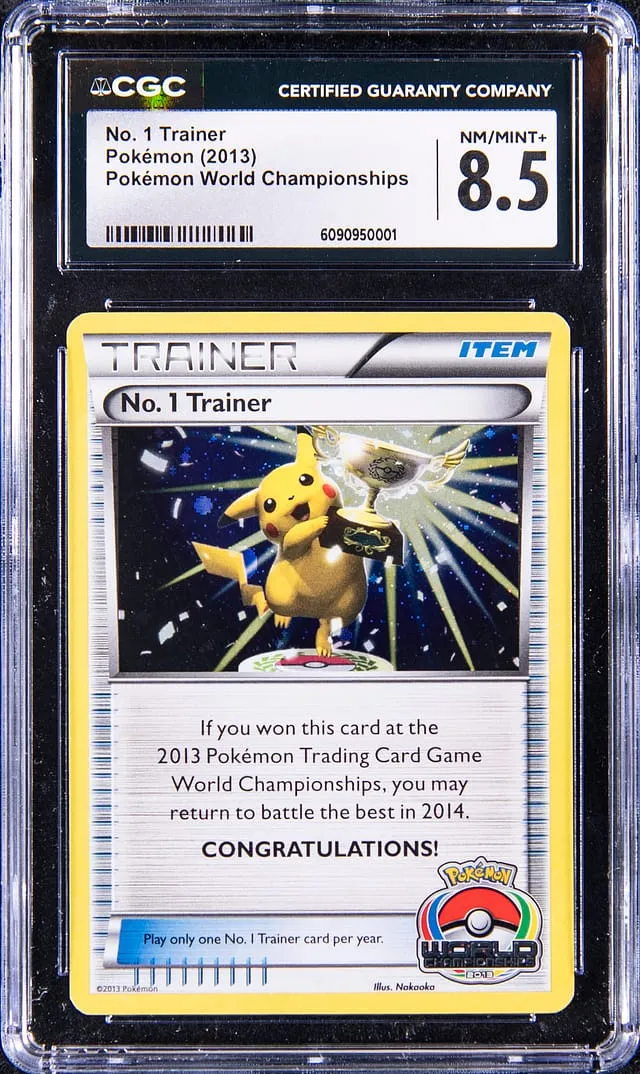
2013 Pokémon No.1 Trainer Pikachu Trophy Card CGC 8.5 sells for $46,495 at Goldin on March 9, 2026. A key data point for high-end trophy cards.
Sold Card
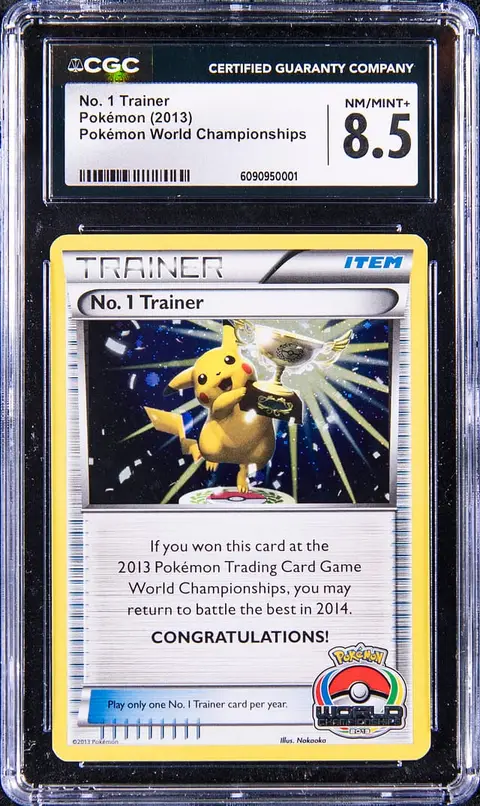
2013 Pokemon World Championships No.1 Trainer Pikachu Trophy Card - CGC NM-MT+ 8.5
Sale Price
Platform
Goldin2013 Pokémon World Championships No.1 Trainer Pikachu Trophy Card Sells for $46,495
On March 9, 2026, Goldin closed a notable sale for one of the hobby’s most elusive tournament cards: a 2013 Pokémon World Championships No.1 Trainer Pikachu Trophy Card, graded CGC NM-MT+ 8.5, realized $46,495.
For newer collectors, these World Championships “Trophy Pikachu” cards sit in a very different lane from regular set cards, even high-end chase cards. They were never sold in booster packs or at retail. Instead, they were awarded to top finishers at the official Pokémon World Championships, making them competition prizes rather than products.
Below, we’ll break down what this specific card is, why collectors care about it, and how this $46,495 result fits into the broader market.
What exactly is the 2013 No.1 Trainer Pikachu Trophy Card?
Key identifiers:
- Character: Pikachu (illustrated in a World Championships trophy-style design)
- Event: 2013 Pokémon World Championships
- Card type: “No.1 Trainer” Trophy Card (awarded to first-place finishers in their division)
- Year: 2013
- Distribution: Event prize, not pack-issued
- Era: Modern / early ultra-modern competitive trophy era
- Grading: CGC 8.5 (NM-MT+)
Although print run data for individual Trophy Pikachu cards is not officially published, the pool of possible copies is naturally constrained by the event structure. No.1 Trainer cards were typically awarded to the champion of each age division at Worlds. That means we are dealing with a very small number of original recipients, plus any later reissues for staff or ceremonial purposes (when they exist).
From a collector’s standpoint, that makes this a true scarcity card: the number of copies that can ever surface is tiny, independent of how many people try to grade or collect it.
Why Trophy Pikachu and No.1 Trainer cards matter
Within Pokémon, Trophy Pikachu and No.1 Trainer cards occupy a position similar to historically important ticket stubs or championship rings in sports collecting. They are physical artifacts of the highest level of competitive play.
Collectors tend to value them for three main reasons:
True event provenance
These were earned on-stage at the World Championships, not pulled from packs. That connection to a specific competition makes them closer to awards than to traditional trading cards.Extreme scarcity
Even if every winner had their card graded, the total possible population is tiny. Population reports ("pop reports"—the grading companies’ counts of how many copies they’ve graded at each grade) for individual years and placements are generally very low.Long-term hobby significance
As Worlds has grown, the early-2010s era has come to be seen as a bridge between the early competitive scene and today’s large, globally followed events. Trophy cards from this stretch capture that transition.
About the CGC 8.5 grade
This example received a CGC 8.5, designated NM-MT+ (Near Mint–Mint Plus). For pack-issued modern cards, an 8.5 might feel mid-tier. For older or event-issued trophy pieces, it is often more than acceptable given how these cards were handled: they were not pulled from a sleeve on camera and immediately top-loaded. Many were handed to players in-person, transported home, and kept as mementos long before grading was common.
CGC uses subgrades on some labels (centering, surface, corners, edges) and has built a niche in Pokémon and TCG grading. While PSA remains the most commonly referenced grading company for price benchmarks, CGC has earned credibility among many Pokémon-focused collectors.
The $46,495 sale at Goldin
- Auction house: Goldin
- Sale date (UTC): March 9, 2026
- Realized price: $46,495
Goldin has become one of the primary venues for high-end Pokémon, especially for once-in-a-while pieces like trophy and prize cards. When a Trophy Pikachu surfaces there, it tends to attract serious collectors who have been waiting for any example to appear, regardless of specific grade.
Because public sales of this exact year and placement (2013, No.1 Trainer) are infrequent, this result mainly serves as a fresh data point rather than a confirmation of a tightly established price band.
How this sale fits into broader Trophy Pikachu pricing
Finding exact “comps” (comparable recent sales of the same card in a similar grade) for a card like this is difficult because:
- The total population is very low.
- Many copies remain in private collections.
- Years and placements (No.1 vs No.2 vs No.3) vary, and collectors do rank them differently.
What you can usually observe instead:
Cross-year ranges
Different-year No.1 Trainer or Trophy Pikachu cards have historically sold in a broad range, influenced by artwork, event nostalgia, and grade. Even within the same year, a PSA 9, CGC 9, or BGS 9 will not always stack perfectly, but they can give directional context.Grade versus availability
For ultra-scarce trophies, the difference between an 8.5 and a 9 is sometimes less dramatic in price than on mass-produced chase cards. Collectors often prioritize owning any authentic copy over holding out for a marginally higher grade that may not appear for years.
Based on available public auction data for adjacent years and placements, this $46,495 result for a CGC 8.5 sits in the zone you would expect for a serious but not record-breaking appearance of a modern-era No.1 Trainer Trophy Pikachu. It reflects:
- Ongoing demand for true competition trophies.
- A market that has cooled from peak speculative periods but has retained strong support for historically important cards.
Collector significance: how people think about this card
For active Pokémon and TCG hobbyists, a 2013 No.1 Trainer Pikachu Trophy Card checks several boxes that don’t usually overlap:
- Historical lane: It’s firmly in the competitive history of the game, linked to a specific World Championships.
- Character lane: It features Pikachu, the franchise’s flagship character, which always broadens the pool of interested collectors.
- Rarity lane: It is a true limited-issue prize, not an artificial low-serial insert.
In conversations among collectors, owning any World Championships trophy card is often talked about as a long-term “pillar piece” in a collection. They are the kind of cards that people plan around: selling multiple modern chase cards to consolidate into a single trophy, or slowly working toward one big purchase over time.
Market context in 2026
The broader trading card market in 2026 is more mature than the rapid run-up of the early 2020s. That matters for reading a result like this:
Less speculative froth
Many short-term speculators have moved on, leaving a higher concentration of long-horizon collectors in this niche.Clearer stratification
Common, reprint, and high-population cards have become more price-sensitive. Low-population, historically important items—like trophies—continue to find buyers when they surface.Greater awareness of event cards
As more content has been produced around competitive Pokémon history, trophy and prize cards are better understood by a wider segment of collectors than they were a decade ago.
Against that backdrop, a nearly $50,000 realized price for this CGC 8.5 is less about a sudden spike and more about reaffirming where World Championships trophies sit in the hierarchy of Pokémon collectibles.
What this means for different types of collectors
If you’re a newer or returning collector:
- Use this sale as a reference point for understanding the category of World Championships trophy cards, not as a target for most collections.
- Trophy cards live in a separate tier from even high-end pack-pulled chase cards. It’s normal if they are out of reach; most collectors focus on more accessible goals.
If you’re an active Pokémon hobbyist:
- This result reinforces that event-issued cards with strong provenance continue to command attention at major auction houses.
- When evaluating similar items, pay attention to:
- The specific year and placement (No.1, No.2, No.3).
- The grading company and grade.
- Whether there is any documentation or story tying the card back to a known player.
If you’re a small seller or trader:
- This kind of trophy card is unlikely to pass casually through local channels, but it sets a high-end reference point for how seriously the market takes event-only items.
- Event promos, staff cards, and prize cards from smaller tournaments are not on the same level, but they benefit from the increased attention given to competition-linked pieces.
Key takeaways
- The 2013 Pokémon World Championships No.1 Trainer Pikachu Trophy Card is a low-population, event-issued prize that sits near the top of the Pokémon collecting hierarchy.
- This CGC 8.5 copy selling for $46,495 at Goldin on March 9, 2026, adds an important modern data point for the card’s market context.
- Trophy Pikachu cards attract collectors who care about competitive history, true scarcity, and long-term significance more than short-term speculation.
For collectors tracking the top end of the Pokémon market, this sale is a reminder that while the broader hobby has normalized, genuine competition trophies remain firmly established as key historical artifacts.