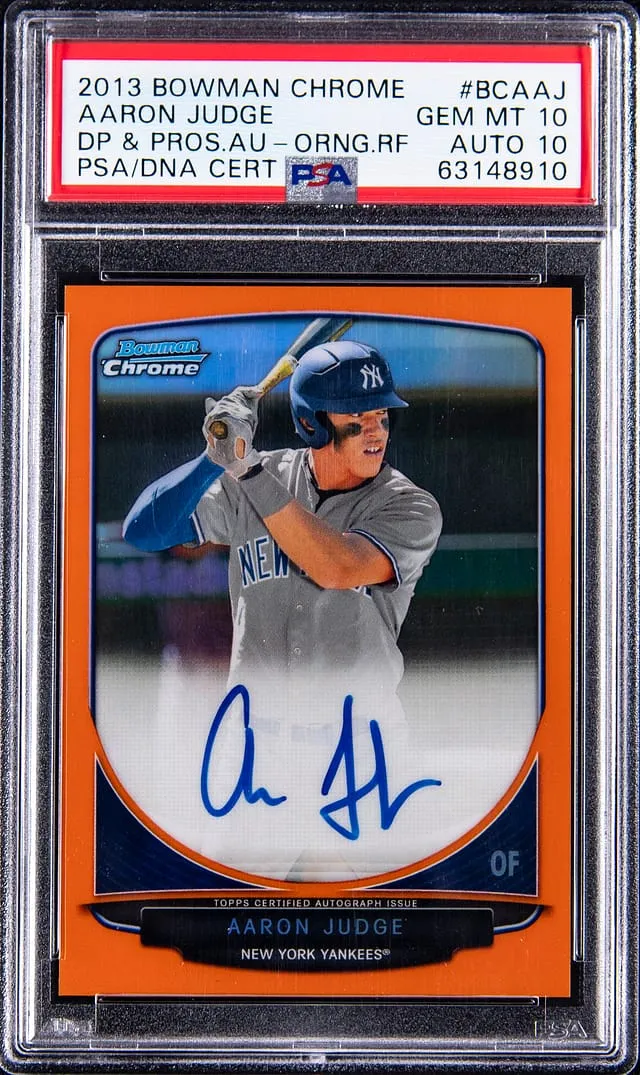
2013 Bowman Chrome Orange Aaron Judge Auto PSA 10
Deep dive into Goldin’s $215,940 sale of the 2013 Bowman Chrome Draft Orange Refractor Aaron Judge auto PSA 10 /25 and what it means for collectors.
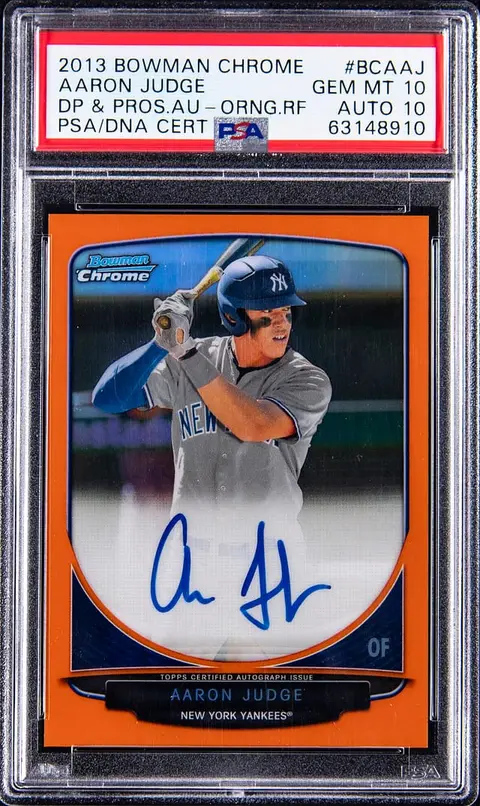
Sold Card
2013 Bowman Chrome Draft Picks & Prospects Autograph Orange Refractor #BCA-AJ Aaron Judge Signed Rookie Card (#10/25) - PSA GEM MT 10, PSA/DNA GEM MT 10 - Pop 4
Sale Price
Platform
GoldinAaron Judge’s prospect autos have helped define the modern baseball market, and few feel as important as his 2013 Bowman Chrome Draft Autograph Orange Refractor.
On March 8, 2026, Goldin sold a 2013 Bowman Chrome Draft Picks & Prospects Autograph Orange Refractor #BCA-AJ Aaron Judge Signed Rookie Card, serial numbered 10/25, graded PSA GEM MT 10 with a PSA/DNA GEM MT 10 autograph. The final price was $215,940.
For a modern baseball issue, that’s a notable data point—and an interesting snapshot of where high‑end Judge cards stand today.
The card at a glance
- Player: Aaron Judge (New York Yankees)
- Year: 2013
- Set: Bowman Chrome Draft Picks & Prospects
- Card: Autograph Orange Refractor #BCA-AJ
- Serial number: 10/25
- Designation: Key early Bowman Chrome prospect autograph (widely treated as a core “rookie” for the hobby)
- Autograph: On‑card, blue ink
- Grading: PSA GEM MT 10 (card), PSA/DNA GEM MT 10 (auto)
- Population: PSA pop report shows 4 copies in this exact dual‑GEM configuration (card 10, auto 10)
While MLB’s official “RC” logo appears on Judge’s 2017 Topps issues, many collectors treat his 2013 Bowman Chrome Draft autographs—especially colored refractors—as his defining rookie‑era cards. Within that run, Orange Refractors (serial numbered to 25) sit near the top of the color hierarchy for non‑Superfractor parallels.
Why this card matters to collectors
1. The core Judge prospect auto
Bowman Chrome Draft is the home of many players’ first licensed MLB prospect autograph. For Judge, the 2013 Bowman Chrome Draft Autograph is effectively his flagship prospect card. When people talk about “the Aaron Judge auto” in high‑end conversations, they are usually referring to this design and this release.
That makes each colored refractor parallel—particularly low‑serial versions like Orange (/25), Red (/5), and the 1/1 Superfractor—a focal point for long‑term Judge collectors.
2. Scarcity plus condition
This specific copy combines three layers of scarcity:
- Print run scarcity: Only 25 Orange Refractors were produced.
- Condition rarity: Only a small subset of those survive in PSA GEM MT 10 condition.
- Dual GEM: The PSA/DNA GEM MT 10 grade on the autograph means both the card and the signature earned PSA’s top grade. According to the listing, this configuration has a population of 4, making it firmly a “top of the pop” example.
In modern cards, population reports (or “pop reports”) are simple tallies of how many copies of a card a grading company has given each grade. For rare parallels like this, even one extra GEM MT 10 can move a card from “chaseable” to “almost never seen.”
3. Modern, but not mass‑printed
Judge’s 2013 Bowman Chrome Draft auto sits in what many collectors call the “ultra‑modern” era—post‑2010 cards, generally with more parallels, more grading, and stronger price swings.
Even in that era, however, an on‑card autograph /25 from a premier chase player is meaningfully scarce, especially in top grade. Unlike base rookies or non‑numbered refractors, these do not surface in every auction cycle.
Market context and recent trends
To put Goldin’s $215,940 March 8, 2026 result in context, it helps to consider a few layers of the Judge market:
Comparing across parallels
Within the 2013 Bowman Chrome Draft Aaron Judge autograph lineup, the usual color tier from more common to more scarce is:
- Base auto (non‑refractor)
- Refractor /499
- Blue /150
- Green /75
- Gold /50
- Orange /25
- Red /5
- Superfractor 1/1
Higher‑end public sales over the last few hobby cycles have tended to concentrate in the Gold, Orange, Red, and Superfractor tiers. While exact figures move with the broader market and Judge’s performance, the Orange Refractor consistently sits in that “core premium” tier—well above Gold and below the very top (Red and Superfractor), but sharing the same conversation.
Grading premiums
As with most modern cards, the spread between grades can be large:
- PSA 9 vs PSA 10: A PSA GEM MT 10 often sells at a strong premium to PSA 9, particularly for low‑serial color. Collectors chasing a “best possible copy” tend to focus heavily on 10s.
- Auto grade: A PSA/DNA GEM MT 10 autograph grade can further separate a card from copies with streaky, faded, or 9‑grade signatures. For on‑card autos, this matters, especially in the $50,000+ range.
Because population is low and transactions are infrequent, direct one‑to‑one comps for a PSA 10 / PSA 10 auto Orange can be sparse. Instead, collectors often triangulate from:
- Recent Orange sales in lower grades
- Gold, Red, or Superfractor sales in similar grades
- Overall direction of Judge’s high‑end Bowman Chrome market
In that context, a mid‑six‑figure result for a dual‑GEM Orange aligns with the card’s position in the hierarchy: not the absolute top Judge 2013 Chrome card, but clearly in the thin air of his key early issues.
Why this sale matters
A reference point for scarce Judge color
With a population of 4 in PSA GEM MT 10 / PSA/DNA GEM MT 10 and only 25 copies printed, each public sale helps set expectations for future negotiations. Many high‑end copies trade privately; an auction like this creates a rare, verifiable benchmark.
For collectors and small sellers, that benchmark is useful in a few ways:
- Relative pricing: It offers a data point for pricing Gold, Green, and base autos, especially in similar grades.
- Condition discussions: It underlines how much weight buyers place on true GEM copies for modern cards.
- Market health check: It shows that there is still meaningful demand for premium Judge color in a mature market.
Judge’s standing in the hobby
Aaron Judge has already checked off several boxes that hobbyists watch for:
- AL MVP
- Record‑setting home run totals
- Face‑of‑franchise status with the New York Yankees
Those factors, combined with his presence in a cornerstone modern prospect product (Bowman Chrome Draft), keep his early autos in steady focus. While performance and the broader sports card market can push prices up or down, the core importance of this specific card to Judge collectors is well established.
Takeaways for collectors
If you’re newer to modern Bowman Chrome or returning to the hobby, here are a few practical notes this sale highlights:
- Learn the color ladder. Understanding how parallels (Gold, Orange, Red, etc.) stack up in rarity helps you compare prices across auctions.
- Watch population reports. A pop of 4 in PSA 10 for a /25 card is genuinely tight supply. With so few examples, each sale can be an outlier—but it still matters.
- Separate card grade from auto grade. A PSA 10 card with a 9 auto does not always behave the same way as a true dual‑GEM. Buyers notice.
- Use high‑end results as directional guides, not guarantees. A $215,940 sale does not promise anything about future values. It’s a data point you can weigh alongside other comps, your own risk tolerance, and how much you enjoy the card.
Final thoughts
The March 8, 2026 Goldin sale of the 2013 Bowman Chrome Draft Picks & Prospects Autograph Orange Refractor #BCA-AJ Aaron Judge, numbered 10/25 and graded PSA GEM MT 10 with a PSA/DNA GEM MT 10 autograph (pop 4), is a clear marker for where one of Judge’s most important early cards currently stands.
For dedicated Judge collectors, it reinforces the Orange Refractor’s place as a foundational chase. For everyone else—from newcomers to small sellers—it’s a useful reference when evaluating Bowman Chrome parallels, grading premiums, and the broader ultra‑modern baseball market.
As always, these results are best viewed as informed context rather than predictions. The real value is in understanding the card, the set, and the role they play in the evolving story of modern baseball collecting.