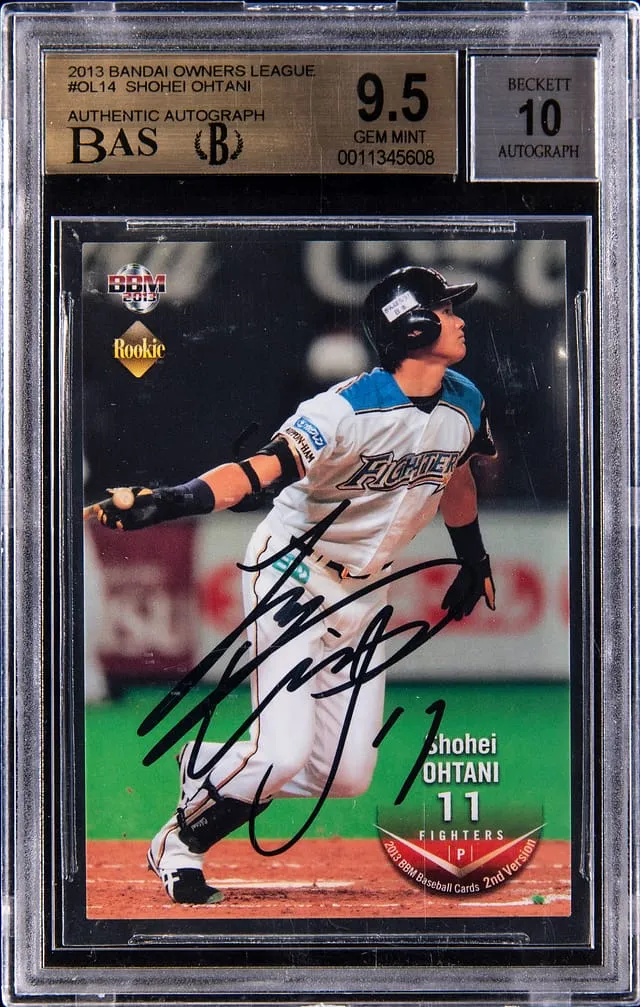
2013 BBM Shohei Ohtani Signed Rookie BGS 9.5 Sale
Goldin sold a 2013 BBM Shohei Ohtani signed rookie BGS 9.5/10 for $366,732. A key data point for early Ohtani autos and high-end Japanese issues.
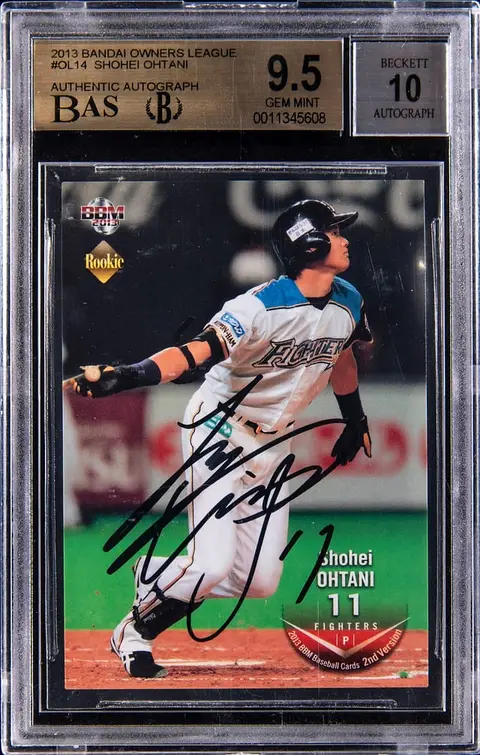
Sold Card
2013 BBM 2nd Version #554 Shohei Ohtani Signed Rookie Card - BGS GEM MINT 9.5, Beckett 10 - True Gem+
Sale Price
Platform
GoldinShohei Ohtani’s Japanese Rookie Auto Hits Big at Goldin
On May 10, 2026, Goldin closed a major sale that caught the attention of Ohtani collectors and modern baseball investors alike: a 2013 BBM 2nd Version #554 Shohei Ohtani Signed Rookie Card, graded BGS GEM MINT 9.5 with a Beckett 10 autograph and designated as a True Gem+, sold for $366,732.
For a card that predates Ohtani’s MLB debut and ties directly to his NPB beginnings, this result adds another important data point to the market for his early Japanese-issue autographs.
What exactly is this card?
Let’s break down the key details of the card itself:
- Year: 2013
- Set: BBM 2nd Version (Japan)
- Card number: #554
- Player: Shohei Ohtani
- Team: Hokkaido Nippon-Ham Fighters (NPB)
- Type: Rookie card with on-card autograph
- Grading company: Beckett Grading Services (BGS)
- Grade: BGS 9.5 GEM MINT, True Gem+ (all subgrades 9.5 or better)
- Autograph grade: Beckett 10 (Gem Mint auto)
BBM is a leading Japanese card manufacturer, similar to Topps or Panini in the U.S. Their 2013 releases are widely viewed as Ohtani’s true first mainstream trading cards from his debut season in Nippon Professional Baseball (NPB). Within that, an on-card signed rookie is one of the most desirable formats you can find.
Why the “True Gem+” label matters
Beckett assigns four subgrades for a card: centering, corners, edges, and surface. A “True Gem+” means:
- All four subgrades are at least 9.5
- At least one subgrade is a 10
Collectors often pay a premium for True Gem+ examples because:
- They sit at the very top within the 9.5 tier.
- They’re harder to replace, especially for cards that are already tough to find in high grade.
- Many registry or high-end collectors specifically target True Gem+ copies.
When you add a Beckett 10 autograph (indicating a clean, bold signature without noticeable issues), you’re looking at one of the most complete grading profiles possible without jumping to a BGS 10 Pristine or Black Label.
Market context: how does $366,732 fit in?
At $366,732, this sale firmly places this Ohtani BBM signed rookie among his more significant early autographs, though still below the absolute record territory we’ve seen for his MLB-licensed patch autos and unique 1/1 cards.
To understand the context, it helps to look at the broader landscape rather than a single comp (short for “comparable sales,” meaning recent sales of the same or very similar cards used as reference):
- Ohtani’s top MLB rookies: High-end Bowman Chrome, Topps Chrome, and premium patch autographs have regularly reached six figures, with select 1/1s and logo patches surpassing that in prior peak cycles.
- Japanese-issue rookies: His 2013 BBM and 2013 Epoch/other early NPB issues are far more limited in supply in graded, on-card auto form than his later MLB releases. True Gem+ copies, especially with perfect auto grades, appear infrequently at major auction houses.
Across recent auction seasons, strong BBM Ohtani rookies have:
- Consistently commanded a premium over lower-grade examples of the same card.
- Shown more stability than some speculative ultra-modern rookies, likely because they link directly to his first professional season.
Exact, up-to-the-week comps for this precise card, in this precise grade configuration, are limited. That’s part of the story: the lack of frequent public sales is itself a signal of scarcity at the high end. Where recent sales are available for similar 2013 BBM Ohtani autos in lower grade or without True Gem+ designation, the step up in price for this Goldin example aligns with what we typically see between:
- Gold-standard grades (True Gem+ or BGS 10) and 9/9.5 non-True Gem copies.
- Strongly presented, clean autos and those with streaking or lower auto grades.
So while we can’t pin this sale as a “record for X exact subgrade configuration” without more granular public data, we can say:
- It sits near the top of the range for this card’s known auction history.
- It reinforces that elite-grade, early Japanese Ohtani autos command a serious premium.
Why collectors care about 2013 BBM Ohtani
Several factors drive demand for this card among hobbyists:
True early-career issue
This is not a retrospective “rookie-style” card made after he became a star. It comes from 2013, when Ohtani debuted in NPB as a two-way player. For many collectors, that origin story matters as much as his MLB breakout.On-card autograph
On-card autos (where the player signs directly on the card, not on a sticker) are generally preferred. They are often seen as more premium and personal, especially for international rookies whose early signatures can be harder to source.Limited supply in top grade
Japanese packs were not opened and graded at the same scale as U.S. products. That means truly high-end graded copies—especially with a Beckett 10 auto and True Gem+—are comparatively scarce. Population reports (often called “pop reports,” which are the grading company’s count of how many copies exist in each grade) for 2013 BBM Ohtani autos tend to be thin at the very top.Historical significance of Ohtani himself
Ohtani has already secured a unique place in baseball history as the most successful two-way player of the modern era. MVP seasons, milestone home runs, dominant pitching stretches, and his move to a marquee MLB franchise all feed long-term interest. Early NPB issues are effectively the first chapter of that story.
Era and set context
The card sits in what collectors often call the “ultra-modern” era (roughly mid-2010s onward), but with several twists:
- It’s a non-MLB, Japanese domestic release, so print runs and distribution differ from U.S.-licensed products.
- Grading of Japanese cards scaled up later than U.S. cards; many 2013 BBM singles still sit raw (ungraded) or in Japan-only collections.
- Condition sensitivity can vary, and shipping/storage across borders adds risk, which helps explain why top-tier BGS examples are scarce.
For collectors, this gives 2013 BBM Ohtani rookies a hybrid identity:
- They have the modern look and feel of contemporary cards.
- They function more like niche, semi-regional issues with lower graded populations and a core collector base that understands their importance.
What could be driving interest right now?
Without leaning on speculation, there are a few grounded drivers that typically influence Ohtani’s market around sales like this:
- On-field performance: MVP runs, postseason appearances, or record-setting seasons tend to increase overall attention, pushing collectors toward his earliest and most meaningful issues.
- Long-term narrative: As Ohtani’s career progresses, many collectors are positioning around cards that tie to his beginnings rather than just his peak seasons.
- Global fanbase: Ohtani has substantial followings in both Japan and North America. Early NPB autographs bridge those markets, so demand comes from multiple regions.
Again, none of this guarantees future movement one way or another, but it does help explain why a single Japanese rookie auto can draw over $300,000 at a major auction house.
What this sale might mean for collectors
For active hobbyists and small sellers, this Goldin result doesn’t rewrite the entire Ohtani market, but it does add some useful signals:
Top-tier grading remains a differentiator
The jump in value from a solid grade to a True Gem+ with a 10 auto is significant, especially on cornerstone rookies. If you own high-potential Ohtani cards (or similar stars) raw, it can be worth carefully evaluating whether they justify a grading submission.Early international issues are firmly on the radar
This sale underscores that key NPB-era cards are not just niche curiosities. They are recognized as foundational pieces for serious player collections.Scarcity of exact comps is part of the story
When there are few direct comparables, auction outcomes can show wider swings. That uncertainty cuts both ways, but for owners of rare configurations (like this True Gem+ / 10 auto), it can be beneficial when strong demand and limited supply intersect.Market health for Ohtani’s premium tier
Seeing a substantial result for a non-MLB rookie auto at a respected venue like Goldin is another indicator that the very top of the Ohtani market still commands deep-pocketed interest.
How collectors can use this data point
If you’re a newcomer or returning collector:
- View this sale as a high-end reference point, not a target you need to chase.
- Learn the difference between Japanese-issue rookies, MLB rookies, and later tribute cards. That knowledge helps you spot value at more accessible price levels.
If you’re an active hobbyist or small seller:
- Track how results like this relate to lower grades of the same card or similar 2013 BBM Ohtani issues.
- Use population reports and recent sales data together when pricing your own cards or deciding which pieces to grade.
And for everyone:
- Remember that auction outcomes provide “recent sales” and “price context,” not guarantees. Use them as one tool among many—alongside player outlook, card condition, and your own collecting goals.
Summary
The May 10, 2026 Goldin sale of the 2013 BBM 2nd Version #554 Shohei Ohtani Signed Rookie Card, BGS GEM MINT 9.5 with a Beckett 10 autograph and True Gem+ subgrades, at $366,732, reinforces the status of Ohtani’s early Japanese autographs as true centerpiece items.
For figoca users and the wider hobby, it’s another clear example of how:
- Early, on-card signed rookies from a player’s first professional league can anchor an entire player market.
- Elite grading outcomes meaningfully separate one copy from the rest.
- International releases can command global attention when the player becomes a generational star.
As more Ohtani cards from both his NPB and MLB eras surface at major auction houses, this sale will remain a key reference point for understanding the top end of his rookie auto market.