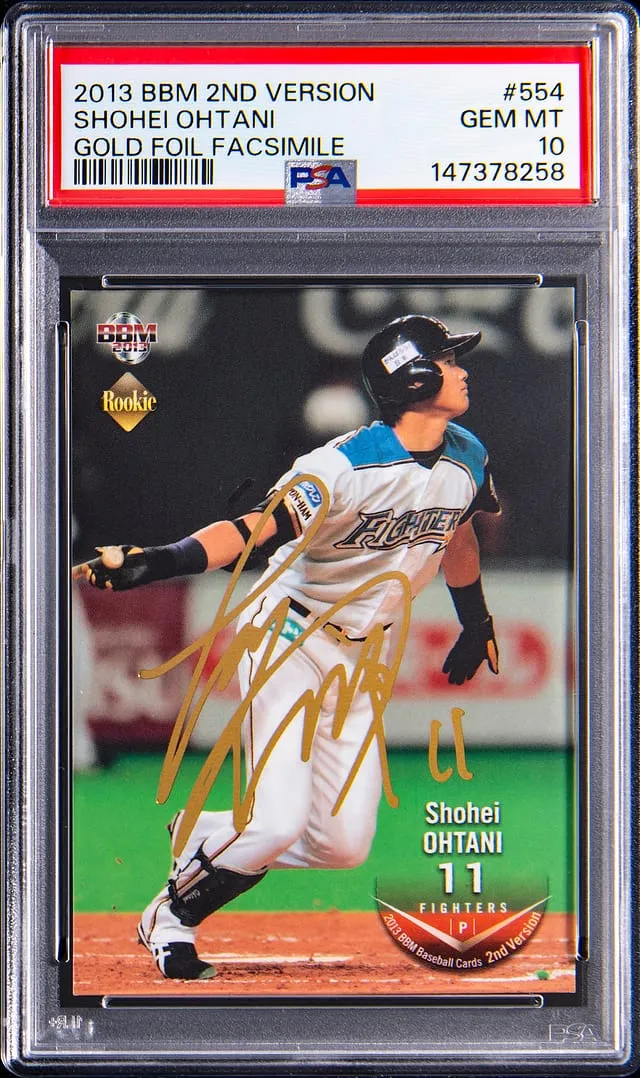
2013 BBM Shohei Ohtani Gold Foil /100 PSA 10 Sale
A PSA 10 2013 BBM Gold Foil /100 Shohei Ohtani rookie sold for $92,720 at Goldin on April 12, 2026. Figoca breaks down the card and the market.
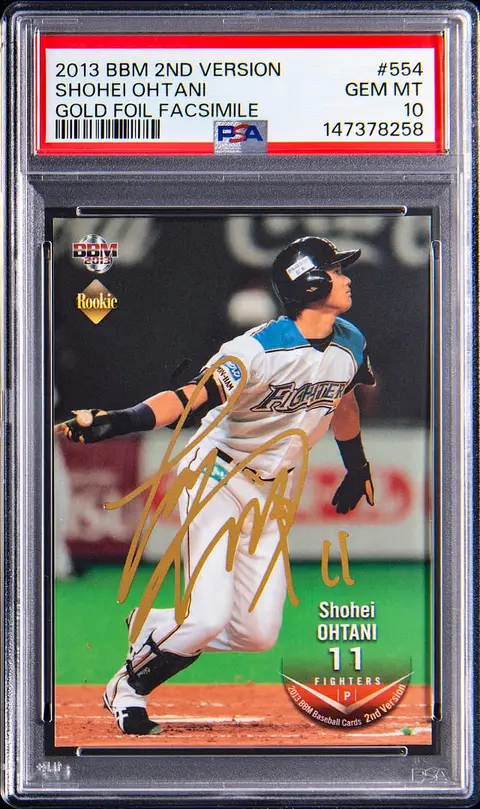
Sold Card
2013 BBM 2nd Version Gold Foil Facsimile #554 Shohei Ohtani Rookie Card (#089/100) - PSA GEM MT 10 - Pop 6
Sale Price
Platform
Goldin2013 BBM 2nd Version Gold Foil Facsimile #554 Shohei Ohtani Rookie Card (#089/100) - PSA GEM MT 10 - Pop 6 Sells for $92,720 at Goldin
On April 12, 2026 (UTC), Goldin closed a major sale for one of the more elusive early Shohei Ohtani rookies: a 2013 BBM 2nd Version Gold Foil Facsimile #554, serial-numbered 089/100, graded PSA GEM MT 10, with a population (“pop”) of just 6 in that grade. The final price landed at $92,720.
For collectors tracking Ohtani’s Japanese-era cards and low-population PSA 10s, this result is an important data point in a segment of the market that has been thinly traded and relatively opaque compared to his MLB-licensed rookies.
Card overview: what exactly sold?
Let’s break down the card and its key attributes:
- Player: Shohei Ohtani
- Team (on card): Hokkaido Nippon-Ham Fighters (NPB – Nippon Professional Baseball)
- Year: 2013
- Set: BBM 2nd Version (a mainstream Japanese NPB release)
- Card number: #554
- Parallel/variant: Gold Foil Facsimile (features a foil reproduction of Ohtani’s signature, not an on-card autograph)
- Serial numbering: #089/100 (only 100 copies produced)
- Rookie status: Considered an early Ohtani rookie from his first NPB season, and a key Japanese-issue card in his run of rookies
- Grading company: PSA (Professional Sports Authenticator)
- Grade: GEM MT 10 (PSA’s highest standard grade for pack-issued cards)
- Population: Pop 6 in PSA 10, meaning PSA has graded only six examples at this top grade so far
This is a low-serial, limited parallel of an early Ohtani card from his first major league season in Japan, sitting in the ultra-modern era but with substantially more built-in scarcity than most mass-produced MLB-licensed rookies from 2018.
Why collectors care about this card
1. Early Ohtani, dual-threat context
Shohei Ohtani’s value in the hobby is built on his unique standing as a true two-way superstar, winning awards both as a hitter and a pitcher in MLB after already being a standout in NPB. Cards from his 2013 Japanese releases capture the beginning of that story—before the international hype and before his move to MLB.
The BBM 2nd Version run is one of the core NPB issues from his debut year. While there is ongoing discussion in the hobby about which exact Japanese issues qualify as his “true” or “most important” rookies, there is broad agreement that 2013 BBM cards are foundational to his early market.
2. Parallel scarcity and numbered print run
The Gold Foil Facsimile version is limited to 100 serial-numbered copies, which immediately separates it from the standard base versions that were printed in much larger quantities. In practical terms:
- Only 100 copies exist by design.
- Some portion of those have been lost, damaged, or remain in collections unlikely to surface for sale.
- PSA has graded only a subset of the total, and just six have reached PSA 10 GEM MT.
Compared to widely available MLB rookies, this level of built-in scarcity creates a very different supply profile: a small, global pool of serious Ohtani and NPB collectors effectively competing for a handful of gem-level copies.
3. PSA 10 population and condition sensitivity
Pop reports (population reports) show how many copies of a card each grading company has graded at each grade. In an ultra-modern era where some base rookies have pop counts in the thousands for PSA 10 alone, a pop of 6 is extremely low.
2013 BBM cards are also not always handled with the same grading-first mindset that modern MLB releases receive. Many were opened, stored, and traded by local collectors before large-scale grading of Japanese issues became mainstream, which can lead to:
- Edge and corner wear from years in nine-pocket pages or boxes.
- Surface scratches or print issues that hold back gem grades.
This context helps explain why a card limited to 100 copies might still have only six PSA 10s.
Sale details and price context
- Auction house: Goldin
- Sale date: April 12, 2026 (UTC)
- Final price: $92,720
When we talk about “comps” (comparable sales), we mean recent, similar items that help set expectations for what a card might sell for. For a niche card like this, comps are sparse, but a few patterns stand out when looking at recent and historical data points across major marketplaces and auction houses:
Exact card, lower grades:
- PSA 9 and BGS 9.5 copies of 2013 BBM Ohtani parallels have tended to sell significantly below gem-mint prices. The gap between PSA 10 and PSA 9 on limited Ohtani NPB issues is often substantial because of the low gem population and perception of long-term desirability for top-grade examples.
Similar 2013 BBM Ohtani rookies:
- Other 2013 BBM Ohtani rookies (non-numbered base or less scarce parallels) have recently traded at much lower price levels, reflecting their larger supply and higher population counts in top grades.
- Serial-numbered or premium parallels from these early Japanese sets (including facsimile signature versions and other low-print inserts) have consistently commanded a significant premium over standard BBM base rookies.
High-end Ohtani rookies overall:
- Ohtani’s top-end MLB-licensed rookies—especially low-numbered on-card autographs, rare flagship parallels, and high-grade examples—have set very strong benchmarks across multiple auction houses.
- While this BBM Gold Foil Facsimile is not an on-card auto, it participates in that broader trend: serious Ohtani collectors often aim to pair his premium MLB rookies with early Japanese issues to build a more complete story of his career.
Within that context, the $92,720 result at Goldin positions this card as a high-end, but not unprecedented, sale relative to elite Ohtani rookies. Given its combination of:
- 2013 NPB rookie-year status,
- serial numbering out of 100,
- a PSA GEM MT 10 grade, and
- a population of only six gems,
this price sits firmly on the strong end of recent Ohtani rookie market activity without appearing disconnected from what collectors have been willing to pay for similarly scarce, high-grade, early Ohtani pieces.
How this sale fits into the broader Ohtani market
1. Japanese issues gaining more attention
Over the past few years, interest in Ohtani’s Japanese releases has steadily increased as more collectors look beyond his 2018 MLB rookies. A sale like this at a major auction house, with a clearly documented result, helps crystallize market awareness around:
- The relative scarcity of 2013 BBM parallels.
- The gap in pricing between base and low-numbered Japanese issues.
- How PSA 10 population data can matter when total print runs are already small.
2. Ultra-modern, but not mass-printed
While 2013 counts as “ultra-modern” in hobby timelines, this card doesn’t fit the narrative of mass-printed base rookies with massive gem populations. Instead, it behaves more like a hybrid between:
- A modern, chase-style parallel (due to the /100 numbering and foil treatment), and
- An international pre-MLB release, which naturally limited initial global distribution.
That combination makes precise valuation harder but also underlines why individual auction results can move the perceived range for future sales.
3. Player performance and news backdrop
Ohtani’s on-field performance and off-field profile continue to be major drivers of demand for his cards. Recent seasons have reinforced his status as one of the most impactful players of his era, leading to:
- Renewed focus on early-career and pre-MLB cards.
- Increased competition for scarce, high-grade examples when they surface at major houses like Goldin.
Without tying this sale to any single game or milestone, it still fits into the broader pattern: strong Ohtani performance tends to support healthy interest across his key rookie and pre-MLB issues.
What collectors and small sellers can take away
For collectors and small sellers tracking Ohtani’s market, this sale highlights a few practical points:
Know your version and numbering
With 2013 BBM in particular, there are base cards, facsimile signature versions, parallels, and serial-numbered cards. Accurately identifying:- whether your card is numbered,
- which foil or signature treatment it has, and
- which exact subset or parallel it belongs to, is essential before comparing prices.
Population and grade matter more as print runs shrink
When total copies are capped at 100, the difference between a PSA 10 and a PSA 9 can be substantial. Population reports for this type of card are not just trivia—they directly influence bidding behavior once the card is widely recognized.Comps will be sparse—but still useful
Thinly traded cards like this won’t have weekly sales to reference. Looking at:- past sales of the exact card,
- sales of nearby parallels from the same set and year, and
- prices for other premium Ohtani rookies with similar scarcity, can help you build a realistic range rather than latch onto any single “record” number.
Auction houses can surface rare cards and serious bidders
A major platform like Goldin can bring together the few collectors willing and able to compete for a pop 6 /100 Ohtani rookie. For highly specialized cards, the venue itself becomes part of the story and part of the eventual price context.
Final thoughts
The $92,720 sale of the 2013 BBM 2nd Version Gold Foil Facsimile #554 Shohei Ohtani Rookie Card (#089/100) in PSA GEM MT 10 at Goldin on April 12, 2026, adds another clear reference point to the high-end Ohtani market.
It underscores how:
- Early Japanese issues, especially low-numbered parallels, are now firmly on the radar of global collectors.
- Population data and condition can drive strong separation within a small, already-limited print run.
- Individual auction results help define the emerging price landscape for niche but important Ohtani rookies.
For collectors building a comprehensive Ohtani run—from NPB debut through MLB superstardom—this card sits squarely in the “cornerstone” category: scarce, early, and now with a firmly established high-end sale to reference in future conversations.