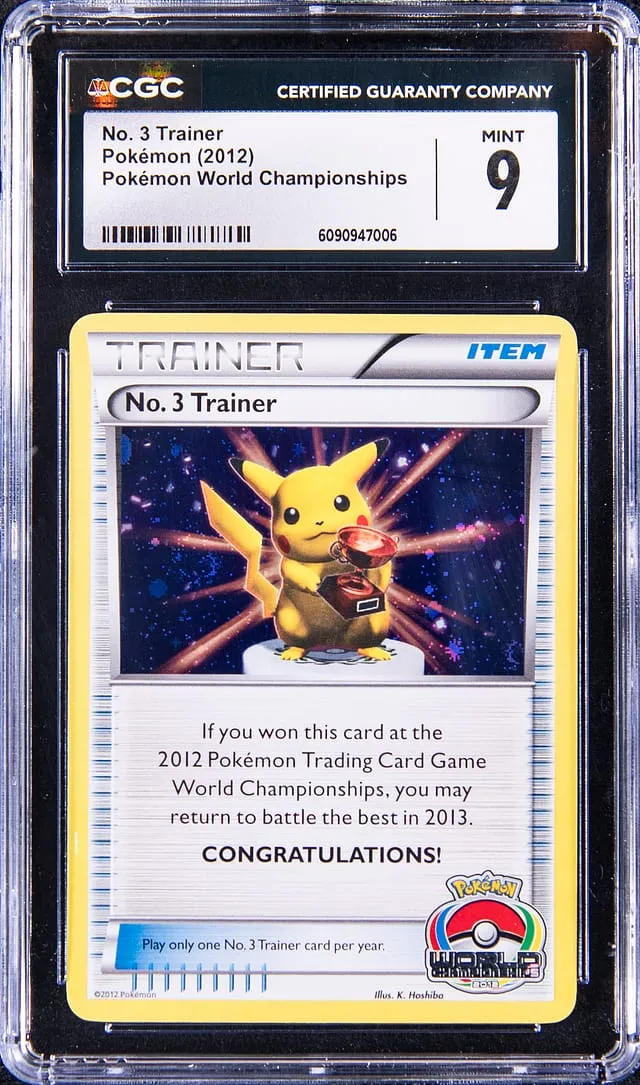
2012 No. 3 Trainer Pikachu Trophy CGC 9 Sells for $30K
Goldin sold a 2012 Pokémon World Championships No. 3 Trainer Pikachu Trophy Card CGC 9 for $30,500. Here’s what it means for high-end Pokémon collectors.
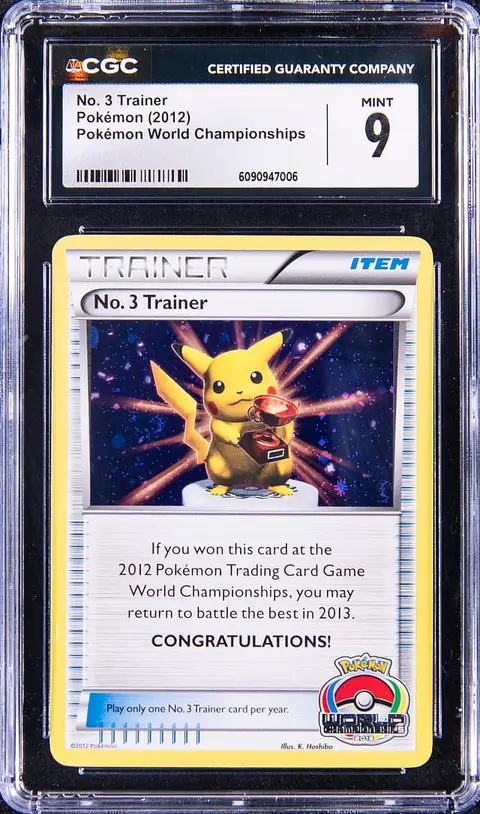
Sold Card
2012 Pokemon World Championships No. 3 Trainer Pikachu Trophy Card - CGC MINT 9
Sale Price
Platform
Goldin2012 Pokémon World Championships No. 3 Trainer Pikachu Trophy Card (CGC 9) Sells for $30,500
On May 18, 2026, Goldin quietly moved a card that sits near the top of many serious Pokémon collectors’ wish lists: a 2012 Pokémon World Championships No. 3 Trainer Pikachu Trophy Card, graded CGC MINT 9, which closed at $30,500.
For a niche, non-pack-issued trophy card, that’s an important data point for the high‑end Pokémon market.
What exactly is this card?
Card details
- Character: Pikachu (illustrated as a trophy card mascot)
- Title: No. 3 Trainer
- Event: 2012 Pokémon World Championships
- Year: 2012
- Type: Trophy card (event prize, not pulled from packs)
- Issuing body: Pokémon organized play / World Championships
- Grading company: CGC
- Grade: MINT 9
This is not a standard set card with a typical set name and card number. It’s an extremely limited prize card awarded to top finishers at the 2012 Pokémon World Championships. These “No. 1 / No. 2 / No. 3 Trainer” cards function as trophies—similar to a medal or plaque, but in card form.
Because they were only given to a handful of finalists across age divisions, total print quantities are believed to be extremely low, often measured in single digits to low double digits per language/age group. That puts them in a very different category from even rare pack-issued chase cards.
Why collectors care about World Championships Trainer trophy cards
Within the Pokémon hobby, Worlds trophy cards have several traits that drive long‑term interest:
- True scarcity – These cards were not sold or pack-inserted; they were awarded. That naturally limits supply compared with even the rarest pack-pulled cards.
- Direct tie to competitive play – The cards commemorate top finishes at the official World Championships, the pinnacle of Pokémon organized play. For many collectors, that historical and competitive connection is more meaningful than a random chase pull.
- Early Pikachu trophy lineage – Pikachu trophy cards (No. 1 / 2 / 3 Trainers) have a long history going back to the late 1990s and early 2000s. Earlier copies—especially 1997–2004 Trophy Pikachu and the 1998/1999 No. 1/2/3 Trainers—have set major price records over the years.
- Ultra‑modern but not mass‑printed – 2012 sits in what many collectors consider the early “ultra‑modern” era. Plenty of set cards from this period are widely available, but World Championships trophies are in a different league of scarcity.
This particular card represents a later chapter in the Trophy Pikachu story, after the brand had already established itself as a global phenomenon. That combination—Worlds heritage plus the Pikachu mascot—creates a strong niche of dedicated collectors.
Understanding the grade: CGC MINT 9
CGC has become a significant player in graded Pokémon, especially among collectors who value detailed subgrades and condition notes. A CGC MINT 9 grade indicates:
- Centering, corners, edges, and surface are all very strong
- Only minor flaws keep it out of gem‑mint territory
For an event card that may have been carried, displayed, and handled at a live tournament, a MINT 9 is substantial. Trophy cards were not handled like sealed pack cards pulled straight into sleeves; many lived as actual awards before grading existed for them.
Population reports ("pop reports")—the census of how many copies have been graded at each grade level—are especially important for such low‑print cards. Even without quoting specific population numbers here, it is fair to say that high‑grade Worlds trophy Pikachu cards rarely appear at public auction.
Market context: how does $30,500 fit in?
The hammer price for this copy at Goldin was $30,500.
When we talk about “comps” in the hobby, we mean comparable recent sales—either of the exact same card/grade or very close alternatives. With ultra‑scarce trophies like this, comps are limited because so few copies ever change hands publicly.
Recent years have seen:
- Earlier Trophy Pikachu cards (late‑1990s era, especially high grades from PSA and BGS) achieving much higher sale prices when they appear.
- Some modern and ultra‑modern trophy and prize cards seeing strong but uneven results, largely driven by condition, provenance, and timing.
In that context, $30,500 for a 2012 No. 3 Trainer Pikachu in CGC 9 fits into a tier of “serious but not record‑setting” trophy prices:
- It sits well above even high‑end set cards from the same era, reflecting the scarcity and status of Worlds trophies.
- It remains below the peak levels seen for the earliest Trophy Pikachu issues, which have decades of historical importance and fewer known copies.
Because recorded public sales of this exact card, year, and grade are sparse, it’s hard to declare this result definitively high or low. Instead, it serves as a reference point that future buyers and sellers can look back to when assessing similar pieces.
Factors that likely influenced this result
Several structural features of the card and the market help explain why a CGC 9 example lands at this level:
True event-issued trophy
This is not a secret rare from a booster box; it’s an award given on stage at the World Championships. That event provenance supports long‑term collector interest.Later‑era Trophy Pikachu
While 2012 is not “vintage,” it carries the established prestige of the Pikachu trophy line. Earlier copies often command higher premiums, but later issues still benefit from that legacy.Grade scarcity and grading mix
Trophy cards have been graded by PSA, BGS, and CGC in relatively low numbers. Some collectors strongly prefer one grading company, while others prioritize the card itself and its condition. A CGC 9 is attractive to condition‑focused collectors, particularly if comparable PSA or BGS options are not readily available.Market cycle and liquidity
High‑end Pokémon has gone through notable swings since 2020. Trophy cards have generally remained more insulated than mass‑produced set cards, but liquidity (how easily something sells) can vary year to year. Each major sale like this helps re‑anchor expectations.
What this sale might signal for collectors
Again, this is not financial advice, and one auction does not set a permanent “value.” But this Goldin sale on May 18, 2026 does provide a few useful signals for people who follow the space:
- Trophy demand is still there. Even in a more selective market, buyers are willing to allocate five‑figure budgets to true World Championships trophies.
- Grade and grading company matter, but the card comes first. While some collectors have strong PSA/BGS/CGC preferences, the combination of trophy status and MINT 9 condition was enough to draw serious bidding.
- Later‑era trophies have their own lane. They may not match the headline prices of 1990s Trophy Pikachu cards, but they continue to occupy a distinct, premium tier above almost all pack‑issued 2010s cards.
Takeaways for different types of collectors
New or returning collectors
If you’re just getting back into Pokémon, this sale highlights a corner of the hobby you might not have seen before:
- Trophy cards are fundamentally different from set cards. They’re more like medals than chase pulls.
- Sales like this are not the norm; they sit at the very high end of the market.
- Understanding event history (World Championships, player finishes, years) is as important as knowing set names and card numbers.
Active hobbyists
For collectors already familiar with high‑end Pokémon, this sale adds one more data point:
- It can be used as a reference comp when looking at other 2010s trophy issues, especially No. 2 and No. 3 Trainers.
- It underscores how infrequently these appear. The absence of frequent comps is part of what defines this segment of the market.
- It’s a reminder that CGC‑graded trophies can attract serious bids, particularly when the card is already known to be scarce.
Small sellers and flippers
Trophy cards like this are typically out of reach for quick‑turn flipping strategies, but they’re still relevant to understand:
- They help set the top of the market against which other Pokémon segments are often mentally benchmarked.
- When you see trophy or prize cards come to market locally or raw, appreciating their unique status can help you research them more carefully.
Final thoughts
The $30,500 Goldin sale of the 2012 Pokémon World Championships No. 3 Trainer Pikachu Trophy Card in CGC MINT 9 is another reminder that the Pokémon market has multiple layers:
- Mass‑printed set cards
- Limited chase and promo cards
- And, at the very top, event-issued trophies with tiny populations
For collectors who track the evolution of high‑end Pokémon, this result doesn’t rewrite the record books, but it does quietly confirm that demand for true Worlds trophies remains steady in 2026.
As always, any single sale is just a snapshot in time. For anyone considering buying, selling, or simply studying these cards, it’s best to look at a range of past results, pop reports, and the broader market environment—rather than anchoring to one auction alone.