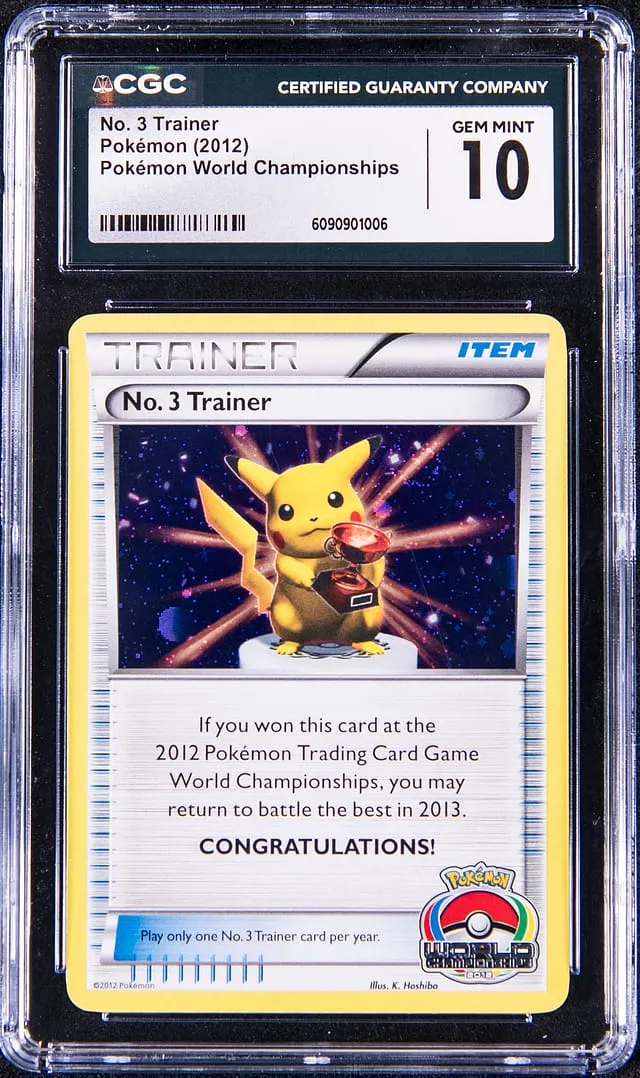
2012 No. 3 Trainer Pikachu Trophy CGC 10 Sells
A 2012 Pokémon World Championships No. 3 Trainer Pikachu trophy card CGC 10 Pop 1 sold for $29,760 at Goldin on Feb 16, 2026. Here’s the market context.
Sold Card
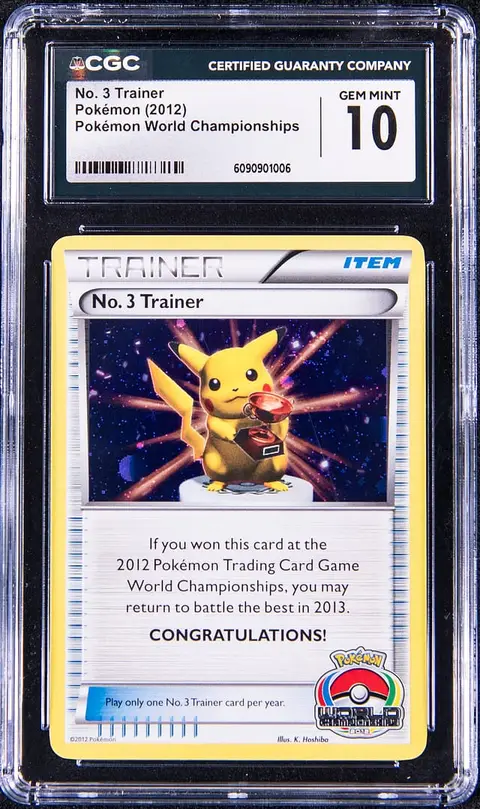
2012 Pokemon World Championships No. 3 Trainer Pikachu Trophy Card - CGC GEM MINT 10 - Pop 1
Sale Price
Platform
Goldin2012 Pokemon World Championships No. 3 Trainer Pikachu Trophy Card CGC 10 Sells for $29,760
On February 16, 2026, Goldin auctioned a true niche grail from the competitive Pokémon scene: a 2012 Pokémon World Championships No. 3 Trainer Pikachu trophy card, graded CGC Gem Mint 10, for $29,760.
For a certain segment of collectors – especially those who follow the history of the World Championships – this is exactly the kind of card that quietly sets the tone for the high-end niche of the Pokémon market.
What exactly is this card?
Let’s break down the basics:
- Title: 2012 Pokémon World Championships No. 3 Trainer Trophy Card (Pikachu artwork)
- Event: Pokémon World Championships 2012
- Character: Pikachu (trophy-style illustration typically associated with World Championship prize cards)
- Type: Trophy / prize card (awarded to top finishers, not pulled from packs)
- Era: Modern / early "ultra modern" competitive era
- Grading company: CGC (Certified Guaranty Company)
- Grade: Gem Mint 10
- Population: CGC population 1 (Pop 1) at the time of sale
This is not a pack-issued set card with a standard card number. It’s a trophy card, meaning it was awarded to high-placing competitors at the 2012 Pokémon World Championships. These cards typically go to finalists or top-ranked players and have extremely limited distributions compared with normal set cards.
Why trophy cards matter to collectors
Trophy cards sit in a different lane from regular chase cards:
- Extremely low print runs: Prize cards from Worlds are produced in tiny quantities compared to mass-released sets. Even within an already small print run, not all copies survive in gradable condition.
- Tied to competitive history: Each card is linked to a specific tournament, year, and often placement (No. 1, No. 2, No. 3 Trainer, etc.). They document the history of competitive Pokémon in cardboard form.
- High barrier to entry (originally): Originally, you couldn’t pull this from a pack or buy it in a store. You had to place at the top of the world’s biggest event.
- Cross-over appeal: They appeal to both TCG historians and high-end collectors who look for true scarcity and story-based significance.
In short, this is a key issue within the world of Pokémon trophy and World Championships cards, even if it’s not a “rookie card” in the traditional sports-card sense.
The grade: CGC Gem Mint 10, Pop 1
CGC has become a well-known grading company in the TCG space, alongside PSA and Beckett. A Gem Mint 10 means the card is essentially as close to perfect as you can reasonably expect: clean corners, sharp edges, strong centering, and very minimal (if any) printing or surface issues.
“Pop 1” is short for population 1. That means that, at the time of this sale, only one copy of this specific card had received a Gem Mint 10 grade from CGC. Population reports (or “pop reports”) are the grading company’s public counts of how many copies of each card exist in each grade.
For a card that already starts from a tiny print run, a Pop 1 top grade can be a meaningful piece of its story.
Price context: where does $29,760 sit in the market?
This copy sold for $29,760 at Goldin on February 16, 2026.
Trophy cards don’t trade hands as frequently as standard chase cards, so there usually aren’t long, stable sales histories. Instead of a neat trend line, you get sporadic, data-point style comps (comparable sales) when a copy surfaces at a major auction house.
For this card and its close relatives, here’s the general pattern collectors have seen over the last few years:
- Earlier-year No. 1 / No. 2 Trainer Pikachu trophies in top PSA grades have reached significantly higher numbers, reflecting their older status, prestige, and longer track record in the market.
- Lower grades or raw copies (ungraded) for later-year World Championships trophies, including 2010s examples, have tended to sell notably below the five-figure levels of the very earliest trophies, especially if they’re not top placement cards.
- Within the 2010s trophy space, high-grade examples from PSA or CGC have increasingly broken into the mid- to high-four-figure and low-five-figure range, depending on year, placement (No. 1 vs. No. 3), and grading company.
Against that backdrop, a Pop 1 CGC Gem Mint 10 2012 No. 3 Trainer landing at just under $30,000 at a well-known auction house sits firmly in the upper tier of modern trophy sales, but below the most famous, early PSA-graded Pikachu trophies that have commanded much higher prices.
Because these cards sell infrequently, it’s more useful to think in terms of ranges and relative tiers than precise trajectories. This sale strengthens the idea that:
- Later-year World Championships trophies in true gem condition are capable of reaching strong five-figure prices.
- The market continues to draw a line between early, historically iconic trophies and 2010s examples, while still valuing the competitive and scarcity story of the modern cards.
Why the 2012 World Championships matter
The 2012 Pokémon World Championships sit in the early stage of the modern competitive era:
- The game’s player base and event coverage were stabilizing and growing, especially compared to prior boom/bust cycles.
- Trophy cards from this era bridge the gap between the earliest, more experimental Worlds-era trophies and today’s more widely recognized Worlds structure.
- For many current adult collectors, the 2010s Worlds tournaments are events they remember watching in real time, which adds a layer of nostalgia.
That positions the 2012 No. 3 Trainer as:
- Historically relevant – it captures a specific year, tournament, and ranking.
- Modern but established – not a brand-new release, but not part of the earliest, most elusive vintage trophy window either.
CGC vs PSA in the trophy space
Most of the record headlines for Pokémon have traditionally centered on PSA-graded copies, especially for 1990s and early 2000s cards. But over the last few years, CGC has carved out a solid share of TCG grading, particularly among collectors who:
- Care deeply about subgrades and technical grading
- Submit a lot of modern and ultra-modern Pokémon and Magic cards
This sale adds another high-end CGC comp to a segment where PSA historically dominated visibility. For collectors tracking cross-grader performance:
- PSA 10 trophy comps generally remain the yardstick for top-of-market expectations.
- CGC Gem Mint 10, especially with Pop 1 status, is increasingly being recognized as a premium grade in its own right.
This doesn’t mean one grading label is “better” – it simply shows that serious buyers are willing to spend five figures on a CGC Gem Mint 10 when the card itself is rare, historically interesting, and hard to replace.
What this sale suggests – without reading too much into it
With a small, illiquid segment like World Championships trophies, it’s risky to over-interpret a single result. Instead, this sale mainly reinforces a few themes that collectors have already been noticing:
Trophy scarcity still matters. Even in a softer or more cautious market climate, cards that were never widely distributed and have deep storylines continue to draw attention when they surface at major auction houses.
Top grades command meaningful premiums. A Pop 1 Gem Mint 10, even from a grading company other than PSA, can separate itself from more common lower-grade copies.
World Championships history is gaining recognition. As more collectors move beyond pack-pulled chase cards and into the lore of the competitive scene, Worlds trophies occupy a clearer niche as historical artifacts, not just collectibles.
Data points vs. trends. It’s helpful to treat this sale as one high-quality data point within a small sample set. Future results for different years, placements, and grades will give a clearer picture of long-term ranges.
None of this guarantees anything about future prices. But it does give collectors a more grounded sense of how the market currently values a 2012 No. 3 Trainer Pikachu trophy at the very top end of grading.
Takeaways for collectors and small sellers
If you collect or handle Pokémon cards and are trying to understand where trophy pieces like this fit into the broader hobby, a few practical points:
- Know the story behind the card. Trophy cards are all about context: year, event, placement, and how many copies likely exist.
- Use comps carefully. Comparable sales are helpful, but in ultra-rare segments you may only see a few results over several years, sometimes across different grading companies and conditions.
- Grade sensitivity is high. With tiny populations, a single Gem Mint copy can sit in its own micro-tier, especially when labeled Pop 1.
- Auction houses matter. A sale at Goldin or another major house can reach a different set of bidders than a quiet private deal or a low-visibility marketplace listing.
For many collectors, this 2012 Pokémon World Championships No. 3 Trainer Pikachu CGC Gem Mint 10 sale at $29,760 on February 16, 2026 via Goldin won’t change what they collect day-to-day. But it does offer a clear, documented snapshot of how the market is currently treating high-end, modern-era Pokémon trophy cards – and how much weight serious buyers are willing to place on condition, provenance, and competitive history.
As more Worlds-era trophies surface over time, sales like this one will help define the long-term price landscape for one of the most specialized corners of the Pokémon hobby.