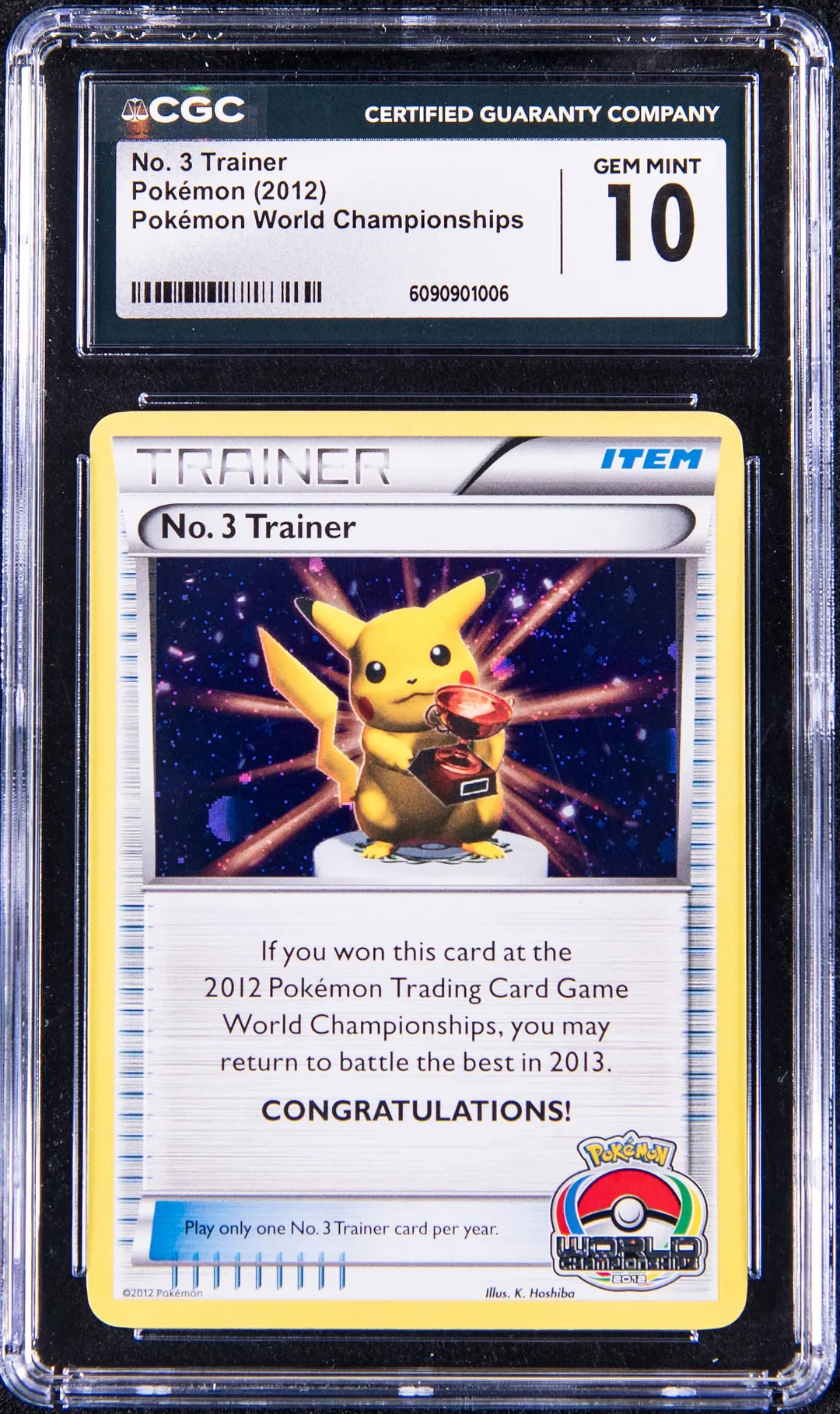
2012 No. 3 Trainer Pikachu CGC 10 sells for $29.8K
A 2012 Pokémon World Championships No. 3 Trainer Pikachu CGC 10 Pop 1 sold for $29,760 at Goldin on Feb 16, 2026. Here’s the market context.
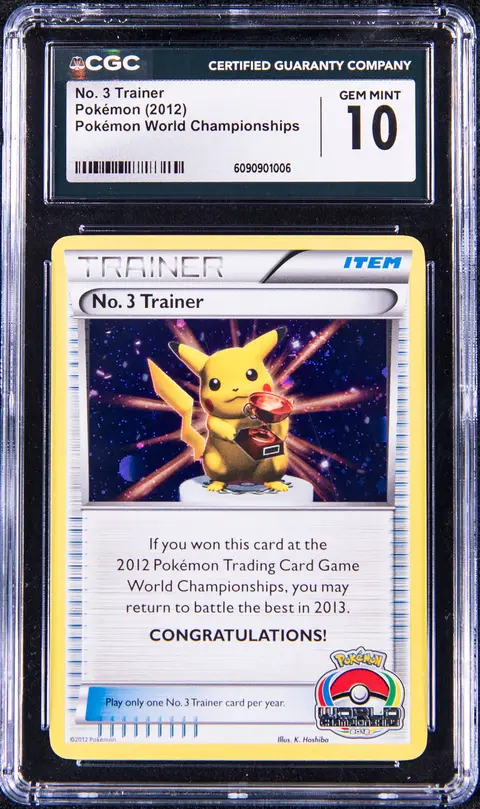
Sold Card
2012 Pokemon World Championships No. 3 Trainer Pikachu Trophy Card - CGC GEM MINT 10 - Pop 1
Sale Price
Platform
Goldin2012 Pokémon No. 3 Trainer Pikachu CGC 10 Sells for $29,760
On February 16, 2026, a 2012 Pokémon World Championships No. 3 Trainer Pikachu Trophy Card, graded CGC GEM MINT 10, realized $29,760 at Goldin. For a niche but highly respected slice of the Pokémon market—Worlds trophy cards—this is a meaningful data point collectors will want to understand.
Below, we’ll break down what this card is, why it matters, and how this sale fits into the broader market for World Championships trophy cards.
What exactly is this card?
Card details
- Title: 2012 Pokémon World Championships No. 3 Trainer Pikachu Trophy Card
- Character: Pikachu (Trophy card artwork used for Worlds prizes)
- Year: 2012
- Event: Pokémon World Championships
- Type: Trophy / prize card (awarded to top finishers, not pack-pulled)
- Variant: No. 3 Trainer (third place award)
- Grading company: CGC (Certified Guaranty Company)
- Grade: GEM MINT 10
- Population: CGC Pop 1 in GEM MINT 10 (only one graded at this level at CGC at the time of sale)
- Sale venue: Goldin
- Sale date (UTC): 2026-02-16
- Price: $29,760
This is not a mass-produced set card from a regular expansion. It’s a trophy card, meaning it was awarded at the official Pokémon World Championships to top-placing competitors. Trophy cards are historically among the lowest-print and most coveted Pokémon items because they are tied directly to the game’s most prestigious event.
Why World Championships trophy cards matter
Worlds trophy cards occupy a different lane from Charizards, alternate arts, or standard set chase cards.
Key points of significance:
Extremely low distribution
The No. 1 / No. 2 / No. 3 Trainer cards for each World Championships year are believed to exist in only a handful of copies per division. Even if exact numbers vary by year and age bracket, the total supply is tiny when compared to typical booster-set chase cards.Competitive prestige
These cards were awarded to players who placed at the very top of the World Championships. That competitive connection—your card exists because someone was one of the best players on earth that year—adds a type of historical weight that pack-pulled cards can’t fully replicate.Trophy card tradition
Worlds trophy cards follow a long lineage that includes iconic Japanese trophy cards from the late 1990s and early 2000s. That tradition keeps them squarely in the conversation whenever collectors talk about the “top shelf” of Pokémon cards.Ultra-modern but truly scarce
Even though 2012 is considered modern/ultra-modern era, these aren’t overprinted. In contrast to high-population modern chase cards that get graded by the thousands, Worlds trophies tend to have very limited grading population (or “pop report,” which is the census of how many copies exist in each grade at a grading company).
Understanding the CGC GEM MINT 10 Pop 1
The card in this Goldin sale is graded CGC GEM MINT 10, with a population (pop) of 1 in that grade at CGC at the time of sale.
- GEM MINT 10 means the card is effectively in top-tier condition with virtually no visible flaws.
- Pop 1 means that, according to CGC’s population report, there is only one card at this exact grade. There may be other copies graded lower, and other copies may be graded by PSA, BGS, or left ungraded.
For trophy cards that already start from a tiny print run, a Pop 1 in a top grade adds an additional scarcity layer on top of the already-limited raw population.
Market context and recent sales
Because trophy cards change hands infrequently, the usual tools collectors rely on—eBay completed listings, regular comps ("comps" meaning comparable recent sales), and consistent population growth—are less straightforward.
For the 2012 No. 3 Trainer Pikachu specifically:
- Publicly available auction results for this exact card, in CGC 10, are very limited. This Goldin sale is one of the clearer data points.
- Related items—such as other World Championships No. 1/2/3 Trainer cards in different years, grades, or grading companies—tend to sell in a wide range depending on year, art, and provenance.
Broadly speaking, Worlds trophy cards:
- Have sold from the mid-five figures into much higher ranges for earlier Japanese trophy cards, high grades, and No. 1 Trainer examples.
- Show uneven but persistent demand from a smaller, very serious subset of collectors.
At $29,760, this CGC 10 Pop 1 sale:
- Sits in what can be described as the serious-but-not-peak range for modern-era trophy cards.
- Reflects both the narrow buyer pool (Worlds trophies are a specialized target) and the uniqueness of this grade (Pop 1 GEM MINT at CGC).
Because direct, same-card comps are sparse, it’s more accurate to view this sale as one data point in a thin market rather than a precise price anchor. Trophy cards often need several public auctions over time to define a stable range.
How grading and company choice might matter
For most modern Pokémon cards, PSA currently dominates the graded population and often commands a pricing premium at the same numeric grade. Trophy cards, though, can be more nuanced:
- CGC’s strength is perceived by many as stricter grading standards and detailed subgrades (when used). A CGC GEM MINT 10 Pop 1 can appeal to collectors who prioritize condition certainty.
- Cross-grading risk (submitting to another grader to see if it matches their 10) exists, but with a Pop 1 GEM MINT, many collectors may prefer to leave the card as-is to preserve that specific label and pop status.
In the absence of direct PSA GEM 10 sales of this same card, we can’t directly quantify a PSA vs. CGC gap for this specific trophy. Instead, it’s more accurate to say this sale demonstrates that high-end CGC 10 trophy cards can attract strong auction results in the right venue.
Why collectors care about this specific 2012 No. 3 Trainer
Beyond being a trophy, this card ties into a few collector themes:
2010s Worlds era
The early 2010s mark a shift where Pokémon TCG play and collecting both grew in global visibility. Trophy cards from this period sit between vintage/early-2000s legends and today's ultra-modern alternate arts.Pikachu as the face of the brand
Worlds trophies that feature Pikachu artwork tap directly into the most recognizable character in Pokémon. Even within the trophy niche, Pikachu-based Worlds cards are often seen as more widely appealing than less iconic characters.Event-specific history
Each Worlds trophy captures a specific year’s tournament. For players and collectors who follow the competitive scene, that historical anchor—the 2012 Worlds—adds context and story to the card.Crossover appeal
While still niche, Worlds trophies can appeal to:- Competitive players who attended or aspire to Worlds.
- High-end collectors focused on rarity and prestige.
- Long-term hobby participants who view trophy cards as a historical record of the game.
How this sale fits into the broader Pokémon market
The broader Pokémon card market has seen cycles of sharp run-ups and gradual corrections, especially post-2020. Trophy cards have not been immune, but they often:
- Trade less frequently, which can soften the impact of fast-paced speculative swings.
- Rely more on a narrow base of deep collectors than on broad, short-term hype.
- Show a long-term trend where the scarcest, historically meaningful items maintain collector interest even when more common modern cards cool off.
This $29,760 Goldin sale on February 16, 2026 reflects a market where:
- The ultra-rare, event-tied segment of Pokémon still commands significant attention.
- Condition and population (CGC 10, Pop 1) can materially influence outcomes.
- Auctions at established houses like Goldin continue to be key discovery points for thinly traded cards.
Takeaways for collectors and small sellers
If you’re watching high-end Pokémon but not necessarily bidding at this level, there are still useful lessons here:
Understand the niche
Trophy cards behave differently from pack-pulled chase cards. Sales are sparse, comps are thin, and each public auction can move expectations.Population reports matter more when supply is tiny
On a mass-produced card with thousands of graded copies, Pop 1 vs. Pop 5 at GEM MINT might not matter much. On a Worlds trophy with only a handful of total graded examples, Pop 1 in top grade becomes a meaningful detail.Auction houses as price discovery tools
For rare, thinly traded cards, major auction houses like Goldin often provide clearer public price signals than fixed-price listings that may sit unsold.Story and provenance add context
Cards tied to specific events, like the 2012 Pokémon World Championships, carry a narrative that many collectors value. Keeping track of those details—who won it, where it was sold, and when—can help contextualize future sales.
As more Worlds trophy cards surface at auction, collectors will have more data to compare. For now, this 2012 Pokémon World Championships No. 3 Trainer Pikachu Trophy Card, CGC GEM MINT 10 (Pop 1), selling for $29,760 at Goldin on February 16, 2026, stands as a noteworthy snapshot of how the market currently values ultra-rare, event-tied Pokémon history.