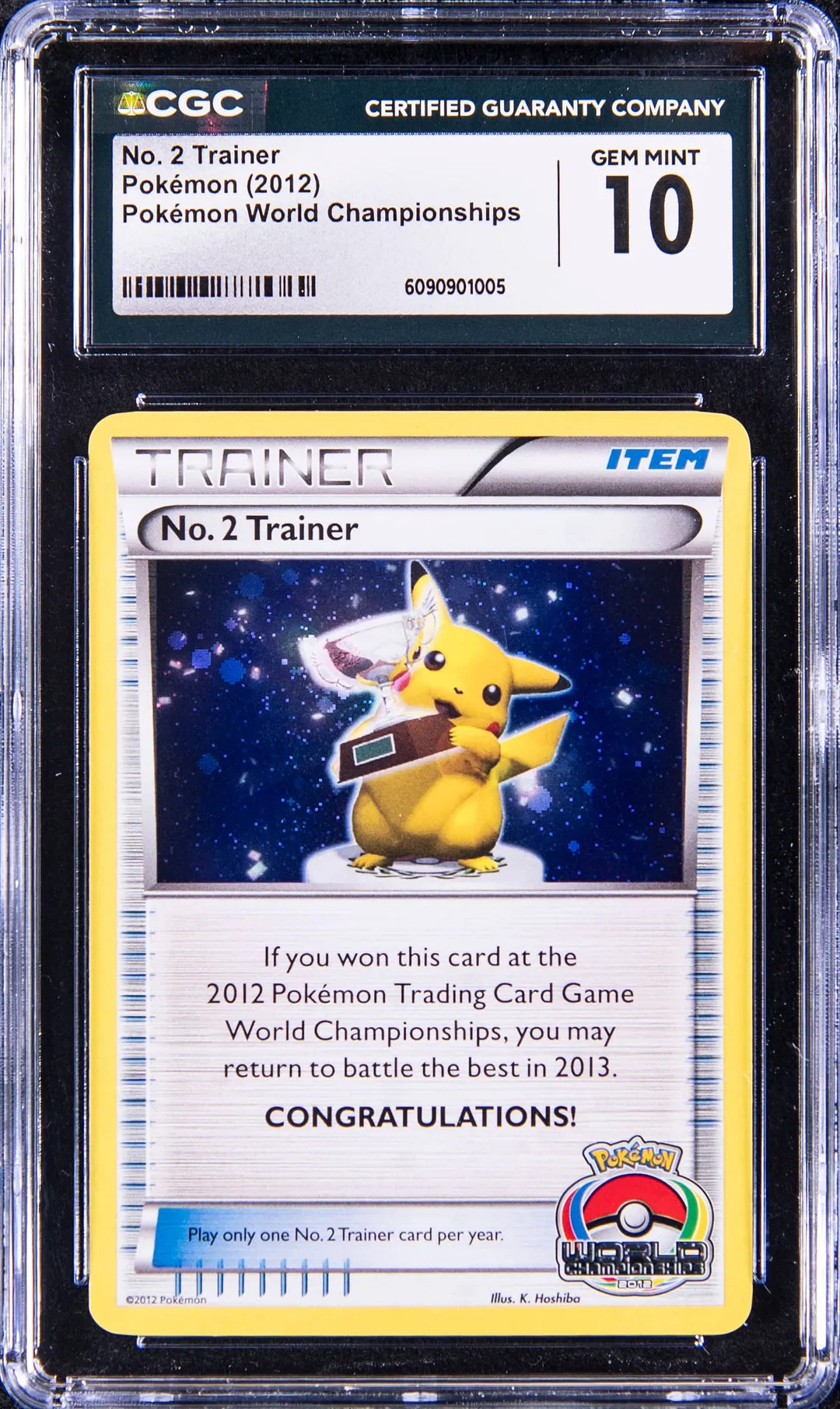
2012 No. 2 Trainer Pikachu Trophy CGC 10 Sale
Goldin sold a 2012 Pokémon No. 2 Trainer Pikachu Trophy CGC 10 (Pop 2) for $36,373. A key data point for modern World Championships trophy cards.
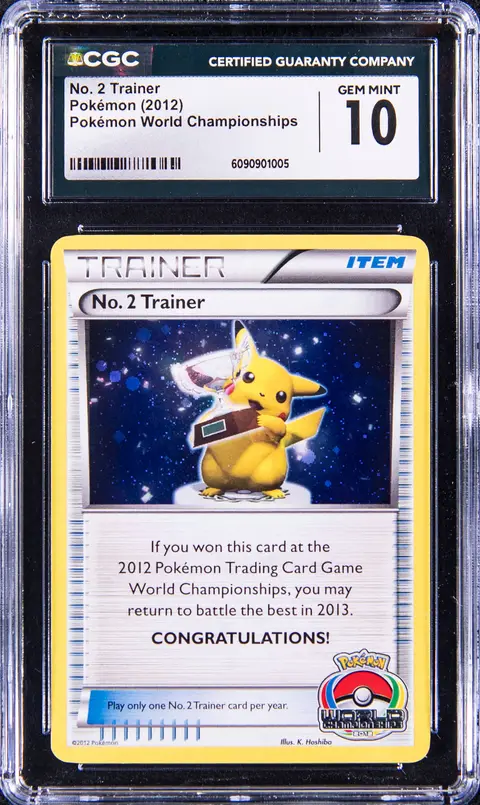
Sold Card
2012 Pokemon World Championships No. 2 Trainer Pikachu Trophy Card - CGC GEM MINT 10 - Pop 2
Sale Price
Platform
Goldin2012 Pokémon World Championships No. 2 Trainer Pikachu Trophy Card Sells for $36,373
On February 16, 2026, Goldin closed a notable sale in the high‑end Pokémon trophy card lane: a 2012 Pokémon World Championships No. 2 Trainer Pikachu Trophy Card, graded CGC Gem Mint 10, realized $36,373.
For a card that most collectors will only ever see in photos, this sale offers a useful reference point for how the market is currently treating modern-era World Championship trophies.
Card overview
Let’s start by identifying the card clearly:
- Title: 2012 Pokémon World Championships No. 2 Trainer Pikachu Trophy Card
- Event: 2012 Pokémon World Championships
- Character: Pikachu (illustrated in a World Championships trophy design)
- Category: Trophy card awarded to the 2nd place finisher in a World Championships division
- Era: Modern / early ultra‑modern (2010s)
- Grading company: CGC Trading Cards
- Grade: CGC Gem Mint 10
- Population: Pop 2 in CGC Gem Mint 10
These No. 2 Trainer trophy cards are not pack-pulled; they were awarded directly to top finishers at the World Championships. That built‑in scarcity is the foundation of their long‑term importance to the hobby.
What makes the 2012 No. 2 Trainer Pikachu important?
World Championship Trainer trophies have been at the top of Pokémon collecting for decades, alongside early Japanese trophies like the 1997–1999 Pikachu Trophies and No. 1/2/3 Trainer cards from earlier Worlds.
The 2012 No. 2 Trainer sits in that same ecosystem:
- Award only: You couldn’t open this in a booster pack. Copies were given only to 2nd‑place competitors in specific divisions. That creates a very small original print run.
- Competitive history: Each card points back to a specific World Championship year, venue, and champion/runner‑up. For some collectors, this connection to organized play matters as much as the artwork.
- Pikachu trophy design: Worlds trophy cards featuring Pikachu link back to the franchise’s mascot, which tends to help long‑term recognizability compared to more obscure trophy characters.
- Modern trophy window: 2012 is far from vintage, but it’s also early enough that print practices and distribution were still quite constrained. You get the prestige of a World Championship era that now feels “historical” without being 1990s‑level old.
Within the 2012 trophy lineup, No. 1 Trainer is typically the headline card, but No. 2 Trainer is still a key issue for collectors building out complete Worlds trophy runs or focusing on specific years.
Grade, pop, and why CGC Gem Mint 10 matters
Grading companies each maintain a population report (or “pop report”), which tells you how many copies of a given card have received each grade. CGC lists this card as Pop 2 in Gem Mint 10 at the time of this sale.
Key points about the grade and pop:
- Gem Mint 10: In CGC’s scale, Gem Mint 10 represents a card with extremely strong centering, surface, corners, and edges — essentially the condition ceiling outside of their Pristine labels.
- Population 2: Only two copies at this grade means very few examples compete for top‑end buyer attention.
- Trophy supply is thin overall: Trophy cards often have low submission counts to begin with, so every top‑grade copy materially changes the available supply.
For cards like this, buyers are often choosing not only “the card” but “this exact copy,” because each example has its own condition nuance and provenance.
Market context and recent sales
For ultra‑scarce items such as World Championship trophies, “comps” (short for comparable sales) are more about direction and ranges than precise pricing models. These cards do not change hands frequently, and each auction can be influenced by timing, bidder overlap, and even which grading company’s slab is involved.
Looking across public records for recent years, here are some broad market patterns relevant to this sale:
- Earlier World trophy cards (late 1990s–mid 2000s) have established themselves in the five‑ to six‑figure range for strong grades, depending on the specific card and grade.
- 2010s World trophies tend to sit at somewhat lower but still very serious levels, reflecting their mix of relative recency and low distribution.
- Cross‑grading and label preference (PSA vs BGS vs CGC) also influence results. Many historically high trophy results have been in PSA slabs, but CGC’s presence, especially for Pokémon, continues to grow.
Within that broader landscape, a final price of $36,373 for a CGC Gem Mint 10, Pop 2 2012 No. 2 Trainer is consistent with how the market has typically treated mid‑2010s trophies: below the blue‑chip 1990s legends, but squarely in “serious, long‑term collector” territory.
For this exact card in this exact grade, public comps are naturally sparse. When sales are separated by years, condition nuance, and grading labels, the best you can do is triangulate:
- Relative to raw or lower‑grade copies, a Top‑Pop Gem Mint example usually commands a significant multiplier because there are so few alternatives.
- Compared to earlier, more historically famous trophy issues that can sell higher, this result fits the pattern of 2010s trophies tracing a more measured but steady path as the player base from that era becomes older and more active as collectors.
Because trophy cards can be so thinly traded, it’s better to think of this sale as a data point rather than a precise “true price.” Still, it gives collectors a practical anchor for how a high‑grade 2012 No. 2 Trainer is currently viewed.
Collector significance: who cares about this card, and why?
Different segments of the hobby see this card through slightly different lenses:
Trophy specialists
These collectors chase World Championships and other event trophies across years, languages, and divisions. For them, 2012 No. 2 Trainer is a piece of a bigger puzzle. The Pop 2 Gem Mint 10 label simply makes it one of the more desirable copies in that specific year’s run.Worlds history collectors
Some focus specifically on Worlds — venues, winning decks, and ephemera. They often view each trophy card as a physical record of a specific accomplishment on the biggest competitive stage of that year.Pikachu and character collectors
Because this is a Pikachu trophy artwork, it shows up on some character‑focused want lists. Not every Pikachu collector goes into trophy territory, but those who do tend to prioritize major milestone cards like these.High‑end Pokémon investors and long‑term planners
Without making any predictions, it’s fair to say some participants see these cards as long‑duration stores of hobby significance. The combination of constrained supply, direct tie to premier events, and recognizable branding makes them candidates for that kind of attention.
How the era shapes scarcity and demand
The 2012 World Championships fall into what many call the modern or early ultra‑modern Pokémon era. It’s an interesting middle ground:
- Not vintage, but not brand new: Card and tournament documentation are better than the 1990s, but we are far enough out that 2012 now feels like a past chapter of competitive history.
- More organized print and prize structures: While earlier trophies sometimes feel almost experimental, 2010s Worlds follow a consistent pattern of No. 1/2/3 Trainer trophy cards. That helps collectors map and compare years more easily.
- Growing nostalgia curve: Players who competed or watched Worlds during this time are now in prime collecting age, adding gradual demand for cards that reflect “their” era.
Reading this sale in a measured way
There are a few balanced takeaways from this Goldin result on February 16, 2026:
- Confirmed demand at a serious price level: A CGC Gem Mint 10, Pop 2 copy finding buyers at $36,373 reinforces that 2010s Worlds trophies are firmly established as high‑end Pokémon cards.
- Population still matters: With only two CGC 10s on record, each auction has outsized influence on perceived value. If one of these changes hands, it may be years before another surfaces at public auction.
- Grading diversification: Seeing a notable result in a CGC holder is another data point in the ongoing normalization of CGC as a grading destination for Pokémon, alongside PSA and BGS.
Because of the low transaction volume, it’s healthy to treat this not as a forecast, but as a point on the curve — a real, documented moment when a very small‑supply card cleared the market at a given price.
What this means for different types of collectors
If you’re:
- New to high‑end Pokémon: This sale is a reminder that some cards live in a completely different ecosystem from pack hits and chase cards. Trophy cards have structural scarcity built in from the start.
- A returning collector from the 2010s: Seeing your era’s trophies command five‑figure prices may help you understand why some of the cards you remember from events are now treated as historical artifacts.
- A small seller or mid‑range collector: Even if this card is far outside your buying range, tracking these results helps you understand how the very top of the market behaves — and how concepts like pop reports, provenance, and event history trickle down into other segments.
Final thoughts
The sale of the 2012 Pokémon World Championships No. 2 Trainer Pikachu Trophy Card – CGC Gem Mint 10 (Pop 2) for $36,373 at Goldin on February 16, 2026 is another clear sign of how mature the Pokémon trophy market has become.
Rather than a shocking outlier, it slots in as a solid, data‑backed marker for where a modern World Championship trophy with top‑tier condition currently stands. For collectors mapping out the long arc of Pokémon’s competitive and collecting history, it’s one more important point on a very selective timeline.