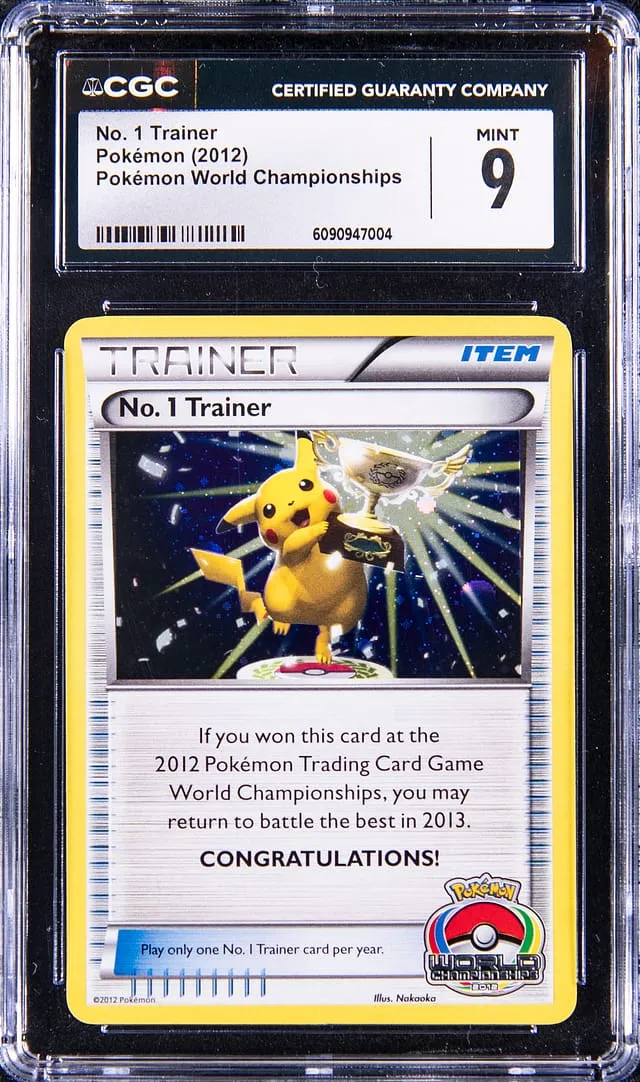
2012 No. 1 Trainer Pikachu Trophy Card Sells High
Goldin sold a 2012 Pokémon World Championships No. 1 Trainer Pikachu CGC 9 for $63,440. See why this rare trophy card matters to collectors.
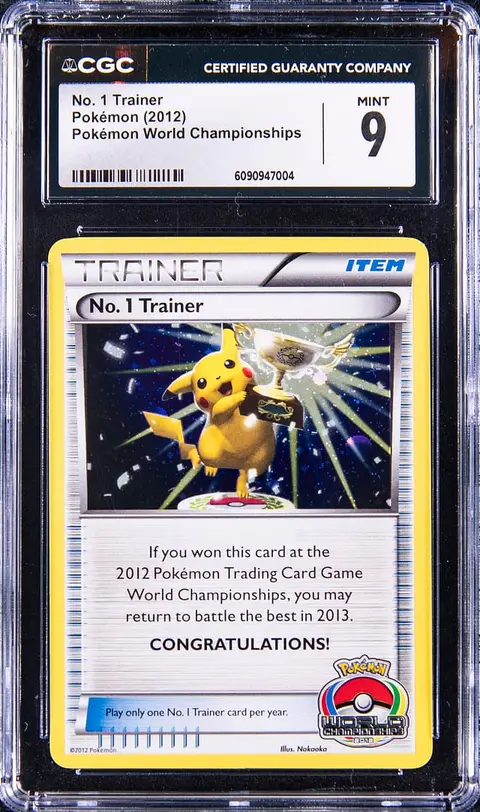
Sold Card
2012 Pokemon World Championships No. 1 Trainer Pikachu Trophy Card - CGC MINT 9
Sale Price
Platform
Goldin2012 Pokémon World Championships No. 1 Trainer Pikachu Trophy Card (CGC MINT 9) Sells for $63,440
On May 18, 2026, Goldin auctioned one of the hobby’s most elusive Pokémon trophy cards: a 2012 Pokémon World Championships No. 1 Trainer Pikachu Trophy Card, graded CGC MINT 9, closing at $63,440. For collectors who track high-end Pokémon, this sale is another data point in a long-running story about how rare World Championships prize cards fit into the modern market.
In this breakdown, we’ll walk through what this card is, why it matters, and how this result fits into recent sales.
What exactly is this card?
Card: 2012 Pokémon World Championships No. 1 Trainer (Pikachu Trophy Card)
Character: Pikachu
Year: 2012
Event: Pokémon World Championships 2012
Type: Trophy / prize card (not a regular pack-pulled card)
Grading company: CGC
Grade: CGC MINT 9
No. 1 Trainer cards are awarded to top finishers at official Pokémon Championship events. They typically feature event-specific artwork and text indicating the tournament and year. Unlike a standard set card, these were not available in booster packs; they were produced in very low quantities and handed directly to players.
The 2012 version is part of the broader lineage of World Championships No. 1 Trainer trophy cards that began in the late 1990s. Population reports (the grading companies’ census of how many copies they’ve graded at each grade level) are extremely low across all years, and many copies never leave the original winners’ collections.
In CGC’s scale, a MINT 9 indicates a high-grade copy with only minor flaws under close inspection. For a trophy card that was originally awarded to a player, even reaching a 9 can be difficult because these cards weren’t always stored like traditional collectibles.
Trophy cards and why they matter
World Championships trophy cards sit at the intersection of rarity, history, and condition. Collectors care about them for several reasons:
True scarcity
These are event prizes, not mass-printed chase cards. Exact print runs aren’t always published, but they are understood to be extremely low. When a card was given only to a small number of top finishers, the realistic supply available to the open market is tiny.Historical significance
Trophy cards record the competitive side of Pokémon—who played well enough at a given time to receive one. For many advanced collectors, that competitive history is as important as set checklists.Era and design
A 2012 World Championships card sits in what many consider the early-2010s competitive era, well before the explosive price run-up of 2020–2021. While not “vintage” in the sense of late 1990s Base Set, this era has gained attention as collectors look beyond the earliest trophy issues.Grading difficulty
Because these cards were prizes, not pack-fresh pulls, they may have been handled, transported, or stored casually before anyone considered long-term preservation. High grades—particularly MINT and GEM MINT—are not automatic.
Market context and comps
To understand what the $63,440 result means, it helps to look at a few pieces of context:
World Championships trophy cards as a group
Earlier and more iconic No. 1 Trainer cards (especially late-1990s Japanese issues) have seen six-figure and, in some cases, higher results at major auction houses. These older issues often have stronger name recognition and longer sales histories.2010s Pokémon trophy landscape
Trophy cards from the 2010s appear less frequently at auction than more mainstream chase cards like Gold Star Pokémon or high-grade 1st Edition Base holos. When they do appear, their realized prices often depend on:- the specific year and artwork,
- language (Japanese vs. English issues or event-specific language), and
- grade distribution across PSA, CGC, and BGS.
Cross-grade and cross-company comparisons
Many trophy sales are still tracked in PSA slabs, which long dominated the market for high-end Pokémon. CGC has built a reputation among collectors for detailed grading and strong surface evaluation. Comparing a CGC 9 directly to a PSA 9 or BGS 9 is tricky; individual eye appeal and card-specific demand matter more than any single label.
Recent public sales data for this exact 2012 No. 1 Trainer Pikachu configuration (same language, same year, CGC 9) are limited, which is common for this category. Instead of a long row of identical comps, collectors usually look at a cluster of related results:
- other years of No. 1 Trainer cards in similar grades,
- sales of the same year’s card across different grading companies, and
- how this price sits relative to earlier, more established trophy issues.
Within that context, a $63,440 sale at a major house like Goldin places this card firmly in the high-end Pokémon trophy segment, but not at the absolute top of the trophy hierarchy that includes older, more iconic pieces.
How this sale fits into the broader market
A few dynamics are worth noting when thinking about this result:
Visibility via a major auction house
Having this card sell at Goldin on May 18, 2026 gives the sale clear visibility. Major houses tend to attract deep-pocketed collectors and institutional buyers, which can support strong but not necessarily record-breaking prices for niche items.Collector segmentation
Not all Pokémon buyers are aiming for trophy cards. Many stay in booster-era cards, sealed product, or modern chase singles. Trophy cards like this appeal to a narrower group of collectors who specifically target history and rarity over nostalgia alone.Price levels vs. mainstream cards
For context, the realized $63,440 puts this card well above most modern pack-pulled chase cards in similar grades. While population reports for standard set cards can run into the hundreds or thousands at high grade, trophy populations are often in the single digits or low double digits across all grading companies combined.Grade sensitivity
With so few copies, the usual step-function in pricing from 8 to 9 to 10 can be less predictable than in typical set cards. A particularly strong-looking 8 or 9 can sometimes attract attention similar to a 10 if the supply is extremely tight.
What this means for collectors and small sellers
If you are a newcomer or returning collector:
- Trophy cards like this aren’t a typical starting point. Instead, they serve as an example of how deep the Pokémon ecosystem goes beyond booster packs and mainstream chase cards.
- Watching sales like this helps build a realistic sense of how rarity, event history, and grading play into value at the very top of the market.
If you’re an active hobbyist:
- This sale provides a new reference point for 2010s-era Pokémon trophy cards in strong CGC grades.
- It reinforces that event-issued cards can sustain substantial demand even when broader market sentiment cools or shifts.
If you’re a small seller:
- You probably won’t handle a 2012 No. 1 Trainer card regularly, but the same principles apply to more accessible cards:
- Understand print run and true supply, not just how often you see a card in your local scene.
- Use population reports and actual recent sales (“comps,” meaning comparable recent realized prices) rather than asking prices.
- Note the grading company’s role; some segments of the market show preferences for particular slabs.
Key takeaways from the Goldin sale
- The 2012 Pokémon World Championships No. 1 Trainer Pikachu Trophy Card (CGC MINT 9) realized $63,440 at Goldin on May 18, 2026 (UTC).
- Trophy cards remain one of the most supply-constrained parts of the Pokémon market. Even a single auction can noticeably reshape the reference range collectors use when discussing value.
- While older, more famous trophy cards still command the highest prices, this result highlights that 2010s competitive-era trophies have established themselves as serious long-term pieces in advanced collections.
As always, these sales are best understood as data points, not guarantees. For collectors at every level, following trophy results is a way to stay in touch with the upper end of the hobby and to understand how rarity and history translate into long-term demand.
figoca will continue tracking notable trophy and high-end Pokémon results so you can see how today’s auctions become tomorrow’s reference points.