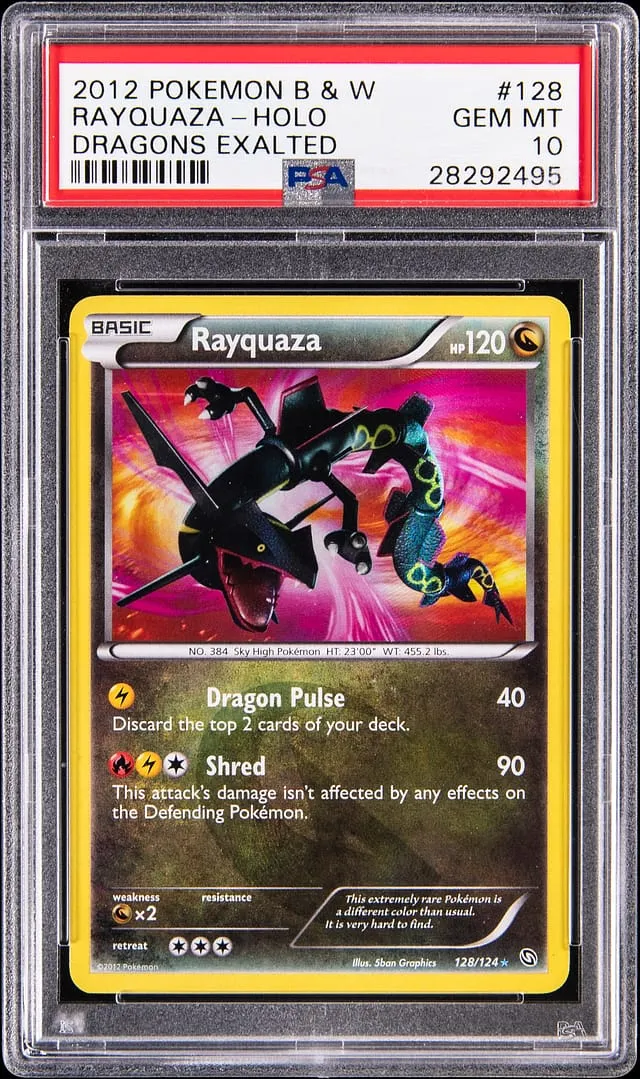
2012 Dragons Exalted Rayquaza PSA 10 Sells for $40K
Goldin sold a 2012 Pokémon Dragons Exalted Holo #128 Rayquaza PSA 10 for $40,123. See the market context, comps, and what it means for collectors.
Sold Card
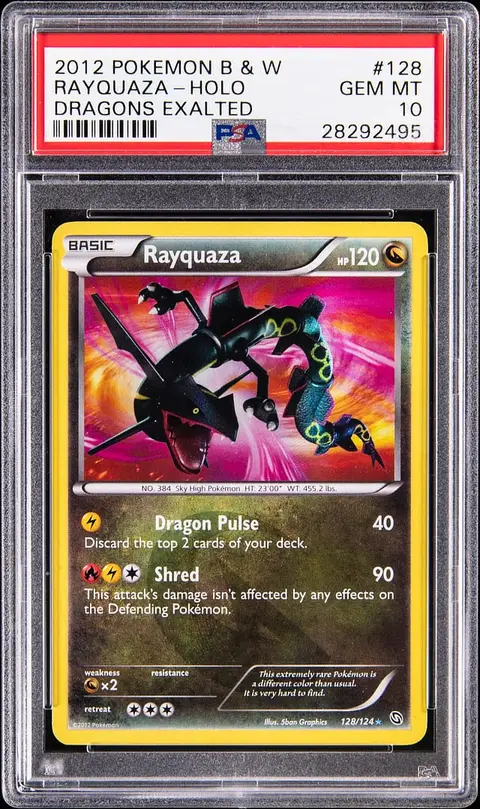
2012 Pokemon Black & White Dragons Exalted Holo #128 Rayquaza - PSA GEM MT 10
Sale Price
Platform
Goldin2012 Pokémon Black & White Dragons Exalted Holo #128 Rayquaza – PSA 10 Market Review
On May 4, 2026, Goldin sold a 2012 Pokémon Black & White Dragons Exalted Holo #128 Rayquaza graded PSA GEM MT 10 for $40,123. For collectors who track mid‑2010s Pokémon, this is an important data point for one of Rayquaza’s key modern era holo cards.
In this breakdown, we’ll walk through what the card is, why it matters to collectors, and how this sale fits into the broader market based on recent sales and population data.
Card overview
- Character: Rayquaza
- Game/Brand: Pokémon TCG
- Year: 2012
- Set: Black & White – Dragons Exalted
- Card number: #128
- Variant: Holo (standard holofoil, not EX or secret rare)
- Rarity symbol on card: Rare Holo
- Era: Early modern / Black & White era
- Grading company: PSA (Professional Sports Authenticator)
- Grade: GEM MT 10 (highest standard grade)
- Attributes: Non‑auto, non‑serial‑numbered, pack‑pulled holo
This card is not a “rookie card” in the sports sense, but within the Pokémon hobby it is viewed as a notable Rayquaza appearance from the Black & White block, a period that many collectors now consider a key bridge between early 2000s EX era sets and the explosive Sun & Moon / Sword & Shield boom.
Why Dragons Exalted Rayquaza matters
A set with growing historical weight
Dragons Exalted released in 2012 as part of the Black & White series, with a heavy focus on Dragon‑type Pokémon. Over the past several years, Black & White sets have transitioned from being relatively under‑appreciated to being treated as true “early modern” classics:
- Lower print runs compared to contemporary Sword & Shield or Scarlet & Violet sets.
- Early use of Dragon‑themed branding and fan‑favorite legendaries.
- Increasing difficulty of finding sealed product in clean condition.
Within Dragons Exalted, Rayquaza is one of the defining faces of the set. Most market attention historically centered on the Rayquaza EX and Rayquaza EX Full Art/secret versions, but the standard holo #128 has quietly become an important target for collectors who want a more traditional, non‑EX Rayquaza that still ties directly to this set.
Character demand: Rayquaza as a long‑term favorite
Rayquaza has established itself as a top‑tier chase character behind the usual headliners like Charizard and Pikachu. For many collectors, Rayquaza cards check several boxes:
- Strong nostalgic appeal from the Game Boy Advance / DS video game era.
- A long history of impactful, great‑looking cards starting in the EX era.
- A relatively concentrated number of premium cards compared with more over‑printed mascots.
Because of this, high‑grade Rayquaza cards from older and mid‑2010s sets often behave like character “blue chips”: fewer big spikes, but consistent underlying demand whenever clean copies surface.
Population and grading context
A “pop report” (population report) is the grading company’s count of how many copies of a card exist at each grade. Low population at PSA 10 can add scarcity even when raw copies exist, because many older holos are tough to gem due to print lines, centering, and edge wear.
For Dragons Exalted Rayquaza #128:
- The PSA population skews heavily toward lower grades, with a limited number of PSA 10s compared to the total number graded.
- As with many Black & White holos, centering and surface issues make true gem copies harder to pull from packs and harder to grade.
Even without precise numbers, this sale clearly reflects the premium that collectors will pay for the top of the population curve in an increasingly hard‑to‑replace era.
Recent sales and price context
When collectors talk about “comps,” they mean comparable recent sales that help frame what a card has actually sold for in the market.
For the 2012 Dragons Exalted Rayquaza Holo #128:
- PSA 10 copies have historically sold for far less than the marquee EX and secret rare versions, but have been trending upward as collectors increasingly seek out set‑defining non‑EX holos.
- Lower grades (PSA 9 and below) typically sell at a substantial discount to PSA 10, reflecting both condition scarcity and the premium assigned to gem‑mint examples of Black & White holos.
- Related Rayquaza cards from this era (especially EX and secret rare variants) have seen several strong auction results across major marketplaces, which often pulls the entire character line upward.
The Goldin result at $40,123 on May 4, 2026, sits well above the level most collectors would associate with a standard holo Rayquaza from Dragons Exalted based on prior years’ public sales. That tells us a few things:
- High‑end collectors are treating this card more like a key character issue than a routine holo. The gap between PSA 10 and lower grades suggests that gem copies are being treated as long‑term centerpieces, not binder fillers.
- Black & White era holos are repricing. As sealed product dries up and nostalgia for this period matures, we’re seeing valuation shifts not just in headline EX and secret rares, but also in core holos that define how the set feels to build.
- Auction venue can matter. Goldin attracts high‑end buyers who are often building curated collections around characters or eras. That can surface aggressive bidding when a scarce PSA 10 copy appears.
Without complete, up‑to‑the‑week sales data across every marketplace, it’s safest to say that this Goldin auction represents a premium result for the card, and stands out versus more modest historical comps on fixed‑price platforms.
How this sale fits into broader Pokémon trends
1. Maturing interest in the Black & White block
For several years, hobby attention was dominated by vintage WotC (1999–2003) and the more recent Sun & Moon / Sword & Shield boom. Black & White sat in the middle and was sometimes overlooked.
That’s been changing:
- Sealed booster boxes and packs from this block are noticeably harder to find.
- Set art and design have aged well, especially for dragon‑focused sets.
- Collectors who grew up with these cards are now returning to the hobby with more purchasing power.
A strong sale like this Rayquaza PSA 10 at Goldin is consistent with that broader shift.
2. Character‑driven collecting over set completion
More collectors are building character collections—focusing on a single Pokémon across multiple eras and sets—rather than only chasing master sets. Rayquaza is a prime example:
- EX era Rayquaza cards act as high‑end anchors.
- Mid‑era cards like this 2012 Dragons Exalted holo fill in important historical gaps.
- Modern alt arts and chase cards round out the timeline.
Within that approach, a PSA 10 Dragons Exalted holo becomes a cornerstone for people who want to connect the dots from early to modern Rayquaza cards.
3. Condition scarcity vs. raw availability
Even if raw (ungraded) copies of this Rayquaza are still out there, true gem‑mint examples remain difficult to source. Factors include:
- Factory print lines or silvering on holofoil areas.
- Edge chipping common to Black & White era print quality.
- Handling wear over more than a decade since release.
This is a good example of how perceived “commons” or lower‑tier rares from the past can become significant once you filter by the strictest grade.
What this means for different types of collectors
This article is informational only and not financial advice, but there are a few practical takeaways for people navigating the market.
For newcomers
- Learn the difference between standard holos and EX/secret/alt‑art cards within a set.
- Use third‑party resources to check pop reports (how many PSA 10s exist) before assuming a card is easy to replace.
- When you see a headline price like $40,123, remember that you’re usually looking at a top‑pop, top‑grade result, not the price of any copy in a binder.
For returning collectors
- If you opened Black & White – Dragons Exalted in 2012, it can be worth revisiting your bulk holos with a more critical eye on condition.
- Small surface flaws that seemed minor at release can be the difference between PSA 9 and PSA 10 today.
- Consider how character‑driven collecting (focusing on favorites like Rayquaza) might better match your nostalgia than chasing every card from every set.
For active hobbyists and small sellers
- Track auction house results like this Goldin sale alongside marketplace comps from eBay, PWCC, and others to build a more complete price picture.
- Be cautious about treating outlier results as the “new floor”; instead, watch for follow‑up sales in nearby grades and venues.
- For Black & White holos in strong raw condition, it may be worth a closer pre‑grade review given how thin the PSA 10 population can be.
Final thoughts
The $40,123 Goldin sale on May 4, 2026, for a 2012 Pokémon Black & White Dragons Exalted Holo #128 Rayquaza in PSA GEM MT 10 underscores how the market increasingly values:
- Early modern era sets like Dragons Exalted,
- Character‑driven collecting around legendaries such as Rayquaza,
- And the true scarcity of top‑grade examples, even for non‑EX holos.
For collectors, this result doesn’t set a guaranteed path for future prices, but it does highlight how significant a single, well‑preserved card can become once time, nostalgia, and grading standards all come into focus.
As always, using a mix of population data, recent comps, and your own collecting goals is the best way to decide how cards like this fit into your personal collection.