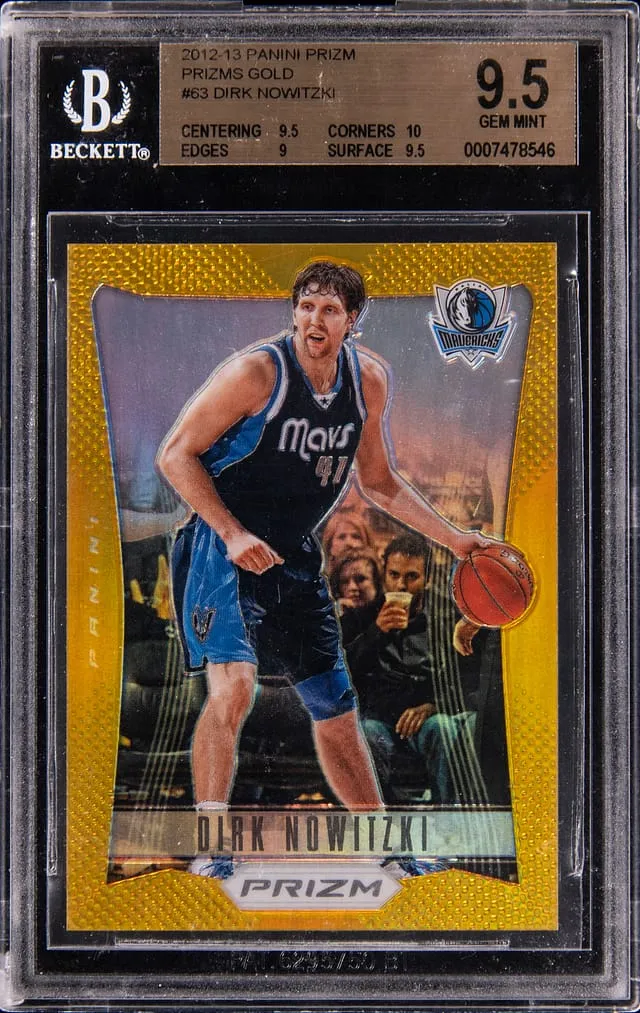
2012-13 Prizm Gold Dirk Nowitzki BGS 9.5 Sale
A BGS 9.5 2012-13 Prizm Gold Dirk Nowitzki /10 sold for $14,640 at Goldin on March 15, 2026. Here’s what it means for early Prizm and Dirk collectors.
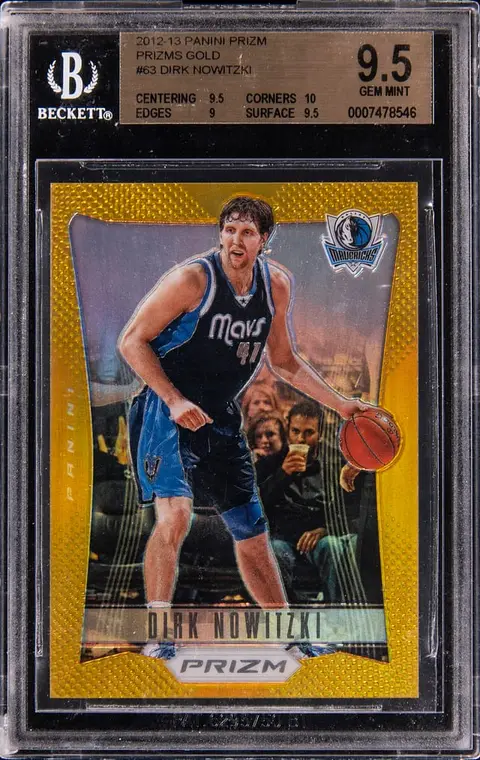
Sold Card
2012-13 Panini Prizm Gold Prizm #63 Dirk Nowitzki (#02/10) - BGS GEM MINT 9.5
Sale Price
Platform
Goldin2012-13 Panini Prizm Gold Dirk Nowitzki #63 BGS 9.5 Sells for $14,640
On March 15, 2026, Goldin sold a 2012-13 Panini Prizm Gold Prizm #63 Dirk Nowitzki, serial numbered 02/10 and graded BGS GEM MINT 9.5, for $14,640. For collectors who follow early Prizm and low-numbered veteran parallels, this is a useful data point in a market that has matured a lot since Prizm’s launch.
In this post, we’ll break down what the card is, why it matters, and how this sale fits into the broader price context for Dirk and early Prizm Gold.
The card at a glance
- Player: Dirk Nowitzki
- Team: Dallas Mavericks
- Year: 2012-13
- Set: Panini Prizm (first-year Prizm basketball)
- Card number: #63
- Parallel: Gold Prizm (serial numbered to /10)
- Rookie card? No – this is a premium veteran card, not a rookie. Dirk’s rookies are from 1998-99.
- Serial number: 02/10
- Grading company: Beckett Grading Services (BGS)
- Grade: GEM MINT 9.5
- Attributes: Non-auto, non-patch, ultra-low serial, iconic early Prizm parallel
This is not a rookie, but it is a key early Prizm Gold for a Hall of Fame–level player. First-year Prizm (2012-13) has become a reference point for modern chromium cards the same way 1986 Fleer is often referenced for 80s basketball.
Why 2012-13 Prizm Gold matters
2012-13 Panini Prizm was the debut year for Prizm basketball, which evolved into one of the hobby’s main “flagship” chromium sets. When collectors call something a flagship, they generally mean a set that acts as a central, recurring product line that the hobby uses as a benchmark.
Within that set, Gold Prizms /10 quickly became the premium non-autographed, non-logoman parallel. They combine:
- Very low serial numbering (/10)
- High visual recognition (gold finish, distinct shine)
- A design that collectors now associate with the rise of modern Prizm
For established stars like Dirk, the 2012-13 Gold functions a bit like a “key issue” from the early ultra-modern parallel era. It’s not his first card, but it is one of his most important chromium parallels.
Understanding the grade: BGS GEM MINT 9.5
This copy received a BGS 9.5 GEM MINT grade. In Beckett’s system, 9.5 indicates a card that is effectively as close to perfect as most pack-pulled cards will get, often with subgrades of 9 or 9.5 across corners, edges, surface, and centering.
For low-serial cards like Prizm Gold /10, even high-grade copies are genuinely scarce, because there are only 10 copies to begin with. Not all of them are submitted for grading, and not all of those will hit 9.5 or better.
Population reports (or “pop reports”) from grading companies summarize how many copies of a specific card have been graded at each grade level. For niche, low-serial veteran parallels like this, pops tend to be small by definition.
The sale: $14,640 at Goldin on March 15, 2026
- Auction house: Goldin
- Sale date (UTC): 2026-03-15
- Realized price: $14,640 (buyer’s premium typically included in Goldin’s published result)
At $14,640, this result firmly positions the card as a high-end, but not record-shattering, Dirk parallel.
Market context and related cards
Because this is a specific, low-population card, exact comparable sales (“comps”) are limited. In hobby language, comps are recent sale prices for the same or closely related cards that collectors reference to understand the current market range.
Based on available public data for the broader category (not all from the exact same week or month):
- Other 2012-13 Prizm Gold veterans: Established Hall of Fame and near-Hall players in BGS 9.5 or PSA 10 have historically sold from the mid four figures into the low five figures, depending on player reputation and the specific auction window.
- Dirk high-end parallels (non-rookie, non-auto): Strong, low-serial chromium parallels from the 2010s, especially from respected sets like early Prizm, have tended to trade in the low-to-mid five-figure range when they appear, with noticeable variation depending on design, numbering, and timing.
This Goldin sale at $14,640 is consistent with that broader pattern of:
- Premium pricing for first-year Prizm Gold
- An additional bump for an all-time great like Dirk
- But still below the levels seen for true rookie cards of top-tier modern superstars
Because copies surface infrequently, it is hard to call this price definitively high or low versus an exact recent comp for the same card and grade. Instead, it is better viewed as one current marker in a thinly traded segment.
Why collectors care about this specific Dirk card
Several factors combine to make this card notable:
Hall of Fame–caliber player
Dirk is widely regarded as one of the best power forwards ever: 2011 NBA champion, 2007 MVP, over 30,000 career points, and a global icon for European players in the NBA.First-year Prizm status
2012-13 Prizm has taken on historical importance as the start of the Prizm line. Collectors often seek first-year Prizm parallels for star players, somewhat similar to “key first appearance” issues in comic books.Gold Prizm /10 scarcity
With only 10 serial-numbered copies, the card is scarce in an absolute sense. Factor in grading, and the number of BGS 9.5 (or equivalent) copies realistically available to the market is even smaller.A parallel, not a rookie, but still a landmark
For player collectors who already track down Dirk’s 1998-99 rookies, this card serves a different role: a centerpiece modern parallel that represents the early 2010s era of the hobby.
Era and hobby dynamics
This card comes from the modern/early ultra-modern period. Key characteristics of that era include:
- Increased attention to parallels and serial numbering
- Wider use of chromium stock and bright refractor finishes
- Greater emphasis on grading, with high-grade copies carrying a noticeable premium
Dirk’s late-career achievements and Hall of Fame status have stabilized interest in his key cards. While short-term pricing can move up or down with general market sentiment, the pool of serious Dirk collectors and Mavericks collectors has remained steady.
How collectors might use this sale
For player collectors and PC (personal collection) builders:
- This sale helps frame expectations if another 2012-13 Prizm Gold Dirk surfaces in a different grade or raw. It shows that high-grade copies are viewed as premium long-term pieces, not casual pick-ups.
For sellers and small consignment operations:
- The $14,640 realized price at Goldin reinforces that early Prizm Gold parallels of established Hall of Famers can justify placement with major auction houses rather than only fixed-price marketplaces, especially in strong grades.
For newcomers to the hobby:
- This is a concrete illustration of how factors like set importance (first-year Prizm), serial numbering (/10), grading (BGS 9.5), and player status (Hall of Famer) stack together to create value, even when a card is not a rookie.
Takeaways
- The 2012-13 Panini Prizm Gold Prizm #63 Dirk Nowitzki /10 is a key early-Prizm parallel for a Hall of Fame–level player.
- The BGS GEM MINT 9.5 example that sold at Goldin on March 15, 2026 realized $14,640, placing it firmly in the high-end segment of Dirk’s non-rookie market.
- Thin supply means future sales may differ, but this result offers a current reference point for collectors tracking premium early Prizm Gold cards.
As always, individual collecting decisions should be based on personal preference and budget. Market data like this is most useful as context, not as a prediction of what any specific card will do next.