2012-13 Flawless Kobe Emerald Patch Auto Sells for $31K
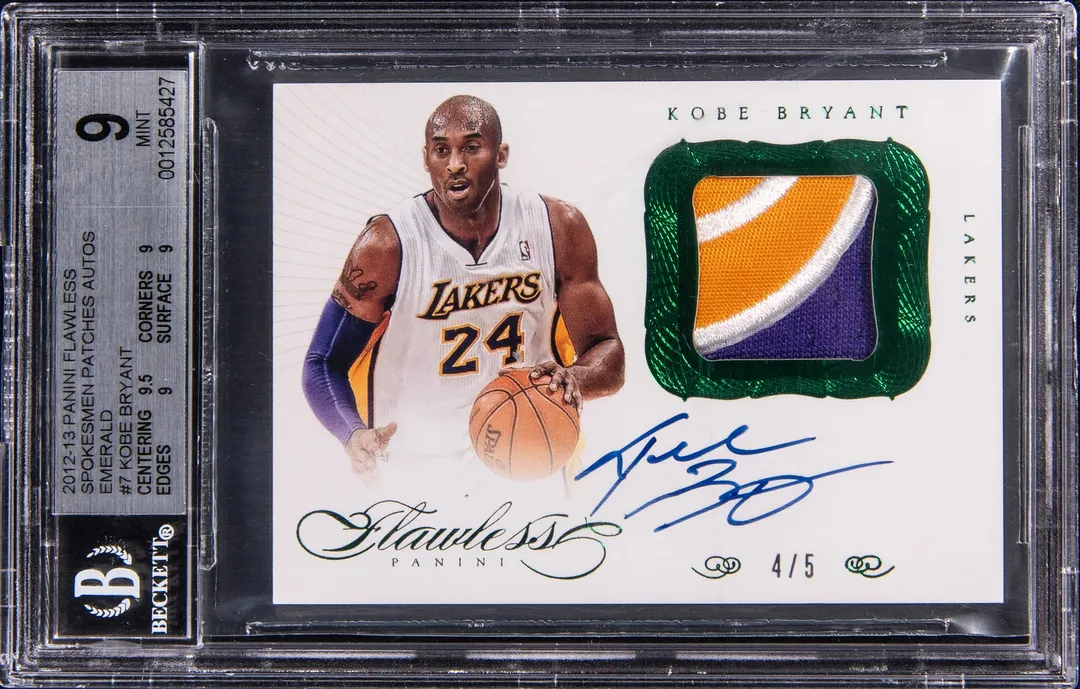
Breakdown of the 2012-13 Panini Flawless Kobe Bryant Emerald /5 BGS 9 auto 10 that sold for $31,721 at Goldin on February 8, 2026.
Sold Card
2012-13 Panini Flawless Spokesmen Patches Autographs Emerald #7 Kobe Bryant Signed Patch Card (#4/5) - BGS MINT 9, Beckett 10 - Pop 2
Sale Price
Platform
GoldinA $31,721 sale for a modern Kobe Bryant patch auto is always going to get attention, but this one checks a very specific set of boxes for high‑end basketball collectors.
We’re looking at a:
- 2012-13 Panini Flawless Spokesmen Patches Autographs Emerald #7
- Kobe Bryant, Los Angeles Lakers
- Serial numbered 4/5 (only five copies made)
- On-card autograph with premium patch window
- BGS MINT 9 with a Beckett 10 autograph grade
- Population: 2 in BGS 9 with 10 auto
- Sold at Goldin on February 8, 2026 (UTC) for $31,721
This is not a rookie card, but it is a key premium issue from one of Panini’s most respected ultra‑high‑end basketball releases.
Card overview: why this Kobe matters
Set and era
2012-13 Panini Flawless was Panini’s first true "super-premium" basketball product. Boxes were extremely expensive at release and built around low-serial-number autographs, star patches, and embedded gems. For modern and ultra‑modern basketball cards, Flawless is considered a flagship luxury brand.
The Spokesmen Patches Autographs subset focuses on on-card signatures from major Panini athletes paired with game or event-used patch windows. The Emerald parallel, numbered to five, sits near the top of the rarity ladder for this insert, behind only 1/1 or similarly short-printed versions.
Key attributes of this card:
- On-card auto: Kobe signed directly on the card, which most collectors prefer over sticker autographs.
- Patch autograph: Multi-color patch window plus signature makes this a classic “RPA-style” chase even though it’s not a rookie.
- Emerald /5: Only five copies of this specific Emerald version exist.
- Serial number 4/5: Serial numbering is important for tracking each copy’s history, even if it’s not a jersey number match.
- BGS 9 / 10 auto: A MINT grade with a perfect autograph grade from Beckett adds liquidity and trust for high‑end buyers.
This combination—early Flawless, Kobe, on-card ink, patch, and serial numbering under 10—is exactly the profile that tends to anchor long‑term collector interest in a player’s post-rookie portfolio.
Grading and population: how scarce is it really?
Goldin’s listing notes this card as BGS MINT 9 with a 10 autograph grade and a population of 2 in this exact configuration. "Pop" or population report refers to how many copies have received a given grade from a grading company.
For a card numbered to five, population data is straightforward: at most five copies can exist, and some may be:
- Still raw (ungraded)
- Graded by different companies
- Graded at different levels (8.5, 9.5, etc.)
A BGS 9 is a strong outcome for a thick patch autograph from this era. Flawless patch autos often suffer from edge and corner issues due to their construction. On modern high‑end patch autos, a 9 with a 10 auto is widely accepted as a desirable collector grade, especially when total supply starts at /5.
Because the full BGS and PSA population breakdowns are relatively small for a /5 parallel, exact census comparisons can be noisy. But we can say:
- Supply is structurally capped at five copies total for this Emerald version.
- Only a subset of those have achieved BGS 9 with a 10 auto (Pop 2).
- Any single sale can materially reset expectations for the card’s market range.
Market context and price comparison
This card sold at Goldin for $31,721 on February 8, 2026 (UTC).
When looking at “comps” (short for comparables—recent sales of the same card or very similar cards), the goal is to understand whether this result is low, mid‑range, or strong for the card type.
For this specific card—2012-13 Flawless Spokesmen Patches Autographs Emerald #7 Kobe /5, BGS 9, 10 auto—public sales are naturally limited. A /5 patch autograph with a small population just doesn’t come to market often. Instead, collectors usually triangulate value from:
Other parallels in the same insert
Examples include:- Ruby or base versions with higher serial numbering (e.g., /10, /15, /20)
- Any known 1/1 counterparts, if they’ve sold publicly These typically sell at a discount or premium according to their print run and patch/autograph quality.
Comparable Kobe Flawless patch autos
Recent years have seen:- On-card Kobe Flawless patch autos /15 to /25 ranging from the mid‑four figures to low‑five figures, depending on patch, aesthetics, and grade.
- Lower-numbered parallels (/5, /3, /1) sometimes moving into stronger five‑figure territory, particularly when paired with eye-catching patches or important subsets.
Kobe’s broader high‑end market
- True rookie cards and key early parallels form the top tier, where PSA 10 and BGS 9.5 examples can sell far higher than this result.
- Non-rookie, high‑end autographed patch cards like this one occupy a critical “collector grail” tier below the absolute headline sales but above mass‑produced autos.
Within that structure, a $31,721 result for a /5 Emerald Kobe Flawless patch auto, BGS 9/10 is consistent with:
- A premium for very low print run and on-card signature, and
- The ongoing demand for early‑2010s Flawless as a benchmark Panini era product.
It does not represent an all‑time Kobe record, but it does reinforce the health of the high‑end, low‑population Kobe patch auto segment.
Because exact public sales data for this precise serial number and grade are limited, it’s more accurate to frame this sale as a strong, data point-setting result rather than a clear outlier high or bargain low.
Why collectors care about 2012-13 Flawless Kobe autos
For modern and ultra‑modern basketball collectors, several themes drive interest in this card:
First-wave Flawless appeal
2012-13 marks the debut year of Flawless basketball. Debut-year high‑end sets (Exquisite, National Treasures, Flawless) tend to be treated as foundational pillars in the modern card landscape.Kobe’s on-card autograph
Kobe signed a significant number of cards during his career, but not all of them were on-card. Early Flawless gives collectors:- Clean, premium card stock
- Well-designed signature areas
- On-card ink that showcases his full autograph
Patch plus auto combination
Patch autographs marry two collecting angles:- A visual, tangible connection to the player’s jersey
- The personal mark of the autograph In the ultra‑modern era, that combination—especially at low serial numbers—is a key feature of “grail-level” pieces.
Post-career and legacy factors
Kobe’s legacy continues to be a central driver in the basketball hobby. Posthumous interest has kept demand relatively resilient, with collectors focusing less on speculation and more on acquiring pieces with:- Clear provenance
- Strong brand backing (Panini Flawless, Exquisite, etc.)
- Meaningful scarcity
This card fits directly into that lane: a legacy-era, premium brand, low‑print run, on-card patch auto from one of the defining players of the 2000s.
Reading the BGS 9 / 10 auto for this card
For collectors new to grading, here’s how this grade profile typically lands in the market:
- BGS 9 (MINT): Indicates only minor wear. On thick patch cards, common subgrade deductions come from corners and edges.
- Beckett 10 autograph: Signals that the autograph is bold, centered, and free of smudges or visible breaks.
On a five-copy card, the market usually focuses less on the difference between 9 and 9.5 and more on:
- The overall look of the patch and signature
- The brand and insert
- The serial numbering
In that sense, this example presents as collector-grade premium: highly presentable, fully encapsulated, and accompanied by a top-tier autograph grade.
What the $31,721 sale tells us
While every sale is unique, this Goldin result helps anchor a few broader observations:
High-end Kobe demand remains targeted, not indiscriminate
The strongest results continue to cluster around:- Limited, low-serial-number issues (/10 and below)
- Recognized high‑end sets (Flawless, Exquisite, National Treasures)
- On-card autographs and premium patches
Debut-year Flawless continues to command respect
2012-13 Flawless hasn’t faded into the background despite newer, flashier products. Instead, it’s increasingly seen as the core Panini high‑end era for stars of that decade.Ultra-low-populations behave differently from mass-market inserts
With only five copies made and just a portion of those graded, pricing is determined more by:- Individual bidder conviction
- Timing and auction venue
- Overall high‑end liquidity
That means pricing can move significantly from one sale to the next without signaling a broad market trend by itself.
Takeaways for collectors and small sellers
If you’re building a Kobe PC (personal collection) or exploring high‑end basketball for the first time, this sale underscores a few practical points:
- Focus on structure, not just the name: Brand (Flawless), insert (Spokesmen Patches Autographs), and print run (/5) matter just as much as the player.
- Understand scarcity: A /5 card with a pop of 2 in BGS 9/10 auto is genuinely thinly traded. You can’t expect a constant flow of comps.
- Use comps as context, not a promise: Past sales give a range, not a guarantee. Especially with ultra‑low population cards, each auction can set its own level.
For small sellers, this Goldin sale highlights the value of:
- Third‑party grading on high‑end patch autos
- Clear cataloging of serial numbers and population info
- Choosing an auction house that regularly reaches deep-pocketed player and set collectors
Final thoughts
The 2012-13 Panini Flawless Spokesmen Patches Autographs Emerald #7 Kobe Bryant /5, BGS 9 with a Beckett 10 auto (Pop 2) is not a card most collectors will ever own, but it is an important reference point.
The $31,721 sale at Goldin on February 8, 2026 reinforces a broader pattern in the modern basketball market: early‑2010s Flawless remains a cornerstone for high‑end collecting, and low-serial, on-card Kobe patch autos from respected sets continue to attract disciplined, long-term buyers.
As more data points emerge on similar Kobe Flawless issues, this sale will sit as a useful benchmark—both for understanding Kobe’s premium patch auto market and for gauging how collectors currently value ultra‑scarce, non-rookie grails from the Panini era.