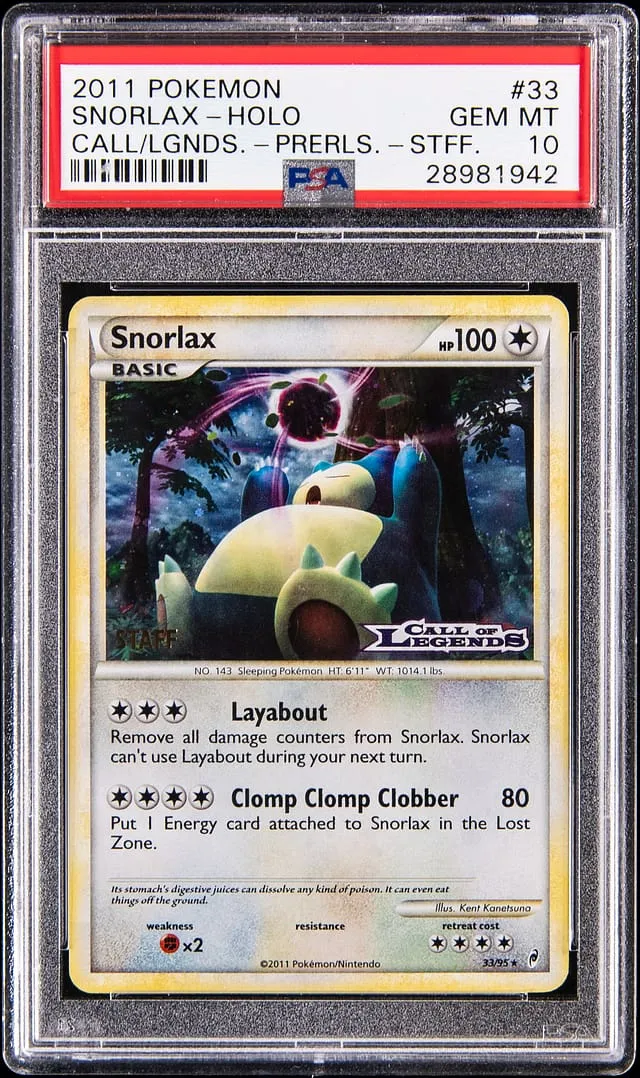
2011 Staff Snorlax PSA 10 Sells for $12,322
Goldin sold a 2011 Pokémon Call of Legends Prerelease Staff Snorlax PSA 10 for $12,322 on May 4, 2026. A key data point for niche promo collectors.
Sold Card
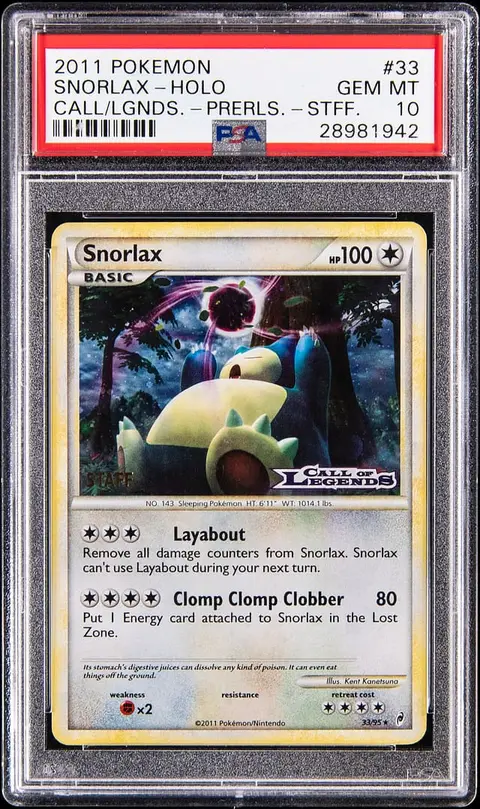
2011 Pokemon Call of Legends Prerelease Staff Holo #33 Snorlax - PSA GEM MT 10
Sale Price
Platform
Goldin2011 Pokémon Call of Legends Prerelease Staff Snorlax PSA 10 Sells for $12,322
On May 4, 2026, Goldin closed a notable sale for a niche but highly respected Pokémon promo: a 2011 Pokémon Call of Legends Prerelease Staff Holo Snorlax #33, graded PSA GEM MT 10, which realized $12,322.
For a card that never appeared in regular booster packs and was only handed to event staff, this result adds another clear data point to how the hobby values rare, early‑2010s Pokémon promos in top grade.
Card basics: what exactly sold?
Let’s pin down the card details first:
- Character: Snorlax
- Year: 2011
- Set: Call of Legends (Black & White era transition, released early 2011)
- Card number: #33
- Version: Prerelease Staff stamped holofoil promo
- Distribution: Given to staff/judges at Call of Legends prerelease events, not pulled from packs
- Grading company: PSA (Professional Sports Authenticator)
- Grade: GEM MT 10 (PSA’s highest standard grade)
- Attributes: Holofoil prerelease promo, with the gold “STAFF” stamp on the artwork
This is not a rookie card in the sports sense, but in the Pokémon world it functions as a key issue Snorlax card: a low‑print, event‑only promo from a transitional era between the HeartGold & SoulSilver and Black & White lines.
Why the Call of Legends Staff Snorlax matters
The Call of Legends set holds a specific spot in Pokémon TCG history:
- It closed out the HeartGold & SoulSilver era and bridged into Black & White.
- The set is relatively small and has a dedicated fan base, especially around its shiny legendary cards.
- Promos connected to this era, especially those not available in packs, have aged better than many contemporary mass‑printed cards.
Staff promos, in general, matter for a few reasons:
- Limited print: Staff cards were intended for judges and organizers at prerelease events. This is a much smaller audience than participants.
- Distinct stamp: The gold "STAFF" text on the artwork separates it visually from regular prerelease cards.
- Condition challenges: Cards given out at events were often stored loosely, making gem mint copies tougher to find years later.
Snorlax itself is also a consistently popular Gen 1 Pokémon. It doesn’t see the same headline prices as Charizard or Pikachu, but it has:
- Strong cross‑generation recognition.
- A history of fun, often nostalgic artwork across multiple eras.
- Lower supply in some of its better promos, which attracts character collectors who prefer depth in one Pokémon instead of chasing only the very top IP.
Put together, a Staff‑stamped, early‑2010s, non‑pack promo of a Gen 1 fan favorite sits right in the lane many focused Pokémon collectors look for as they move beyond base set nostalgia.
Market context and recent sales
Any single sale is just one data point. To get a sense of how meaningful $12,322 is for this card, it helps to look at “comps”—short for comparable sales, or recent transactions for the same or very similar cards.
Because Staff prerelease promos are much lower volume than flagship chase cards, public comps are often sparse. When you see only a handful of recorded sales over several years, that in itself is a data point: the card tends to trade quietly and mostly stays in long‑term collections.
Within that context, a few broad themes apply to this card and similar promos:
- PSA 10 vs. lower grades: For niche, low‑population promos, the price gap between PSA 9 and PSA 10 can be very wide. Collectors who build “best possible” character or promo runs are usually willing to stretch for a true top‑grade example, and they may wait years for one to surface.
- Staff vs. standard prerelease: Staff versions typically outsell their regular prerelease counterparts because of the smaller print and the visual distinction of the stamp.
- Early‑2010s promo timing: Cards from roughly 2010–2013 sat in a quieter period of the hobby and were not mass‑graded at the time. As a result, the PSA population report (the census of how many copies exist at each grade) for these specific Staff cards is usually thin at the top.
This Goldin sale at $12,322 lands firmly in the “premium for scarcity and grade” zone rather than in the territory of speculative modern chase cards. With limited public sales for PSA 10 Staff Snorlax, this result functions as a clear reference point going forward:
- It demonstrates that collectors are willing to pay five figures for this particular combination of character, era, promo type, and condition.
- It gives both buyers and sellers a recent, well‑documented auction comp to refer to when considering private deals.
Population and scarcity
A pop report (short for population report) is the grading company’s count of how many copies of a card have been graded at each grade level. For niche promos like this, the total population tends to be small, and the PSA 10 population is often in the single digits or low double digits.
While exact population numbers can change as more cards are submitted, the broad picture for this Snorlax Staff promo is:
- Not heavily graded compared to main‑set holos from the same period.
- Very few PSA 10s.
- A noticeable drop‑off from 9 to 10, indicating tighter condition standards or handling wear at the time of distribution.
For collectors, this scarcity shows up in two ways:
- Low listing volume: It is uncommon to see multiple PSA 10 Staff copies available at the same time across major marketplaces.
- Auction variability: Because the card doesn’t trade every week, individual results can move more when a couple of determined bidders face off.
Where this sale fits in the broader Pokémon market
This Snorlax Staff result is part of a pattern that has been visible over the last few years:
- Event‑only promos with strong characters and low print runs continue to command solid premiums.
- Collectors increasingly look beyond just the most famous chase cards and into side channels like prereleases, Staff promos, and early‑era league rewards.
- The early‑2010s window is benefiting from renewed attention as newer collectors move past the obvious 1999–2000 nostalgia targets.
The timeframe (early Black & White era) also matters. It falls into what some would call early “ultra modern,” but with notably lower print and grading volume than 2016–2021. That middle ground often appeals to collectors who want cards that feel reasonably modern but not massively overprinted.
Takeaways for collectors and small sellers
A single auction doesn’t rewrite the market, but it does offer some practical lessons:
- Condition and niche matter together. A rare or obscure promo only truly stands out when it’s also in elite condition. PSA 10 is a significant differentiator here.
- Staff stamps are more than just cosmetic. The combination of smaller distribution and a visible stamp has proven to be valued by the market across multiple sets.
- Low‑volume cards require patience. Because comps are thin, price discovery can be uneven. If you collect or sell these, expect longer holding periods between strong public sales.
For collectors of Snorlax, Call of Legends, or early‑2010s promos, this Goldin sale on May 4, 2026 is a clean benchmark: a PSA GEM MT 10 Staff Holo Snorlax at $12,322. It doesn’t guarantee what the next copy will do, but it clearly shows how the hobby currently values a top‑tier example.
As always, treat these numbers as context, not a price promise. Rarity, grade, timing, and who is bidding all play a role in where the final hammer lands.
If you’re tracking niche Pokémon promos, this result is one more reminder that quiet, event‑only issues from the early 2010s can carry just as much long‑term interest as some of the more loudly hyped chase cards—especially when they feature a fan favorite like Snorlax and sit in a PSA 10 holder.