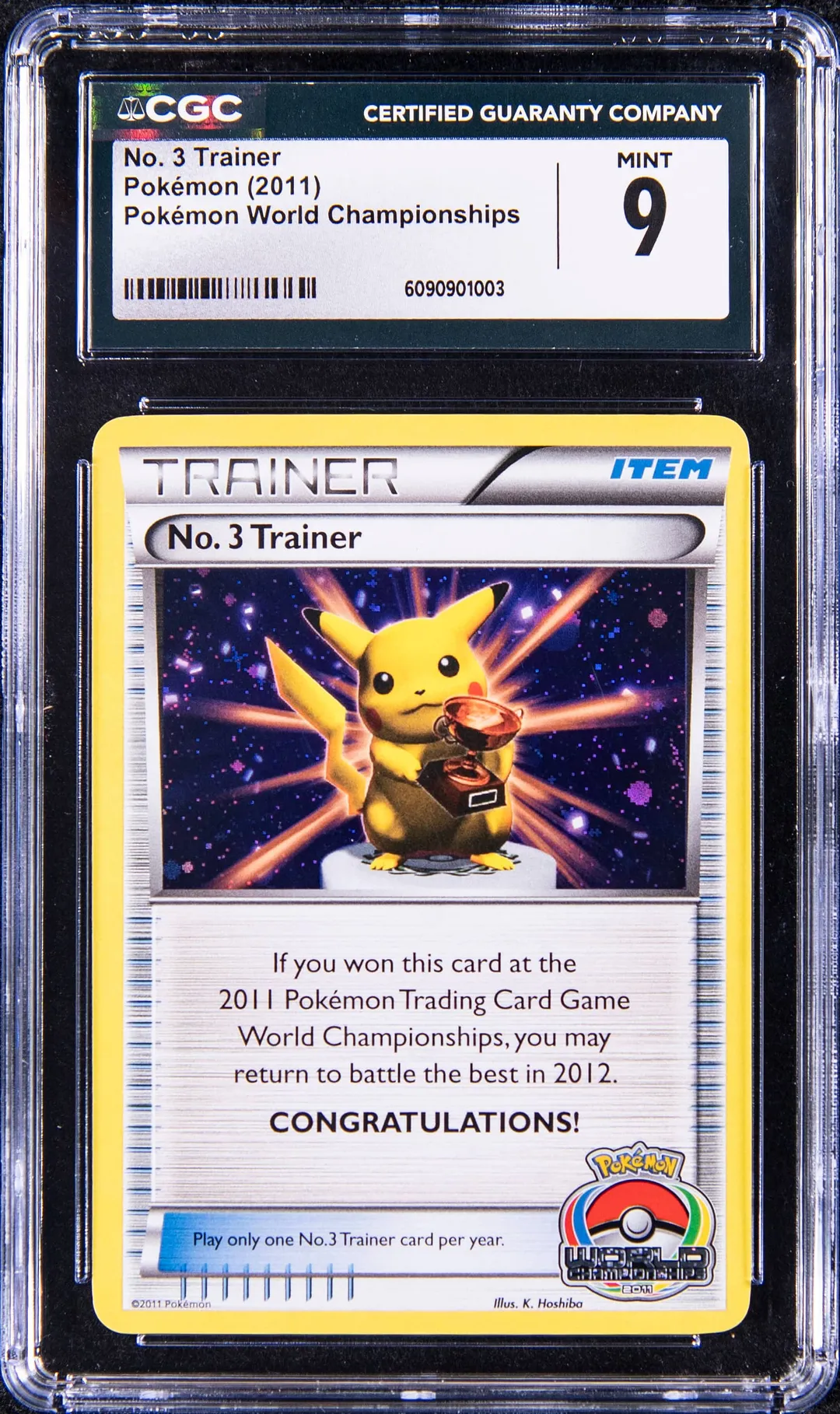
2011 No. 3 Trainer Pikachu Trophy CGC 9 Sells
Breakdown of the 2011 No. 3 Trainer Pikachu Trophy Card CGC 9 sale at Goldin for $27,280, and what it means for high-end Pokémon collectors.
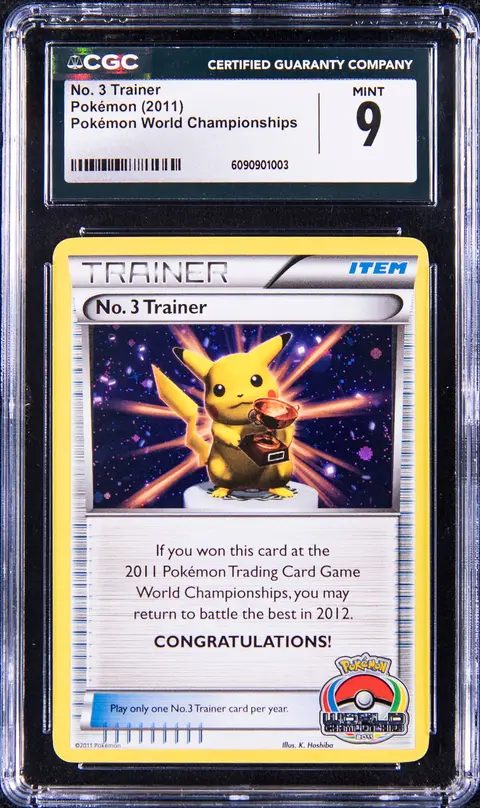
Sold Card
2011 Pokemon World Championships No. 3 Trainer Pikachu Trophy Card - CGC MINT 9 - Pop 1
Sale Price
Platform
Goldin2011 Pokémon World Championships No. 3 Trainer Pikachu Trophy Card (CGC 9) Sells for $27,280
The ultra‑scarce World Championship “Trainer” cards sit in a very different lane from pack‑pulled chase cards. They were never sold in booster boxes, never printed for stores, and never meant for the general public. Instead, they were awarded directly to top finishers at the Pokémon World Championships.
One of those award cards – a 2011 Pokémon World Championships No. 3 Trainer Pikachu Trophy Card, graded CGC MINT 9 – just sold at Goldin on 2/16/26 for $27,280. For a niche, event‑only card with a population of one in this grade, that result is an important data point for anyone following high‑end Pokémon.
In this breakdown, we’ll walk through what the card is, why it matters, and how this sale fits into the broader market.
What exactly is the 2011 No. 3 Trainer Trophy Card?
Here’s how to identify this card from a collector’s perspective:
- Character: Pikachu (featured as the iconic trophy artwork used on multiple World Championship prize cards).
- Year & event: 2011 Pokémon World Championships.
- Card type: No. 3 Trainer Trophy Card – an award card given to a top finisher (typically third place) at Worlds.
- Distribution: Not pack‑pulled; awarded on site to a tiny number of competitors.
- Era: Often grouped into the “modern to early ultra‑modern” competitive era, but still firmly in the early years of official World Championship prize cards.
- Grading: CGC Trading Cards, CGC MINT 9.
- Population: Pop 1 in CGC 9 at the time of the sale (no other copies at this grade in the CGC census).
There is no serial numbering on the card itself, but functionally it behaves like a low‑serial piece: only a handful were ever produced, and even fewer have been graded.
Why trophy cards like this matter to collectors
Trophy cards occupy a small, specialized niche in the Pokémon market:
- Ultra‑low initial supply: Only awarded to top finishers. Unlike standard sets, there is no mass print run to fall back on.
- Direct tie to competition history: These cards are physical artifacts of specific World Championship events and placings, not just characters or artwork.
- High barrier to entry: Many of the most famous Pokémon sales have been trophy cards (for example, early Pikachu Trophy cards from the late 1990s). That history shapes how collectors think about newer World Championship trophies.
- Crossover appeal: They interest both set builders (who chase key Pikachu or World Championship pieces) and “history” collectors who focus on the evolution of organized play.
Within that landscape, the 2011 No. 3 Trainer Pikachu sits as a later‑generation World Championship trophy. It doesn’t have the vintage mystique of the 1997–1999 Japanese trophies, but it continues the same lineage and remains extremely hard to source.
Grading, condition, and the CGC MINT 9
For truly scarce cards, condition can matter as much as – or more than – the card itself.
- CGC MINT 9: CGC’s Mint grade corresponds to a card with only very minor flaws visible under close inspection. For many collectors, MINT 9 represents investment‑grade condition without the premium that a 9.5 or 10 often commands.
- Pop 1: “Pop” (short for population) refers to how many copies of a specific card/grade exist in a grading company’s census. A pop 1 CGC 9 signals that this is, at least for now, a unique example at that grade in CGC’s database.
For a World Championship trophy with a tiny original print run, a pop 1 isn’t surprising – most copies simply aren’t on the market and may never be submitted. But it does underscore that buyers in this lane rarely have the option to “wait for the next one.”
The sale: $27,280 at Goldin (2/16/26)
- Auction house: Goldin
- Sale date (UTC): 2/16/26
- Final price: $27,280 (converted from 2,728,000 cents)
In the high‑end Pokémon world, six‑figure results for early trophies and first‑edition grails get most of the headlines. This sale sits in a different space: firmly five figures, but for a later‑era trophy that’s still extremely difficult to find.
While exact public comps (comparable sales) for this precise 2011 No. 3 Trainer Pikachu in CGC 9 are limited or non‑existent, there are some useful points of reference:
- Earlier Pikachu Trophies (late 1990s): These have historically commanded very strong prices, often substantially higher than later World Championship trophies in similar condition, reflecting their age and legendary status.
- Other World Championship Trainer trophies (2000s–2010s): When they surface, they commonly sell in the mid‑ to high‑five‑figure range depending on year, placement (No. 1 vs. No. 2 vs. No. 3), grading company, and grade.
Against that backdrop, $27,280 feels consistent with how the market has treated later‑generation Pikachu trophies: a strong price that acknowledges rarity and significance without approaching the record territory reserved for the earliest, most storied examples.
Market context and what this sale suggests
Because reliable public sales data for such a specific card are sparse, it’s more helpful to talk about ranges and context instead of exact benchmarks.
A few themes emerge from this result:
Continued demand for competitive history cards
The price indicates that collectors still assign meaningful value to cards directly tied to World Championships – not only to the earliest releases. The competitive story continues to matter.Grade scarcity versus card scarcity
With a card this rare to begin with, population reports mainly confirm what collectors already know: you’re unlikely to see many duplicates in the same grade. The pop 1 CGC MINT 9 status signals that this particular copy has few direct comps, which often results in a wider potential price band.Cross‑grading and registry considerations
Some collectors track pop counts across grading companies (CGC, PSA, BGS, etc.) and think about whether a card might cross from one holder to another. A strong CGC 9 sale can influence how the market values similar cards in other holders, even without direct 1:1 comps.Stable, data‑driven interest rather than hype
Unlike sudden spikes tied to a content trend or a short‑term hype cycle, trophy card sales tend to reflect slower‑moving collector demand. The Goldin sale fits that pattern – a serious result for a serious niche.
Why this matters if you’re new or returning to Pokémon
If you’re just coming back to the hobby, a $27,280 sale for a card most people have never seen can be confusing. Here’s how to frame it:
- This is not a typical card: Most Pokémon cards, even older ones, will never approach this price level. Trophy pieces are outliers.
- Not pack‑pulled: You won’t find this in a sealed product or a random childhood binder. It’s a competition prize.
- Historical footprint: Owning a trophy card is less about completing a set and more about holding a piece of organized play history.
For many collectors, following these sales isn’t about chasing the same card, but about:
- Understanding how the market values rarity plus history.
- Seeing how grading and population data factor into pricing.
- Learning how auction houses like Goldin handle high‑end Pokémon.
Takeaways for active hobbyists and small sellers
If you’re already active in the hobby—even at a much lower price tier—this sale still offers some useful lessons:
- Know the story behind your cards: Provenance and context matter. Event‑only, prize, and promo cards can behave very differently from pack‑pulled hits.
- Pay attention to population reports: For rare cards, pop reports (from CGC, PSA, etc.) help you understand whether you’re dealing with a truly scarce item or just a tough grade.
- Use comps carefully at the high end: With ultra‑low population cards, there may be long gaps between public sales. Instead of expecting perfect price matches, think in terms of ranges and relative positioning to similar trophies.
- Auction choice matters: High‑profile houses like Goldin can bring a broader audience of bidders, which in turn can affect realized prices for rare material.
Closing thoughts
The 2011 Pokémon World Championships No. 3 Trainer Pikachu Trophy Card in CGC MINT 9 is a niche piece of the Pokémon universe, but an important one. With a pop 1 grade and an award‑only origin, it offers a clear window into how the market continues to value rare, competition‑linked cards.
The $27,280 sale at Goldin on 2/16/26 doesn’t rewrite the record books, but it adds a meaningful, data‑rich point to the ongoing story of World Championship trophies. For collectors who care about the intersection of rarity, history, and condition, it’s a sale worth noting—and a reminder that some of the most interesting Pokémon cards were never pulled from packs at all.